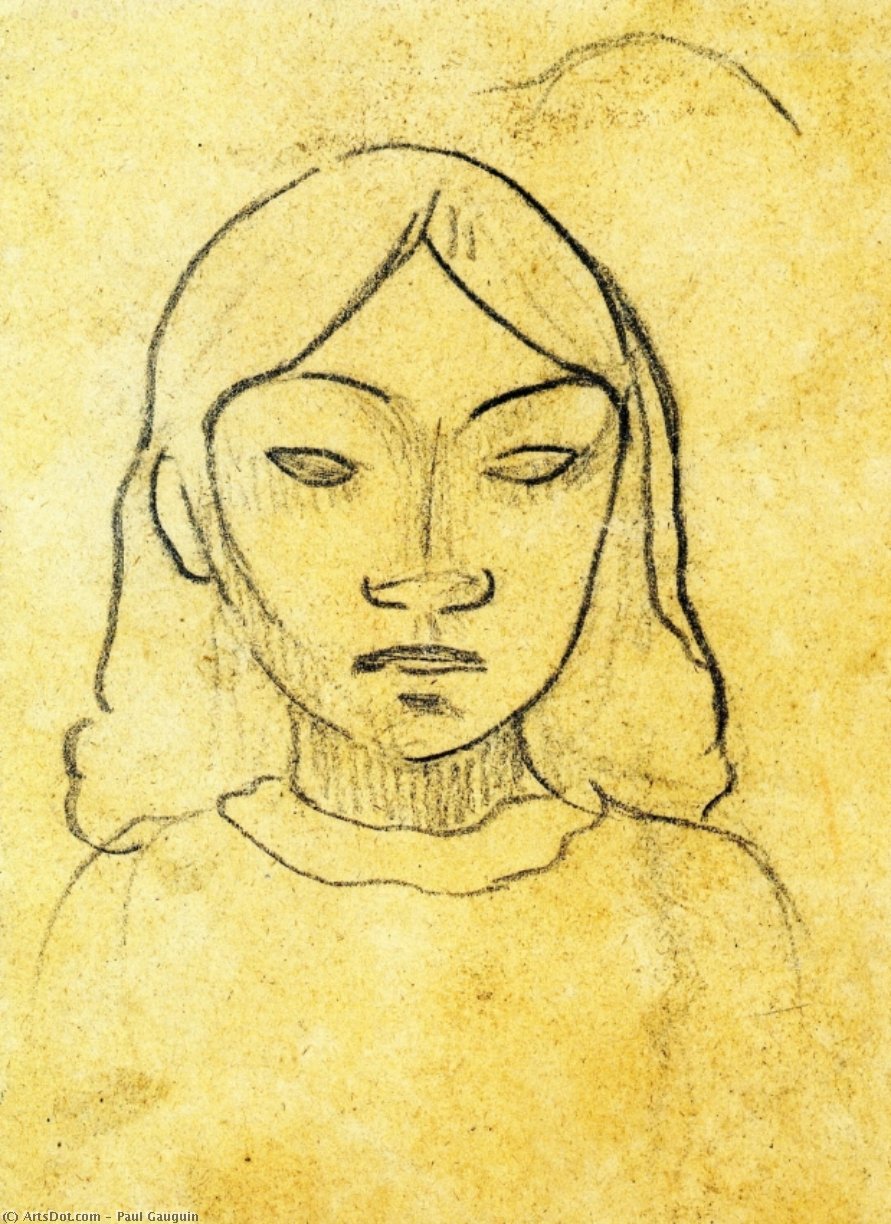
Paul Gauguin’s expressive pencil drawing captures a Tahitian woman's intense gaze and contemplative mouth—a bold testament to Post-Impressionism’s emotional depth. Explore this iconic masterpiece by Eugène Henri Paul Gauguin, born 1848, and discover the beauty of primitive art.
Paul Gauguin: Revolucionarni umetnik impresionizma poznat po intenzivnim bojama i egzotičkim motivima koji su oblikovali umetnost početka 20. veka. Istražite njegov stil, simbolizam i istorijski značaj ovog umetnika!
A Window Into Polynesian Soul: Examining Gauguin’s ‘Tahitian Woman’s Head’
Paul Gauguin's 'Tahitian Woman's Head,' created in 1892 during his transformative journey to French Polynesia, isn’t merely a portrait; it’s a crystallized embodiment of the Post-Impressionist movement’s ambition to delve beyond surface appearances and tap into primal emotion. This deceptively simple pencil drawing—measuring just 16 x 12 cm—commands attention through its masterful execution and profound symbolic resonance. Gauguin's decision to abandon the Impressionists’ preoccupation with fleeting light for a more deliberate exploration of form and expression marks him as a crucial figure in art history, propelling it toward abstraction while retaining an undeniable connection to observation.
The Context of Primitive Inspiration
Gauguin arrived in Tahiti seeking refuge from Parisian society and driven by a fervent desire to reconnect with what he perceived as the authentic spirit of humanity—a concept powerfully articulated by thinkers like Nietzsche and Wagner. He viewed Polynesian culture as untouched by Western civilization’s corrupting influences, representing an idealized vision of innocence and vitality. This fascination fueled his artistic endeavors, inspiring him to depict subjects with uncompromising honesty and rejecting academic conventions in favor of bold lines and expressive shading. The influence of Japanese prints—particularly Ukiyo-e—is palpable in Gauguin's compositional choices, demonstrating the widespread appreciation for Eastern aesthetics during this period.
Technique and Artistic Expression
The drawing’s technique speaks volumes about Gauguin’s artistic philosophy. Employing pencil on paper or parchment, he achieved remarkable detail despite the small scale of the artwork. Notice the careful rendering of the woman's facial features—the dark eyes conveying an intensity of gaze, the open mouth hinting at suppressed emotion. Gauguin utilized hatching and cross-hatching to build up tonal values, creating a textured surface that enhances the drawing’s dramatic effect. This deliberate layering of lines isn’t simply about replicating reality; it’s about channeling feeling onto the canvas—a hallmark of Post-Impressionism's rejection of Impressionistic illusionism.
Symbolic Layers: Beyond Representation
‘Tahitian Woman’s Head’ transcends a straightforward depiction of a female figure. The woman’s expression – considered by some scholars to be indicative of defiance or sorrow – embodies the broader anxieties surrounding Western colonialism and its impact on indigenous cultures. Gauguin deliberately avoided idealized beauty, opting instead for a portrayal that captures the raw essence of human experience. Furthermore, the positioning of the head—slightly tilted—suggests contemplation and introspection, inviting viewers to ponder themes of identity and spirituality.
Emotional Resonance: A Legacy of Bold Vision
Ultimately, ‘Tahitian Woman’s Head’ succeeds in conveying a powerful emotional response. Its stark simplicity belies its depth of feeling, capturing a moment frozen in time—a testament to Gauguin's ability to distill complex psychological states into visual form. This drawing continues to resonate with audiences today because it speaks to universal themes of vulnerability and resilience. It serves as an enduring reminder that art can transcend cultural boundaries and communicate profound truths about the human condition. Its quiet intensity invites contemplation and encourages us to consider what lies beneath the surface of appearances—a legacy of artistic vision that persists across generations.