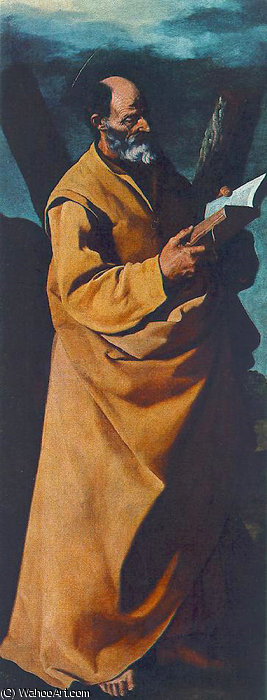
The Serene Contemplation: Unveiling Francisco de Zurbarán’s ‘Apostle St Andrew’
Francisco de Zurbarán's 'Apostle St Andrew,' painted in 1631, is not merely a portrait; it’s an immersion into the profound spirituality of the Spanish Baroque. This arresting image transcends simple representation, offering instead a glimpse into the soul of a man deeply connected to his faith. The painting depicts a figure seated outdoors, bathed in the stark, almost theatrical light characteristic of Zurbarán's style – a technique he honed during his early training under Alonso de Najera but ultimately perfected through his own intensely personal vision.
The subject, identified as St Andrew, is presented with an arresting simplicity. He’s not depicted in heroic action or dramatic gesture; rather, he embodies quiet contemplation. His posture is relaxed yet dignified, his gaze lowered upon a book held gently in his hands – a symbol of knowledge, scripture, and the inner life of faith. The muted palette—primarily browns, ochres, and deep reds—further emphasizes this sense of solemnity and introspection. Zurbarán masterfully employs *tenebrism*, a dramatic contrast between light and shadow, to draw our attention to specific details: the texture of the robe, the folds of his garment, and most importantly, the profound stillness radiating from his face.
A Master of Religious Intensity in the Spanish Golden Age
To understand ‘Apostle St Andrew,’ we must situate it within the broader context of the Spanish Golden Age. This period, spanning roughly from the late 15th to the early 17th centuries, witnessed an unparalleled flourishing of art and literature, deeply intertwined with the Catholic faith. Zurbarán’s work exemplifies this era's preoccupation with religious themes – particularly depictions of monks, saints, and martyrs. His style, often described as “Spanish Caravaggio” due to his masterful use of light and shadow, was a reaction against the more elaborate and ornate styles prevalent in Italy at the time. He sought to capture the essence of piety through stark realism and emotional intensity.
The Spanish Golden Age itself was profoundly shaped by the influence of the Catholic Church, which commissioned vast amounts of religious art for churches, monasteries, and private chapels. Zurbarán’s work reflects this patronage, but he transcends mere commission; he imbues his subjects with a palpable sense of devotion and spiritual depth. His connection to Extremadura, a region known for its austere landscapes and devout population, undoubtedly informed his artistic sensibility – a preference for simplicity, solemnity, and an engagement with the divine.
Symbolism and the Essence of Faith
Beyond the immediate depiction of St Andrew, the painting is rich in symbolic meaning. The book he holds represents not just knowledge but also the path to salvation through scripture. His seated posture suggests a life dedicated to contemplation and prayer – a rejection of worldly distractions in favor of spiritual pursuits. The outdoor setting itself is significant; it symbolizes the connection between humanity and God, a realm beyond the confines of earthly existence. The lack of ornamentation or elaborate details reinforces this sense of purity and focus.
Furthermore, consider the figure’s face – it's not one of outward expression but rather an inward gaze, suggesting a profound inner life. Zurbarán doesn’t offer us a portrait of a saint; he offers us a representation of faith itself—a quiet, unwavering devotion that transcends words.
A Timeless Masterpiece: Reproductions and Beyond
ArtsDot is proud to offer meticulously crafted hand-painted reproductions of Francisco de Zurbarán’s ‘Apostle St Andrew.’ These reproductions capture the essence of the original painting—the dramatic light, the subtle textures, and the profound emotional impact—with unparalleled fidelity. Whether you're an art collector, a design enthusiast seeking inspiration for your interior spaces, or simply someone captivated by the beauty of this timeless masterpiece, our reproductions provide a stunning way to experience Zurbarán’s genius.