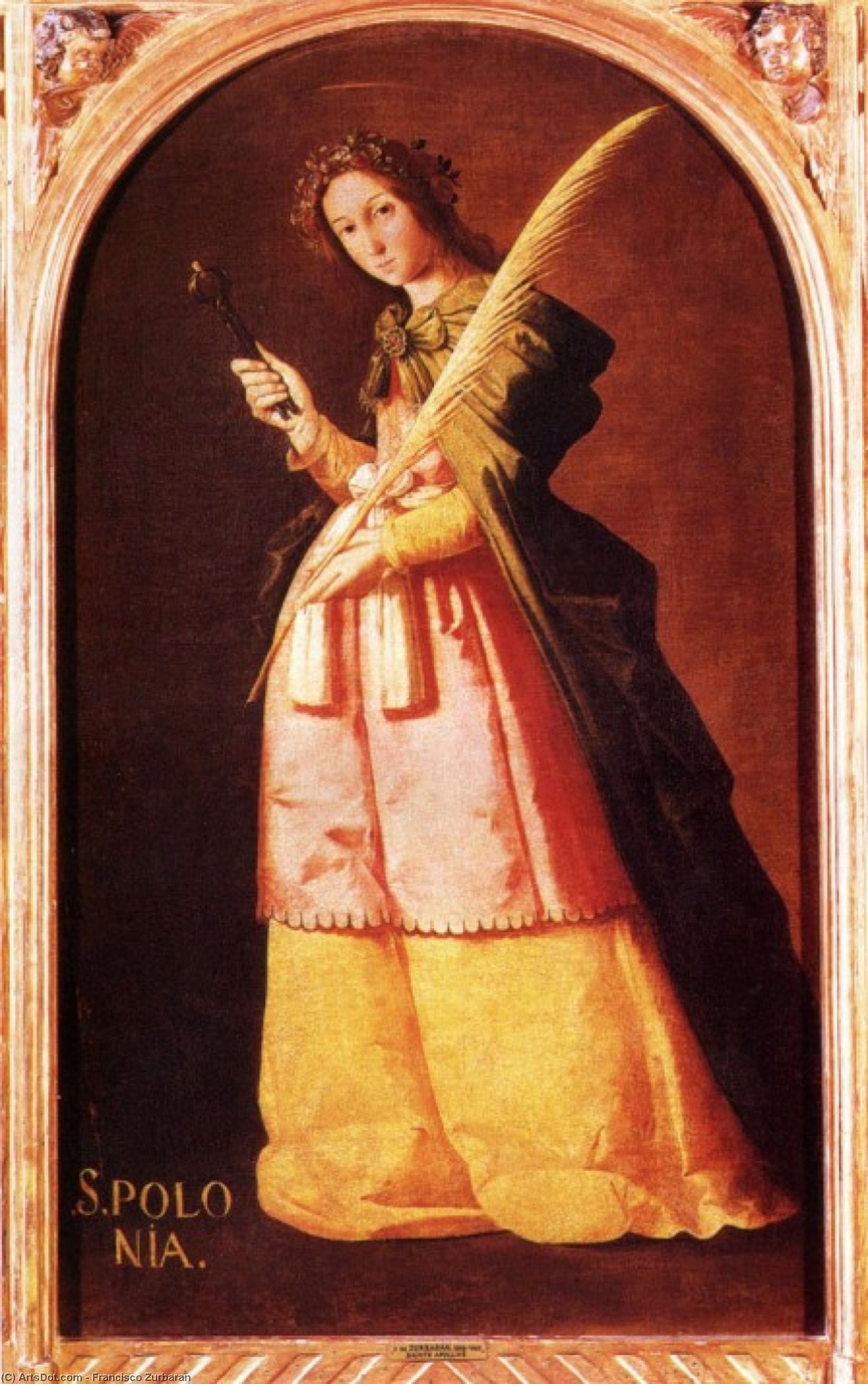
The Silent Witness: De St. Apollonia by Francisco de Zurbarán
Francisco de Zurbarán’s “De St. Apollonia” is not merely a painting; it's an immersion into the austere spirituality of 17th-century Spain, a testament to the artist’s mastery of tenebrism and his profound ability to convey inner emotion through stark realism. The image depicts a woman, identified as Saint Apollonia, rendered with a quiet intensity that transcends mere representation – she embodies a stoic acceptance of suffering, a poignant emblem of faith forged in adversity. The composition is deceptively simple: a figure framed against a dark, receding wall, her hooded robe enveloping her form in shadow, drawing the viewer’s eye to her face and hands.
Zurbarán, often dubbed the “Spanish Caravaggio,” was deeply influenced by the Counter-Reformation. His work during this period—particularly his depictions of religious subjects—was commissioned by the Spanish church as a means of reinforcing Catholic doctrine and combating the rising tide of Protestantism. “De St. Apollonia” exemplifies this trend, eschewing elaborate ornamentation or dramatic action in favor of a concentrated focus on spiritual contemplation. The painting’s palette is deliberately restrained – deep browns, ochres, and blacks dominate, creating an atmosphere of solemnity and reverence. This limited color range serves to heighten the impact of the figure's features and the subtle nuances of her expression.
The Torture and Symbolism
The story behind “De St. Apollonia” is one of enduring faith and brutal suffering. According to tradition, she was a virgin deaconess in Alexandria who endured horrific torture – all of her teeth were violently broken out by Roman soldiers—for refusing to renounce her Christian beliefs. This act of martyrdom, vividly depicted here, became synonymous with her name and has cemented her status as the patron saint of dentistry and those afflicted with toothache. The painting doesn’t graphically portray the violence; instead, Zurbarán focuses on Apollonia's face – a study in quiet dignity and unwavering resolve. Her eyes are downcast, suggesting introspection and acceptance, while her hands gently hold a scroll or book—symbols of knowledge, faith, and perhaps even divine guidance.
The dark background serves as more than just a compositional element; it represents the spiritual darkness from which Apollonia emerged, a realm of suffering and temptation. The light, however, is carefully controlled, illuminating her face and hands, highlighting her inner strength and unwavering devotion. The scroll or book she holds could represent scripture, prayer, or even the very essence of her faith—a tangible link to the divine amidst unimaginable pain.
Zurbarán’s Technique: Tenebrism and Realism
Zurbarán's signature style is characterized by his masterful use of *tenebrism*, a dramatic technique that employs stark contrasts between light and shadow. This creates a heightened sense of realism, emphasizing the textures of fabric, skin, and wood—elements rendered with meticulous detail. Observe how he captures the folds of her robe, the smoothness of her skin, and the subtle sheen on her hands. These details are not merely decorative; they contribute to the overall impression of solidity and presence.
Furthermore, Zurbarán’s approach to depicting religious figures was revolutionary for his time. He moved away from the idealized representations common in Renaissance art, opting instead for a more naturalistic style that emphasized the humanity of his subjects. Apollonia is not presented as an ethereal saint but as a woman—a human being who has endured immense suffering and emerged with her faith intact. This shift towards realism was crucial to the Counter-Reformation’s efforts to connect with the faithful on a deeply emotional level.
A Timeless Masterpiece: Reproduction Possibilities
ArtsDot offers meticulously crafted, hand-painted reproductions of “De St. Apollonia” that capture the essence of Zurbarán's original masterpiece. Our skilled artisans utilize traditional techniques and archival-quality materials to ensure that each reproduction faithfully replicates the painting’s rich textures, dramatic lighting, and profound emotional impact. Whether you are an art collector, interior designer seeking a statement piece, or simply someone captivated by this iconic work of Spanish Baroque art, our reproductions provide a beautiful and authentic way to experience the enduring legacy of Francisco de Zurbarán.