A Vision of Faith: Francisco Zurbarán’s Saint Lucy
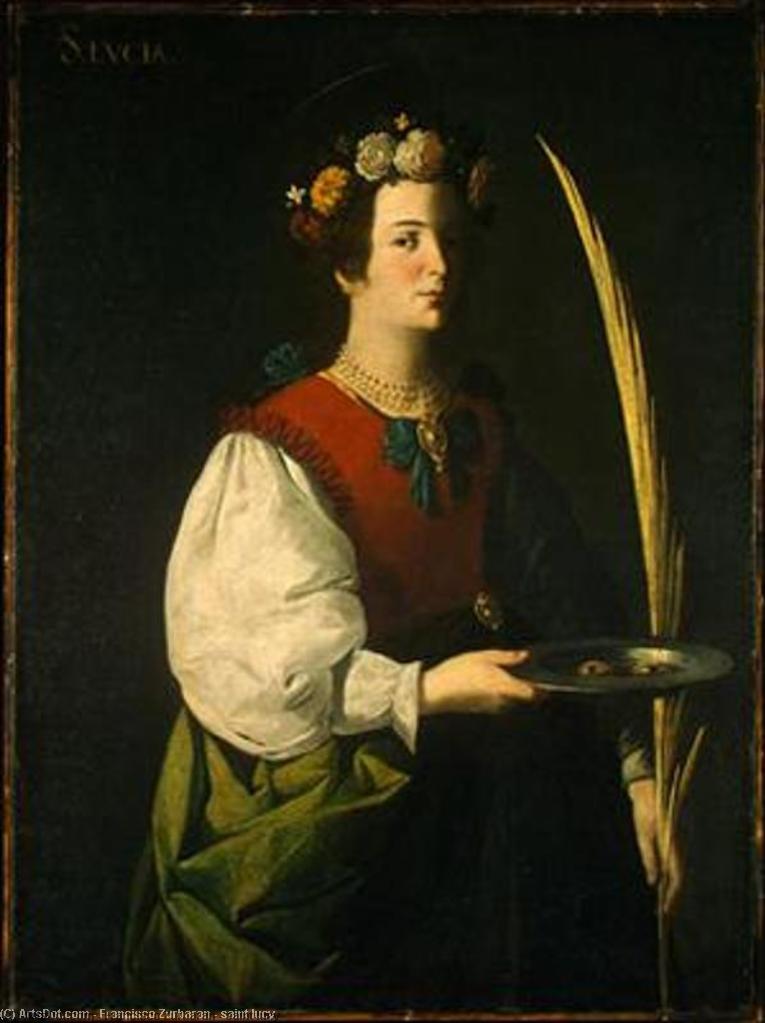
This captivating oil painting by Francisco Zurbarán, created around 1630, presents a deeply moving portrait of Saint Lucy. The work exemplifies the artist's signature style – a powerful blend of realism, dramatic lighting, and spiritual intensity that defined Spanish Baroque art. The small scale of the piece invites intimate contemplation, drawing the viewer into a close encounter with the saint.
Stylistic Mastery: Tenebrism & Renaissance Echoes
Zurbarán’s artistic prowess is immediately apparent in his masterful use of *tenebrism* – a dramatic contrast between light and shadow. This technique, inherited from Caravaggio but uniquely adapted by Zurbarán, doesn't merely illuminate the figure; it sculpts her form, emphasizing her piety and inner life. While deeply rooted in Baroque sensibilities, echoes of Renaissance portraiture are also present in the classical composition and focused attention to detail. The shallow depth of field concentrates our gaze on Saint Lucy herself, minimizing distractions and maximizing emotional impact.
Decoding the Symbolism
Saint Lucy is depicted holding a plate – often interpreted as containing her eyes – and a bundle of wheat. This imagery directly references her martyrdom: according to legend, Lucy plucked out her own eyes to preserve her chastity, and then miraculously regained her sight. The wheat symbolizes abundance, fertility, and the nourishment of faith. The red and white garments she wears are traditional colors associated with virgin martyrs, while the floral adornments in her hair add a touch of delicate beauty amidst the solemnity.
Zurbarán & The Golden Age of Spanish Painting
Francisco Zurbarán (1598-1664) was one of the most important painters of the Spanish Golden Age. He initially trained under Alejandro de la Mina and later, more significantly, with Alonso de Najera, who instilled in him a Baroque sensibility. Zurbarán became renowned for his religious paintings, particularly those depicting monks, saints, and scenes from monastic life. His work often served as devotional pieces for churches and monasteries throughout Spain and its colonies. He was a highly sought-after artist during his lifetime, known for the quiet dignity and spiritual depth of his figures.
Emotional Resonance & Interior Design
This portrait of Saint Lucy is not merely a historical or religious depiction; it’s an exploration of faith, sacrifice, and resilience. The painting evokes a sense of serene contemplation and profound spirituality. Its subdued color palette – dominated by earth tones punctuated by the vibrant red of her attire – lends itself beautifully to a variety of interior design schemes.
It would be particularly striking in a library, study, or meditation space, adding a touch of historical elegance and spiritual depth. A high-quality reproduction captures the essence of Zurbarán’s technique, offering an opportunity to bring this powerful image into your home or collection.
The painting's intimate scale makes it versatile for both smaller spaces and as part of a larger gallery wall.
Key Features
- Artist: Francisco Zurbarán
- Date: c. 1630
- Medium: Oil on canvas
- Style: Spanish Baroque, Tenebrism
- Subject: Saint Lucy, a Christian martyr