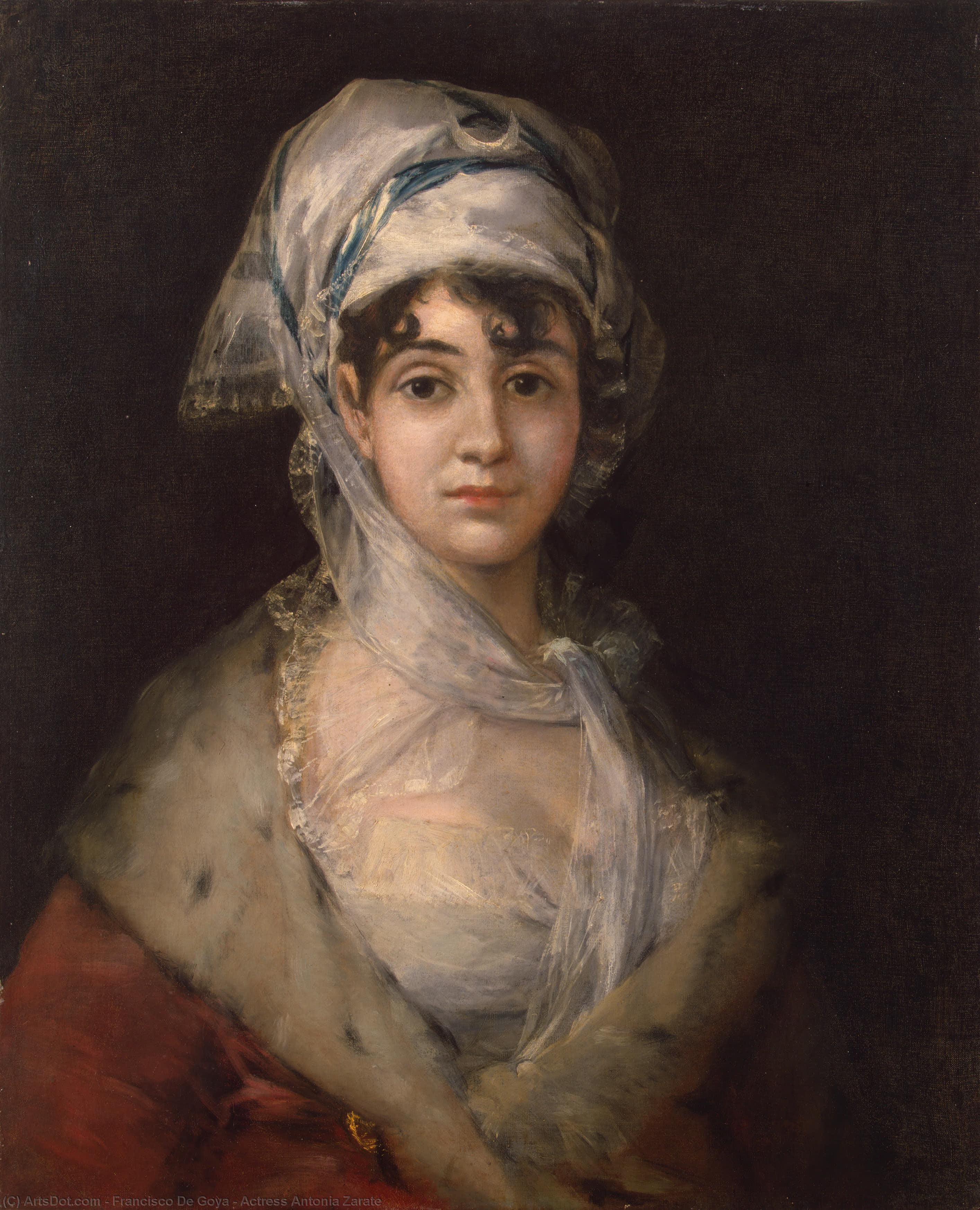
Actress Antonia Zarate
Francisco de Goya’s “Actress Antonia Zarate” stands as a poignant emblem of Romanticism—a movement characterized by fervent emotion, fascination with the sublime, and an unflinching gaze upon human experience. Completed in 1811, this oil on canvas portrait transcends mere representation; it delves into the psychological complexities of its subject and embodies Goya’s masterful command of artistic technique. Currently housed at the Museo de Bellas Artes de Santander, Spain, the painting invites contemplation and offers a glimpse into a pivotal moment in Spanish art history.
### The Subject: Antonia Zarate
Antonia Zarate (1775–1811) was a celebrated Spanish actress whose performances captivated audiences during her time. Goya’s depiction captures her ethereal beauty and poise, portraying her as a woman of refined grace—a figure embodying the ideals of feminine elegance prevalent in the Romantic era. The artist skillfully utilizes chiaroscuro, employing dramatic contrasts between light and dark to illuminate Zarate's face while enveloping the rest of the canvas in shadow. This technique lends an air of mystery and invites viewers to consider the inner life of the sitter.
### Artistic Style and Technique
Goya’s stylistic choices align perfectly with the Romantic aesthetic—a rejection of Neoclassical formalism in favor of expressive emotion and subjective experience. The painting's dark background serves as a counterpoint to Zarate’s vibrant attire, directing attention towards her visage and highlighting the intricate details of her costume. Goya’s meticulous brushwork reveals an unwavering dedication to capturing texture and nuance—evident in the delicate folds of Zarate’s gown and the subtle shading around her eyes. The artist's masterful manipulation of color contributes significantly to the painting's emotional impact, conveying a sense of melancholy and introspection.
### Historical Context
Commissioned by Antonio Gil y Zarate, Antonia’s son, after her untimely death in 1811, “Actress Antonia Zarate” reflects the turbulent political landscape of Spain during Napoleon’s invasion. The portrait is believed to be based on an earlier likeness Goya painted in 1805—a work now residing at the National Gallery of Ireland in Dublin. This dual representation underscores Goya's enduring fascination with capturing human character across time, demonstrating his ability to distill emotion and essence into a single image.
### Provenance
The painting’s journey through history is marked by several notable transactions: Initially held in Spain until 1900, it passed through the hands of New York dealers before finding its way into Armand Hammer's collection—valued at nearly $1 million—and subsequently donated to the Hermitage Museum in St. Petersburg, Russia. This extensive provenance underscores the painting’s cultural significance and confirms its status as a masterpiece of Romantic art.
- Painting Title: Actress Antonia Zarate
- Artist: Francisco De Goya
- Date: 1811
- Style: Romanticism
- Medium: Oil on Canvas
- Dimensions: 71 x 58 cm
- Museum: Museo de Bellas Artes de Santander, Spain
For those seeking to immerse themselves in the artistic legacy of Francisco De Goya, reproductions of “La Maja Desnuda” and “Saturn Devouring His Son” are available on ArtsDot. Additionally, a comprehensive guide to the Museo de Bellas Artes de Santander’s collection can be found at
Museo de Bellas Artes de Santander (Santander, Spain) - A Comprehensive Guide.