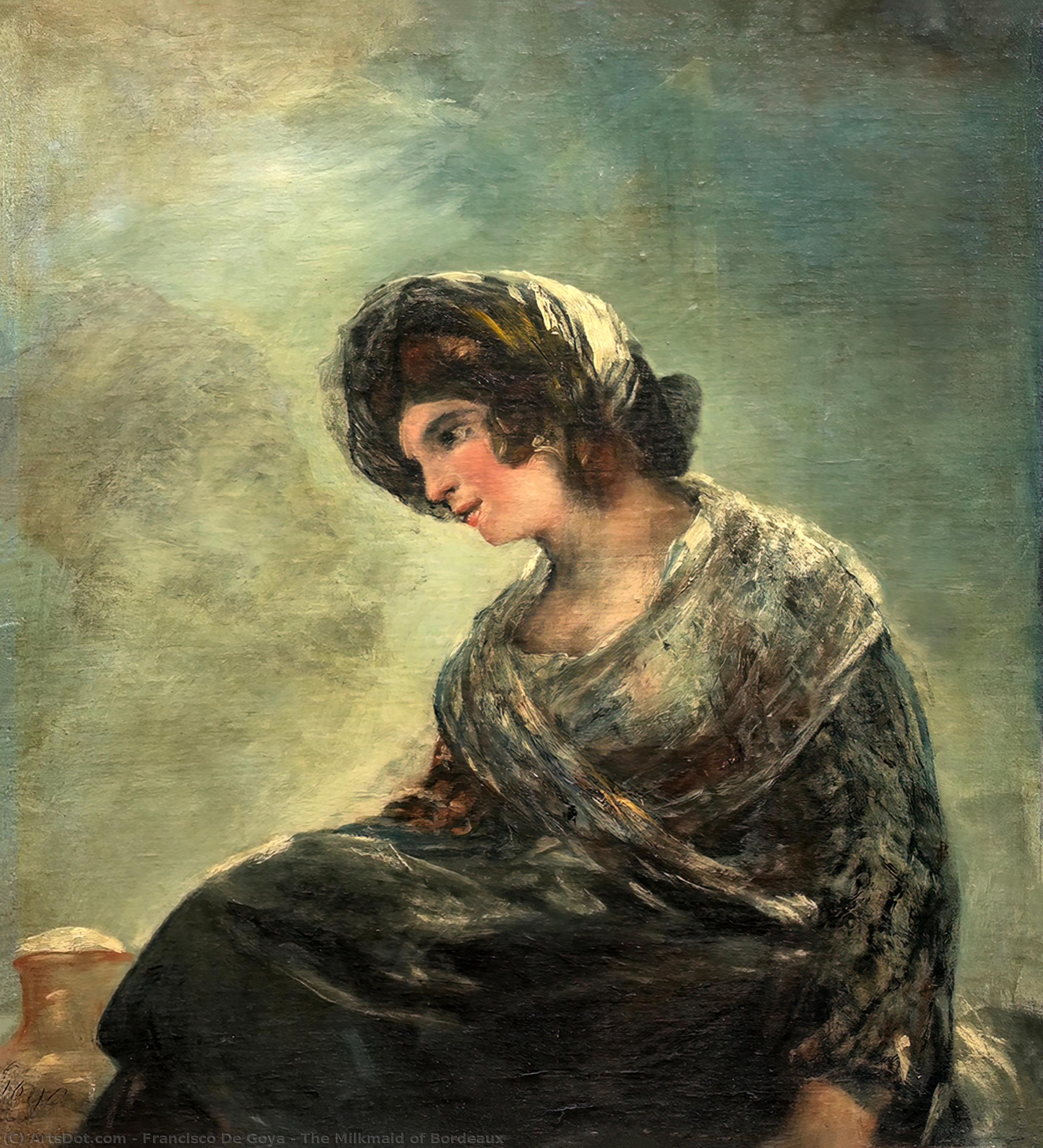
The Milkmaid of Bordeaux
The
Milkmaid of Bordeaux is an oil on canvas painting attributed to the Spanish artist
Francisco De Goya, completed between 1825–27. This enigmatic work has been a subject of admiration and debate among art historians and enthusiasts alike, with some questioning its authenticity as a genuine Goya piece. Its fame stems from the profound mystery surrounding its origins and interpretation—a puzzle that continues to fascinate scholars today.
The Subject and Composition
At first glance, it depicts a woman with long hair, elegantly draped in a head scarf, who appears to gaze downwards, perhaps contemplating the earth beneath her feet or absorbed in her task. Goya’s masterful use of chiaroscuro—the dramatic interplay between light and shadow—immediately draws the viewer's eye to her face, which dominates the central portion of the canvas. This deliberate focus isn’t merely stylistic; it suggests a deeper exploration of human emotion and vulnerability. The background is subtly rendered with a hazy sky, adding depth and dimensionality to the scene and hinting at an indoor setting – likely Goya’s studio. Two vases positioned on either side of the woman serve as compositional anchors, grounding the figure within a domestic space and reinforcing the painting's quiet intimacy.
Attribution and Provenance
Despite its widespread acclaim, the painting’s attribution to Goya has been disputed by some art historians. Initial assessments suggested it might be a work by José Luzán y Martínez, but subsequent research solidified Goya’s authorship based on stylistic similarities and documented provenance. It is believed to portray Rosario Weiss or her mother Leocadia Weiss—individuals who cared for Goya during his exile in Bordeaux following the Napoleonic Wars. The painting's journey through history includes a bequest from Goya himself to his son Javier, followed by a sale necessitated by financial difficulties. Remarkably, it was subsequently donated to the
Museo del Prado in Madrid in 1946—a testament to its enduring artistic merit and a cornerstone of Spanish art heritage.
Artistic Style and Influence
The
Milkmaid of Bordeaux exemplifies Goya’s Romantic style—a movement characterized by emotional intensity and a fascination with the sublime. Unlike the polished elegance of Neoclassicism, which dominated European art during his formative years, Goya embraced expressive brushstrokes and tonal variations that conveyed psychological depth. His technique involved layering thin glazes of pigment onto the canvas, achieving remarkable luminosity and capturing subtle nuances of color—a hallmark of his oeuvre. Furthermore, Goya’s influence extends far beyond painting; he pioneered printmaking techniques like aquatint and etching, producing monumental series such as
Los Caprichos—a satirical commentary on Spanish society—and
The Disasters of War—a harrowing chronicle of the Peninsular War—solidifying his position as a pivotal figure bridging the gap between Old Masters and Modernism.
Conclusion
The
Milkmaid of Bordeaux remains a captivating piece—a poignant meditation on femininity and solitude rendered with unparalleled artistic skill. Whether or not it is definitively Goya’s creation, its haunting beauty and the enduring questions surrounding its symbolism ensure its place as an unforgettable emblem of Spanish Romanticism. For those eager to delve deeper into Goya's artistic legacy,
Francisco De Goya and other paintings by Francisco De Goya can be found on ArtsDot. Additionally, a visit to the
Museo del Prado—located in Madrid—offers an unparalleled opportunity to experience Goya’s artistic vision firsthand
The Museum Museo Thyssen-Bornemisza (Spain) - A Comprehensive Guide.