A Regal Vision: Unveiling Heinrich Friedrich Füger’s “Jupiter Enthroned”
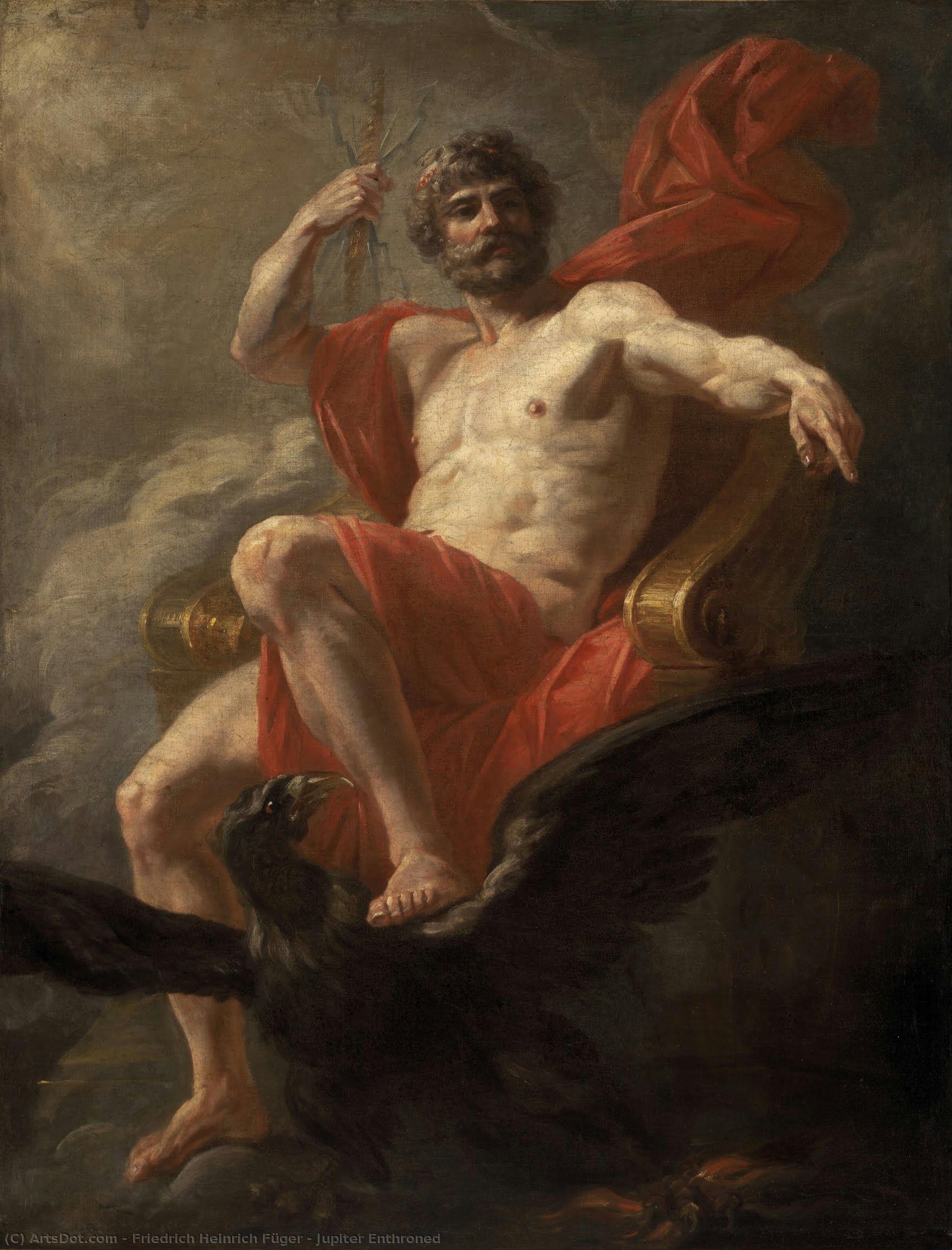
Heinrich Friedrich Füger's "Jupiter Enthroned," a monumental oil painting housed within the Museum of Fine Arts in Budapest, is more than just a depiction of the Roman god; it’s a carefully constructed allegory of power, divine authority, and the enduring legacy of classical ideals. Completed around 1795-1810 during a period of fervent Neoclassicism in Vienna, the artwork transcends mere portraiture, offering a profound meditation on rulership and the very nature of kingship. Füger, deeply influenced by the artistic principles championed by David and Mengs, masterfully employs a restrained yet dramatic style, prioritizing clarity, balance, and idealized forms – hallmarks of his era’s commitment to reason and order.
The painting immediately commands attention with its imposing scale and meticulously rendered details. Jupiter, seated upon an elaborate throne crafted from gold and adorned with symbols of dominion—a thunderbolt grasped firmly in one hand, a radiant eagle perched at his feet—occupies the central space. His expression is serene yet commanding, projecting an aura of absolute authority. The composition is rigorously structured, utilizing a clear pyramidal arrangement that draws the eye upwards towards the god’s majestic presence. Füger's skill lies not merely in replicating reality but in elevating it to a realm of symbolic significance, transforming a simple portrait into a potent visual statement.
The Language of Symbols: Decoding Jupiter’s Throne
Beyond the obvious representation of Jupiter – Zeus in Greek mythology – the painting is rich with symbolic elements. The throne itself, constructed from precious materials and embellished with emblems, speaks to the divine right of kingship, a concept deeply ingrained in European thought during the late 18th century. The thunderbolt, Jupiter’s signature weapon, represents his power over storms and the heavens, reinforcing his role as the ultimate authority. The eagle, a symbol of strength, vigilance, and imperial dominion, further solidifies Jupiter's position as protector and ruler. Even the clouds swirling around the throne contribute to the overall atmosphere of grandeur and divine presence, suggesting that Jupiter’s realm extends beyond the earthly plane.
Notably, the inclusion of two small birds – one near the bottom left corner and another towards the top right – adds a layer of subtle complexity. While their precise meaning remains open to interpretation, they could represent messengers or attendants, subtly acknowledging the interconnectedness between the divine and mortal realms. Füger’s careful attention to detail extends to the drapery, which cascades in elegant folds, creating a sense of movement and dynamism within the otherwise static composition. The use of rich reds and golds further enhances the painting's visual impact, evoking feelings of power, wealth, and majesty.
A Legacy of Neoclassicism: Füger’s Influence
“Jupiter Enthroned” stands as a significant example of Füger’s contribution to the Viennese art scene. His work reflects the broader trends of the Neoclassical movement, which sought to revive the artistic principles and ideals of ancient Greece and Rome. Unlike the Rococo style that preceded it, Neoclassicism emphasized clarity, order, and restraint, prioritizing intellectual rigor over emotional expression. Füger’s mastery of technique—his precise draftsmanship, his skillful use of color, and his ability to create a sense of depth and perspective—helped shape the artistic landscape of Vienna during this pivotal period. His influence extended beyond painting, impacting the training of subsequent generations of artists at the Academy.
Reproductions of “Jupiter Enthroned” offer an exceptional opportunity to bring this magnificent artwork into your home or office. The rich colors and intricate details are faithfully captured in high-quality prints, allowing you to appreciate Füger’s artistic vision and the enduring power of classical mythology. Whether displayed as a statement piece in a grand salon or as a subtle accent in a more intimate setting, this painting is sure to captivate viewers with its regal beauty and profound symbolism.