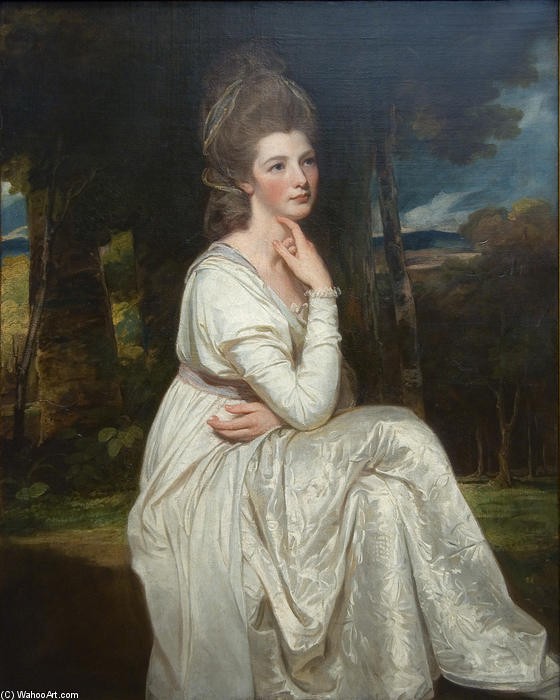
A Moment Frozen in Time: The Soul of Lady Elizabeth Hamilton
In the quietude of George Romney’s 1776 masterpiece, Lady Elizabeth Hamilton, Countess of Derby, we encounter more than a mere aristocratic likeness; we step into a profound moment of psychological intimacy. The painting serves as a window into the refined elegance of Georgian England, capturing a woman caught in a state of deep, inward reflection. As she sits with her hands resting gently against her chin, her gaze drifts toward an unseen horizon, inviting the viewer to wonder what thoughts occupy such a graceful mind. This is not the staged, rigid portraiture often associated with high society; rather, it is a study of quiet contemplation, where the subject's inner life is as much a part of the composition as her exquisite attire.
The emotional resonance of the piece lies in its ability to bridge the gap between the sitter and the spectator. There is a palpable sense of stillness, a deliberate pause amidst the grandeur of her station. For the collector or the designer, this artwork offers a unique emotional anchor—a sense of peace and intellectual depth that can transform the atmosphere of any room, bringing a touch of historical gravity and contemplative beauty to a modern interior.
Mastery of Light and Romantic Idealism
George Romney was a virtuoso of Romantic Idealism, a style that sought to elevate reality through a lens of perfected beauty. In this portrait, his technique is nothing short of masterful. He employs a delicate use of chiaroscuro, the sophisticated interplay between light and shadow, to sculpt the contours of Lady Elizabeth’s face and torso. This technique lends a three-dimensional realism to her features, making the luminous flesh tones appear almost warm to the touch.
His brushwork is characterized by a soft, fluid grace that avoids harsh lines, favoring subtle tonal gradations instead. This softness contributes to the ethereal quality of the painting, particularly in the way the light catches the folds of her white clothing and the gentle landscape behind her. The background—a picturesque arrangement of trees and distant mountains—is rendered with a painterly lightness that ensures the focus remains steadfastly on the subject, while simultaneously providing a sense of expansive, natural freedom that contrasts beautifully with the structured elegance of her pose.
A Legacy of Georgian Elegance
To understand this portrait is to understand the cultural heartbeat of late 18th-century Britain. Lady Elizabeth herself was a figure of significant social importance, the daughter of the Duke of Hamilton and a woman whose presence in the upper echelons of society was marked by both fashion and influence. Romney, who rose from humble beginnings as a cabinet maker’s apprentice to become a formidable rival to giants like Gainsborough, possessed a unique ability to capture the very essence of this era's social hierarchy and individual character.
For those seeking to adorn a space with art that tells a story, this reproduction offers an unparalleled opportunity. It is a piece that embodies historical prestige and artistic excellence. Whether placed in a sunlit library or a sophisticated dining room, the portrait of Lady Elizabeth Hamilton acts as a conversation piece, evoking the grandeur of the past while maintaining a timeless aesthetic appeal that complements both classical and contemporary decor.