A Symphony of Form: Deconstructing Reality in Braque’s Still Life
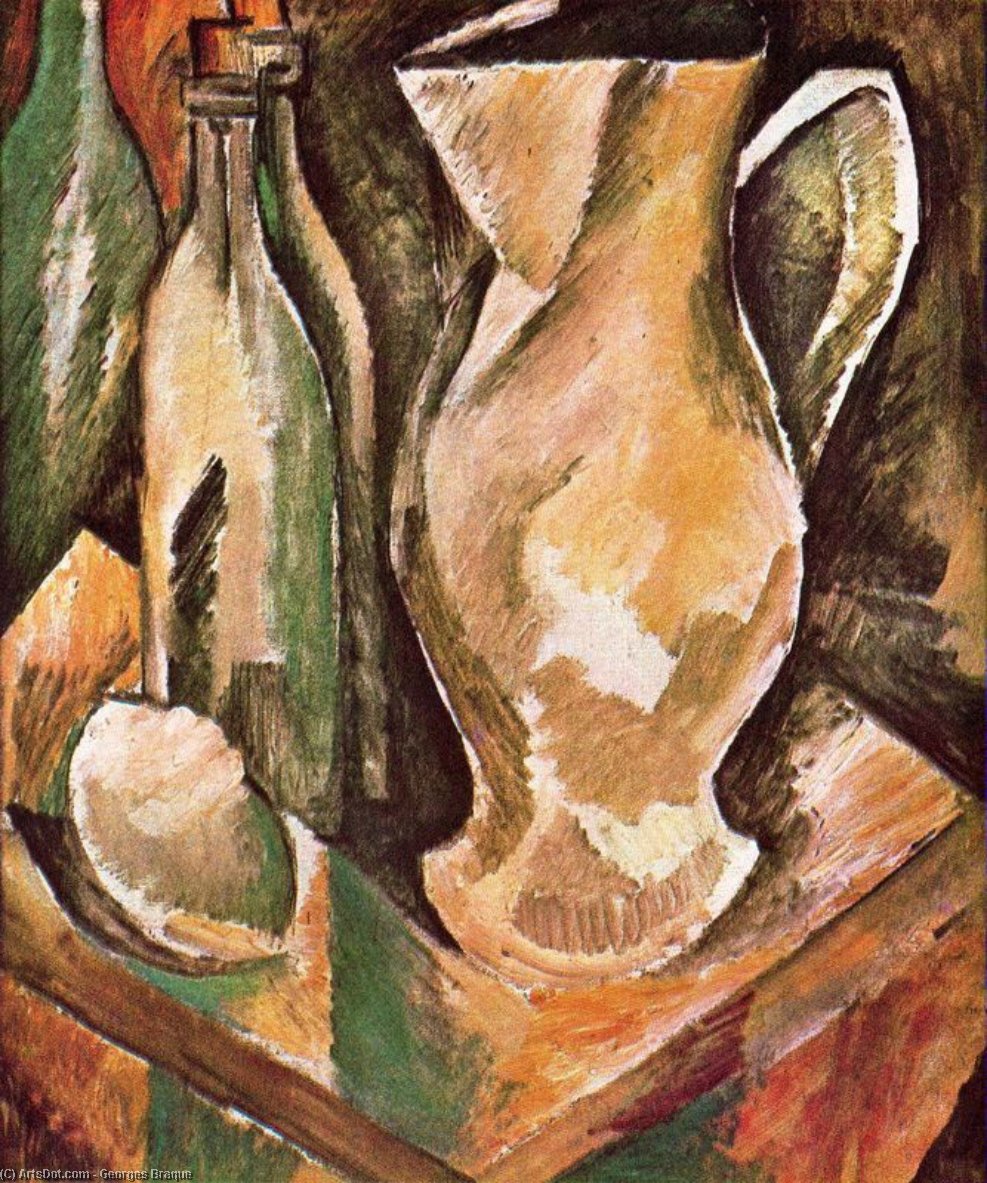
To gaze upon Georges Braque’s "Jugs, Bottles and Lemon" is to witness the very moment the mirror of traditional art was shattered and reassembled into something far more profound. Executed during the transformative years between 1910 and 1914, this masterpiece serves as a cornerstone of Cubism's formative era. Rather than offering a mere window into a quiet corner of a Parisian studio, Braque invites us into a complex dialogue about perception itself. The composition centers on a humble arrangement: two vases—one commanding the right side of the frame and another more delicate presence to the left—interspersed with various bottles and the bright, tactile suggestion of apples. Yet, through Braque’s visionary lens, these mundane objects are elevated into a rhythmic dance of geometric truth.
The brilliance of this work lies in its radical departure from the fleeting light of Impressionism. Instead of soft, blurred edges, Braque employs a meticulous Cubist technique characterized by fractured planes and overlapping facets. He abandons the singular, fixed viewpoint that had dominated Western art since the Renaissance, opting instead to depict multiple perspectives simultaneously. As your eyes move across the canvas, you are not just seeing the side of a bottle or the rim of a vase; you are experiencing the object from several angles at once, capturing its structural essence. This method creates a palpable sense of physicality, where the surfaces feel as though they possess a weight and texture that can be almost touched.
The Intellectual Pulse of Modernity
Beyond its formal experimentation, "Jugs, Bottles and Lemon" is deeply embedded in the intellectual fervor of early 20th-century Paris. This was an era defined by scientific breakthroughs in optics and a growing fascination with how space and time are perceived. Braque, working alongside his close collaborator Pablo Picasso, sought to capture not just the outward appearance of things, but the very way they inhabit our consciousness. The painting reflects the broader anxieties and instabilities of a modernizing world, where the old certainties were being dismantled by new theories of relativity and fragmentation.
There is a subtle, poetic symbolism woven into this analytical structure. The lemon, a recurring motif in Braque’s oeuvre, acts as a spark of vitality amidst the muted, earthy tones of the composition, representing freshness and the fleeting beauty of nature. This tension between the rigid, geometric deconstruction of the objects and the organic life they represent creates an emotional resonance that is both intellectual and deeply moving. For the collector or the interior designer, this piece offers more than just aesthetic beauty; it provides a sophisticated focal point that commands attention through its complexity and historical weight.
Whether displayed in a contemporary gallery setting or as a centerpiece in a curated home collection, a high-quality reproduction of this work brings with it the spirit of the avant-garde. It is an invitation to slow down, to look closer, and to rediscover the profound beauty found within the fragments of our everyday world. To own such a piece is to possess a fragment of the revolution that redefined the boundaries of modern vision.