A Glimpse into Modern Life: Decoding Seurat’s Intimate Scene
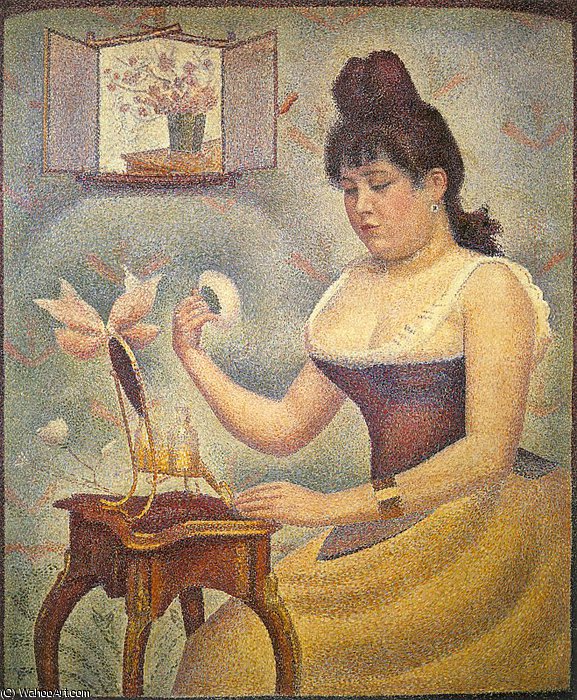
Georges Pierre Seurat, a pivotal figure in Post-Impressionism and the originator of Pointillism, presents us with a remarkably intimate portrayal of domesticity in this untitled work (4494). While celebrated for expansive landscapes like “A Sunday on La Grande Jatte,” this painting offers a quieter, more focused exploration of everyday life – a woman absorbed in her work, rendered with a sensitivity that belies its seemingly simple subject matter.
Subject and Composition
The artwork depicts a woman seated at a table, diligently operating a sewing machine. She is not idealized; instead, she’s presented as an individual engaged in the practical realities of life. The inclusion of details such as her corset and earrings subtly allude to the societal expectations placed upon women during the late 19th century, while simultaneously emphasizing her personal presence and agency. A vase containing flowers and a potted plant introduce elements of domestic comfort, softening the industrial aspect of the sewing machine itself.
Style & Technique: The Nuances of Divisionism
Although not as overtly Pointillist as some of his more famous creations, “untitled (4494)” demonstrably showcases Seurat’s meticulous approach to color and light. While a fully realized pointillist technique isn't present, the viewer can discern small, deliberate brushstrokes that build form and texture. This suggests an exploration of divisionism – the separation of colors into their constituent parts – which was central to his artistic philosophy. Seurat believed that applying pure hues in close proximity would allow the viewer’s eye to optically blend them, resulting in a more vibrant and luminous effect. The overall palette is muted yet harmonious, reflecting both the interior setting and the focused activity within it.
Historical Context: Modernity & Changing Roles
Created during Seurat's brief but profoundly influential career (1859-1891), this painting emerges from a period of significant social and technological transformation. The late 19th century witnessed accelerating industrialization, and the sewing machine was a relatively recent invention that dramatically altered domestic labor. Seurat’s decision to depict a woman utilizing this technology is particularly noteworthy; it acknowledges evolving gender roles and the impact of modernity on daily life. He dedicated himself to capturing modern life – not grand historical narratives, but rather the everyday experiences of Parisians.
Symbolism & Emotional Impact
“untitled (4494)” evokes a sense of quiet contemplation and focused industry. The woman’s absorbed posture suggests concentration, perhaps even a degree of independence within her domestic sphere. The painting isn't about dramatic action; it’s about the subtle poetry found in ordinary moments. It invites viewers to reflect on the labor – both physical and emotional – that underpins everyday existence. The work subtly celebrates the dignity of labor and the quiet strength of women navigating a changing world.
Display & Interior Design Recommendations
This artwork would be beautifully showcased in a variety of settings:
- Residential: A study, bedroom, or dining room would provide an intimate setting for this piece. Its muted tones complement both traditional and contemporary décor styles.
- Commercial: A boutique hotel lobby, a tea room, or a design studio could benefit from the painting’s understated elegance and historical resonance.
Consider pairing it with:
- Antique furniture to emphasize its period context.
- Neutral wall colors (soft grays, creams) to allow the artwork's subtle palette to shine.
- Simple, elegant framing that doesn’t distract from the painting itself – a natural wood or understated gold frame would be ideal.
“untitled (4494)” is more than just a portrait; it’s a window into a moment in time, offering a glimpse of both artistic innovation and the quiet dignity of everyday life. It's a piece that rewards close observation and invites ongoing contemplation.