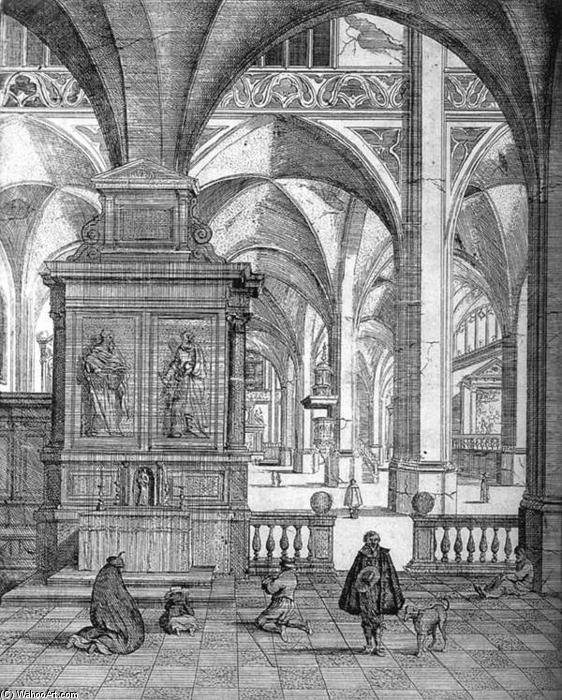
Admire Gerard Houckgeest’s "Imaginary Gothic Church" (1637). A stunning Dutch masterpiece showcasing intricate detail & atmospheric interiors. Explore this iconic artwork!
Explore Gerard Houckgeest's stunning Dutch Golden Age paintings! Master of church interiors & Renaissance buildings. Discover his Delft masterpieces at the Mauritshuis.
Rijksmuseum
(Amsterdam, Netherlands)
Istražite holandske umetnosti i istoriju u Rijksmuseumu Amsterdam! Oduševite se remek-delima Rendvrika, Vermeer i Van Goga u ikoničnoj zgradi – putovanje kroz 800 godina kulture.
Imaginary Gothic Church: A Vision of Faith and Architectural Grandeur
The artwork "Imaginary Gothic Church," executed by Gerard Houckgeest in 1637, stands as an exceptional testament to the artistic sensibilities of the Dutch Golden Age. More than just a depiction of ecclesiastical architecture, it embodies a profound exploration of faith, stability, and the sublime—themes central to Baroque aesthetics and deeply rooted in the spiritual landscape of seventeenth-century Europe. This engraving, meticulously crafted after an original painting by Pieter Saenredam, captures not merely the physical structure but also its emotive essence, inviting contemplation on divine majesty.
Composition and Perspective: Mastering Depth
Houckgeest’s compositional genius is immediately apparent in the artwork's central focus—a towering altar dominating the middle ground. Surrounding it are receding arches and columns that skillfully employ linear perspective to create an illusion of vastness and depth, mirroring the grandeur of cathedral spaces. The artist’s deliberate positioning of figures within the foreground draws the viewer’s gaze inward, fostering a sense of immersion in this sacred realm. Diagonal lines contribute dynamism, emphasizing the architectural scale and enhancing the overall visual impact.
Detailed Realism and Baroque Technique: A Symphony of Line
Houckgeest's technique exemplifies the hallmark precision characteristic of Baroque engraving—a painstaking process involving cross-hatching and stippling to achieve nuanced tonal variations. These meticulous marks capture the textures of stone, highlighting intricate carvings on the altar and architectural elements with remarkable accuracy. The artist’s dedication to detail reflects a broader artistic commitment to representing reality as faithfully as possible while simultaneously elevating it to an idealized form—a stylistic hallmark of the period.
Symbolism and Emotional Resonance: Echoes of Divine Presence
Beyond its technical prowess, “Imaginary Gothic Church” resonates with powerful symbolic significance. The architecture itself symbolizes faith, resilience, and transcendence—concepts paramount in the religious fervor of the time. The kneeling figures evoke feelings of humility, devotion, and contemplation, conveying a palpable sense of spiritual reverence. Houckgeest’s masterful rendering captures not only visual beauty but also an emotional depth that speaks to the human yearning for connection with something greater than oneself.
Historical Context: Pieter Saenredam's Influence
The artwork’s genesis lies in Pieter Saenredam’s original painting, “St Bavo’s in Haarlem,” which served as inspiration for Houckgeest’s engraving. Saenredam’s celebrated depictions of churches—particularly St Bavo’s Cathedral—established a precedent for architectural interiors as subjects of artistic exploration during the Baroque era. Houckgeest skillfully adapted Saenredam's vision, transforming it into a stunning monochrome print that continues to inspire admiration for its compositional brilliance and technical mastery.
Further Exploration: The Mauritshuis Collection
A remarkable specimen of Dutch Baroque art, “Imaginary Gothic Church” resides within the Mauritshuis’s collection in Amsterdam—a testament to Houckgeest's enduring legacy as a master of architectural representation. Visiting this museum offers an unparalleled opportunity to experience firsthand the grandeur and spiritual depth captured by Houckgeest’s engraving and to appreciate its place within the broader artistic panorama of the seventeenth century.