A Symphony of Shadows and Silk
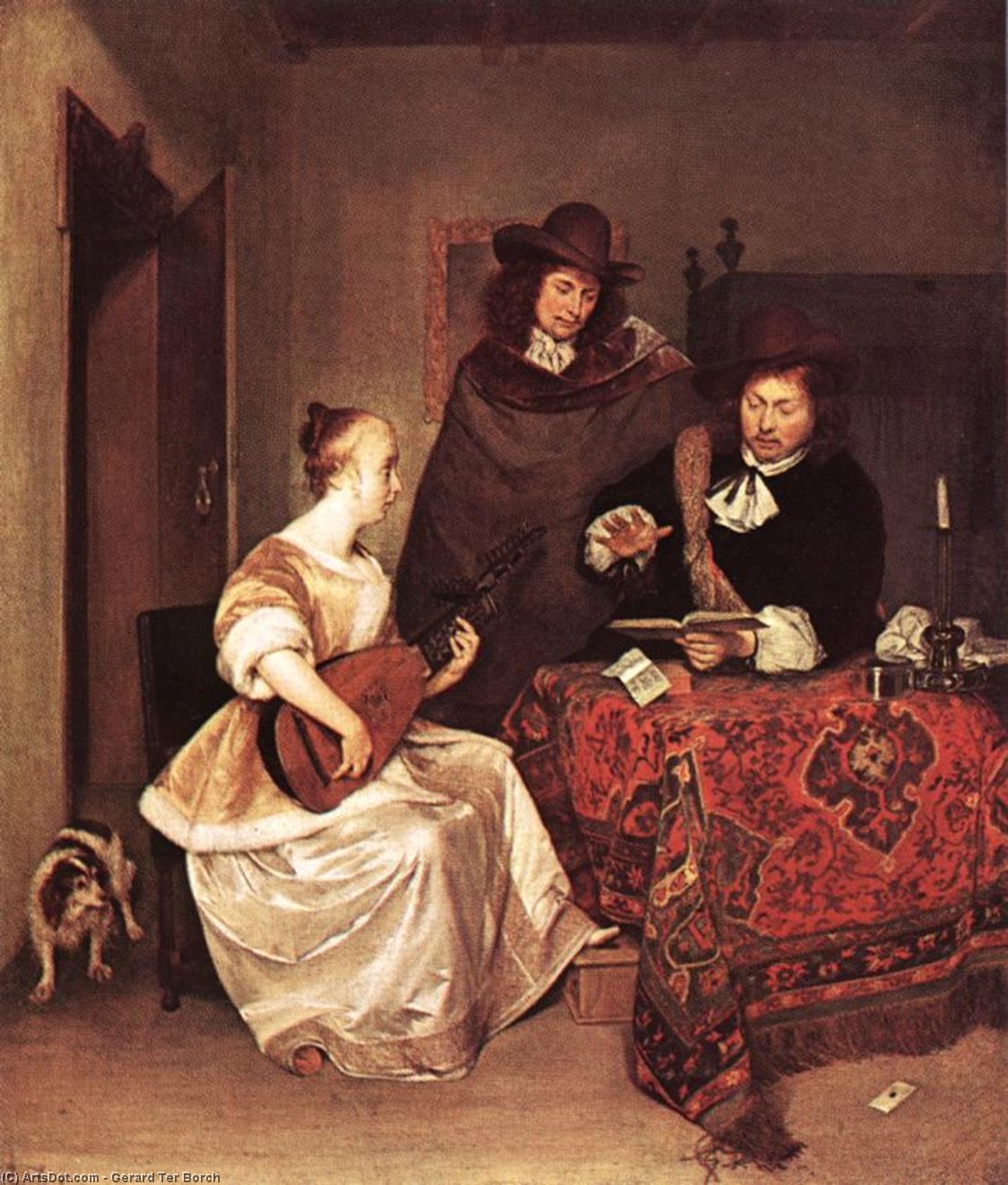
In the quiet, amber-hued corners of the Dutch Golden Age, few artists possessed the ability to capture the breathless tension of a private moment quite like Gerard ter Borch. His masterpiece, "A Young Woman Playing a Theorbo to Two Men," is not merely a depiction of a musical interlude; it is a psychological landscape draped in the luxurious textures of seventeenth-century life. As the eye wanders across the canvas, one is immediately drawn into an intimate domestic circle where music serves as both a bridge and a veil. The central figure, a young woman lost in the rhythmic pulse of her theorbo, anchors the composition with a sense of serene grace, while the two men flanking her exist in a state of watchful observation, their presence adding a layer of social complexity to the melodic scene.
Ter Borch’s mastery lies in his "selective naturalism," a technique that eschews overwhelming clutter in favor of profound, focused detail. He does not seek to overwhelm the viewer with every corner of the room; instead, he uses chiaroscuro to sculpt light from the darkness, pulling the figures forward into a palpable reality. The way light dances across the polished wood of the instrument and catches the subtle sheen of fine fabrics creates an illusion of spontaneity, as if the viewer has just stepped quietly into the room, catching a fleeting glimpse of a private rehearsal.
Symbolism Hidden in Plain Sight
Beyond the surface beauty of the figures and their surroundings, Ter Borch weaves a sophisticated web of symbolism that rewards the contemplative viewer. Beneath the feet of the musicians lies a striking crimson Ushak carpet, a luxurious element that anchors the room's warmth. Yet, tucked subtly within this rich textile rests a single ace of spades—a provocative detail traditionally associated with impulsiveness and the unpredictable nature of desire. This small, silent herald of fate introduces an undercurrent of tension to the otherwise tranquil setting, suggesting that beneath the polite veneer of musical performance, much more volatile emotions may be at play.
The composition is further enriched by carefully placed elements that speak to the themes of domesticity and hidden intimacy. A curtained bed visible in the background serves as a soft reminder of the private lives led within these walls, while the presence of a loyal dog near the bottom corner adds a touch of grounded, everyday reality. Even the books resting on the table suggest a world of intellect and quiet contemplation, contrasting with the more visceral, emotional resonance of the music being played. For the collector or interior designer, these layers of meaning offer a profound depth, making the artwork a conversation piece that invites endless reinterpretation.
An Eternal Elegance for the Modern Collector
For those looking to infuse a contemporary space with historical soul, this painting offers an unparalleled sense of prestige and warmth. The palette—dominated by deep crimsons, earthy shadows, and luminous highlights—complements both classical and modern interiors, providing a focal point that is both sophisticated and emotionally resonant. It is a work that does not demand attention through grand spectacle, but rather earns it through its quiet, enduring power.
Owning a high-quality reproduction of this Ter Borch treasure allows one to bring the atmospheric magic of the Dutch Golden Age into the home. It serves as an invitation to slow down, to appreciate the nuances of light and shadow, and to find beauty in the subtle, unspoken narratives of human connection. Whether placed in a curated gallery wall or standing alone as a centerpiece in a study, this painting remains a timeless testament to the art of intimacy.