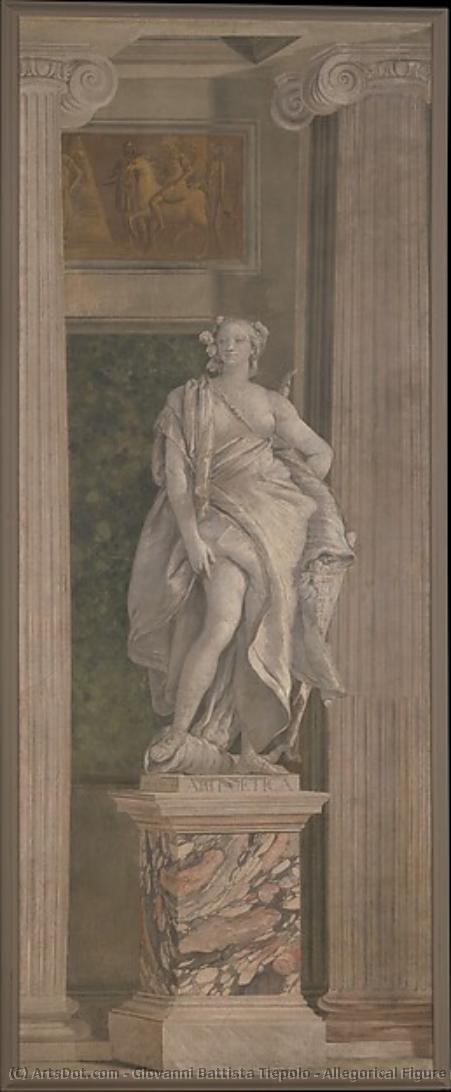
Giambattista Tiepolo’s Allegorical Figure Representing Arithmetic: A Venetian Masterpiece of Illusion
Within the opulent confines of the Palazzo Valle Marchesini Sala in Vicenza resides a captivating fresco, “Allegorical Figure Representing Arithmetic,” painted by the prodigious Giambattista Tiepolo around 1760. More than just a decorative element, this work embodies the spirit of the Rococo era and showcases Tiepolo’s unparalleled mastery of illusionistic painting—a technique that transformed walls into immersive landscapes and imbued static surfaces with dynamic life. The piece isn't merely a depiction; it’s an invitation to explore the very foundations of knowledge, rendered in vibrant color and meticulously crafted detail.
At first glance, the scene presents a serene female figure seated within a richly adorned niche. She is draped in flowing robes of deep crimson and gold, suggesting both nobility and intellectual pursuit. Her pose is one of contemplative grace, holding a wreath—a symbol often associated with victory and reward—in her outstretched hand. However, the true brilliance of this fresco lies not in its immediate visual appeal but in the subtle complexities woven into its design. The niche itself isn’t merely a frame; it's an architectural marvel, subtly receding into the distance to create a powerful sense of depth. The surrounding columns and moldings are rendered with such precision that they seem to exist within a meticulously constructed space—a testament to Tiepolo’s profound understanding of perspective and spatial relationships.
The Language of Symbols: Unveiling Arithmetic's Allegory
The title, “Allegorical Figure Representing Arithmetic,” immediately hints at the work’s deeper meaning. Rather than a straightforward portrait, this fresco employs a complex system of symbols to represent the abstract concept of mathematics. The wreath in the figure’s hand isn’t simply decorative; it symbolizes the rewards and achievements gained through diligent study and intellectual endeavor. The architectural elements within the niche—columns, arches, and geometric patterns—are not merely ornamental but serve as visual representations of mathematical principles. The careful arrangement of these forms echoes the logic and structure inherent in arithmetic itself.
Further adding to the complexity is the presence of a small, almost hidden figure behind the central female form. This enigmatic figure, often interpreted as representing geometry, reinforces the fresco’s thematic core. The interplay between these symbolic elements creates a layered narrative—a visual poem that invites viewers to engage with the subject matter on multiple levels.
Technique and Innovation: Tiepolo's Pioneering Approach
Tiepolo’s technique is nothing short of revolutionary for his time. He employed a method known as “veist,” or “laying in,” where he first sketched out the entire composition directly onto the wet plaster wall using charcoal. This allowed him to establish the overall perspective and proportions before applying color. Crucially, he utilized incised lines—subtle grooves carved into the wet plaster—to guide his brushstrokes as he painted. These lines acted like a roadmap, ensuring that elements like architecture and figures were rendered with perfect alignment, particularly when viewed from a central point. This innovative approach was made possible by the collaboration of Mengozzi, a specialist in perspective, who ensured the illusionistic depth remained consistent throughout the vast fresco cycle.
The use of color is equally remarkable. Tiepolo’s palette is rich and vibrant, dominated by warm reds, golds, and blues—colors that evoke a sense of luxury and grandeur. He masterfully employed chiaroscuro—the dramatic contrast between light and shadow—to create a three-dimensional effect, further enhancing the illusionistic depth of the scene. The fresco’s luminosity is particularly striking, reflecting Tiepolo's understanding of how light interacts with surfaces to create visual interest.
A Legacy of Illusion: The Fresco as Gesamtkunstwerk
"Allegorical Figure Representing Arithmetic" stands as a prime example of Tiepolo’s “Gesamtkunstwerk”—a total work of art—where every element, from the architectural design to the color palette and symbolic imagery, is carefully orchestrated to create a cohesive and immersive experience. This fresco was part of a larger cycle decorating the Palazzo Valle Marchesini Sala, demonstrating Tiepolo's ability to seamlessly integrate decorative elements with narrative themes. The work’s enduring appeal lies not only in its technical brilliance but also in its capacity to transport viewers to another time and place—a testament to Tiepolo’s genius as one of history’s greatest illusionistic painters.