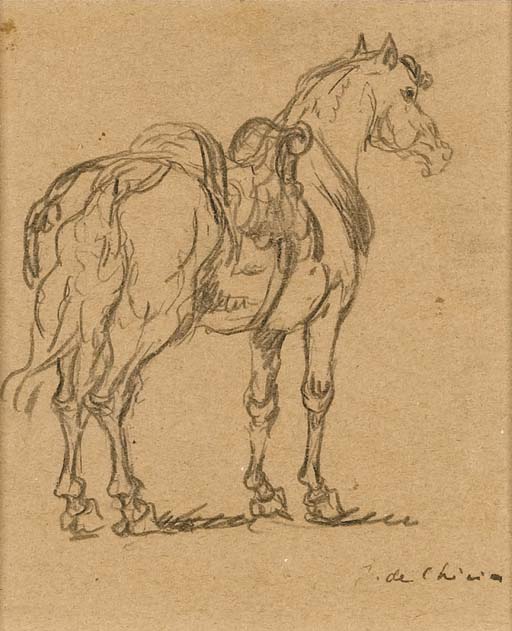
Explore Giorgio de Chirico’s ‘Cavallo 1,’ a striking pencil sketch embodying Metaphysical art's surrealism & evocative power. A study of form, movement, and timeless beauty.
A Study in Surrealist Stillness
Giorgio de Chirico's “Cavallo 1,” a pencil sketch executed with remarkable precision, embodies the core tenets of Metaphysical Art—a movement that profoundly influenced Surrealism and continues to fascinate art historians today. More than just a depiction of a horse, it’s an exploration of form itself, capturing fleeting moments of dynamism within a carefully constructed composition.
The artwork immediately draws the eye with its stark simplicity: a solitary horse rendered in profile against a muted grey-brown paper texture that speaks to the artist's fascination with aged materials and textures. This deliberate restraint serves not to diminish the image’s impact but rather to heighten it, forcing viewers to focus on the fundamental elements of visual representation—line and shadow.
Technique and Material Considerations
De Chirico’s masterful technique relies heavily on hatching and cross-hatching – meticulous lines interwoven to build tonal depth and contour. Graphite pencil was chosen for its ability to convey subtle nuances of shading, allowing the artist to simulate the texture of fur and muscle with impressive accuracy. The careful layering of graphite creates a palpable sense of materiality, mirroring the artist’s desire to capture essence rather than photographic realism.
The positioning of light—presumably originating from above—further enhances the sketch's expressive qualities, casting delicate shadows that delineate the horse’s musculature and contribute to its overall sculptural presence. Perspective is simplified, prioritizing a dynamic representation over strict spatial accuracy; this stylistic choice aligns perfectly with the movement’s preoccupation with subconscious imagery.
Symbolism and Emotional Resonance
Beyond its formal considerations, “Cavallo 1” resonates with deeper symbolic meanings rooted in Nietzschean philosophy. The horse itself—often associated with strength, nobility, and primal instinct—becomes a conduit for exploring themes of existential anxiety and the confrontation with irrational forces. Its stillness juxtaposed against implied movement suggests an internal struggle, mirroring the artist’s own intellectual journey.
The artwork's muted palette and textural surface evoke a mood of contemplative melancholy, inviting viewers to contemplate the complexities of perception and the elusive nature of reality—characteristics that define Metaphysical Art’s enduring legacy. It stands as a testament to de Chirico’s ability to distill profound ideas into deceptively simple visual forms.
Provenance and Artistic Influence
Records indicate that “Cavallo 1” was donated to the Metropolitan Museum of Art as part of Florene Schoen’s bequest, highlighting its significance within the broader context of Surrealist art history. De Chirico's influence extended far beyond his immediate peers; he paved the way for artists like René Magritte and Yves Klein to explore similar dreamlike landscapes and psychological investigations.