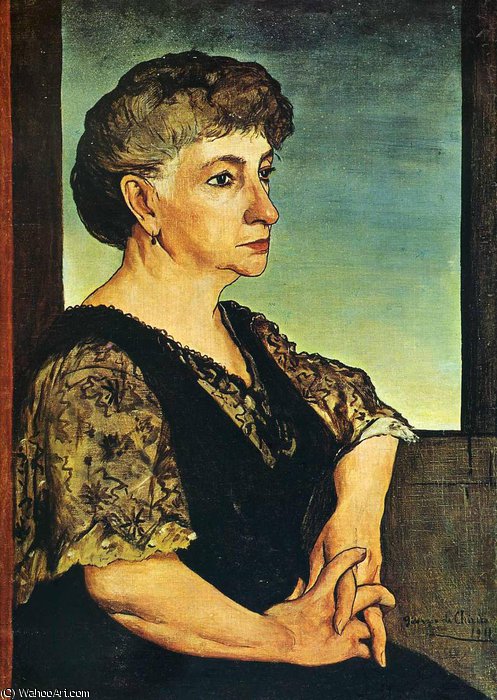
Жорж Де Кирико био је италијански сликар који је основоположник метафизичке школе уметности. Из познатих делија као што су „Утицање мислиоца“, „Тајна послеподневне пролеће и“ Песма радости, Де Кирико је оставио траг у европској уметности почетка века и био је веома инспиративан за сурреалисте као што су Рене Магрит и Салвадор Дали.
A Fragment of Dreamscape: Examining Giorgio de Chirico’s Untitled (1608)
Giorgio de Chirico's “Untitled (1608)” stands as a cornerstone of Metaphysical Art, a movement that irrevocably altered the landscape of early 20th-century painting and profoundly influenced Surrealism. This enigmatic canvas, executed around 1913, captures a moment suspended between reality and illusion—a visual distillation of Nietzschean philosophy and Schopenhauerian pessimism—that continues to fascinate viewers today. The artwork depicts a solitary woman seated before a window, her gaze directed outwards into an indeterminate expanse. Her hands clasped together convey a palpable stillness, hinting at contemplation or perhaps profound melancholy. Two figures inhabit the periphery of the composition: one positioned on the left and another on the right, engaged in activities that seem disconnected from the central figure’s internal state.
Stylistic Innovation and Formal Elements
De Chirico's distinctive style is immediately recognizable through its unsettling juxtaposition of familiar architectural elements—specifically an arched doorway reminiscent of Roman ruins—with jarring incongruities. The stark, geometric precision of the architecture contrasts sharply with the soft, diffused light emanating from the window, creating a palpable sense of disorientation. Shadows stretch across the floor, emphasizing emptiness and amplifying the psychological tension inherent in the scene. De Chirico employed oil paint on canvas, utilizing meticulous brushwork to achieve remarkable textural detail—particularly noticeable in the woman’s drapery and the subtle variations in tone within the architectural backdrop. The artist's masterful manipulation of perspective contributes to the artwork’s dreamlike quality, subtly distorting spatial relationships and undermining conventional notions of realism.
Philosophical Resonance: Nietzschean Influence
“Untitled (1608)” is deeply rooted in the intellectual currents of its time, reflecting De Chirico's unwavering engagement with the existentialist ideas championed by Friedrich Nietzsche. Like Nietzsche’s exploration of the will to power and the confrontation with nihilism, the painting presents a world devoid of comforting narratives—a realm where appearances deceive and underlying anxieties dominate. The woman’s solitary posture embodies the individual’s struggle against overwhelming forces, mirroring Nietzsche's assertion that humanity is perpetually adrift in an abyss of meaninglessness. Furthermore, De Chirico’s fascination with Schopenhauerian pessimism – the belief that life is fundamentally irrational and driven by instinct—is evident in the pervasive atmosphere of melancholy and detachment permeating the composition.
Symbolism and Emotional Impact
The woman herself serves as a potent symbol of introspection and vulnerability, representing the human psyche grappling with existential dilemmas. The window acts as a conduit to an unknown future, symbolizing both opportunity and apprehension. The two figures flanking the central subject contribute to the artwork’s unsettling effect, suggesting that we are never truly alone—that external forces constantly intrude upon our inner lives. “Untitled (1608)” evokes a profound emotional response in viewers, prompting contemplation on themes of isolation, uncertainty, and the elusive nature of consciousness. Its dreamlike atmosphere lingers long after viewing, inviting interpretation and fostering a connection to the artist’s philosophical convictions.
Conclusion: Legacy and Influence
Giorgio de Chirico's “Untitled (1608)” remains an enduring testament to Metaphysical Art’s transformative power—a visual manifesto of disillusionment and intellectual rigor that paved the way for Surrealism. Its meticulous technique, unsettling imagery, and philosophical depth continue to inspire artists and collectors alike, cementing its place as a masterpiece of modern art. A reproduction from ArtsDot offers an exceptional opportunity to experience this iconic artwork firsthand, capturing its haunting beauty and conveying its profound psychological significance.