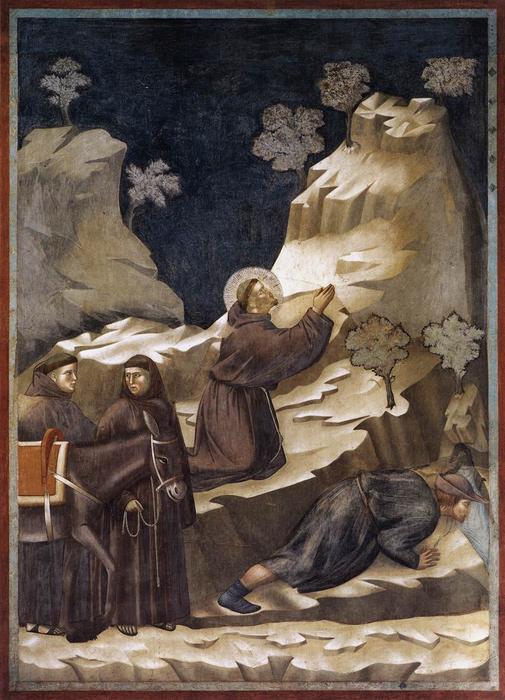
Experience Giotto Di Bondone's masterpiece – ‘The Miracle of the Spring’ (1299) from Padua’s Cappella Scrovegni! Explore Proto-Renaissance realism & profound emotion in this iconic fresco.
Firenca
Italija
Đžoto di Bondone
Đžoto
Otkrijte Đžota di Bondona (1267-1337), revolucionarnog italijanskog slikara! Istražite njegove freske u stilu proto-renesanse, naturalizam i emotivnu dubinu u delima poput Scrovegnijeve kapel. Ključna figura u istoriji umetnosti.
Proto-renesansa
Masacio
Čimabue
oko 1267. godine
1337. godine
Đžoto di Bondone
Italijan
Scrovegnijeva kapela
Firenca,
The Miracle of the Spring: Giotto’s Pioneering Vision
Giotto di Bondone's *The Miracle of the Spring*, painted in 1299, stands as an undeniable cornerstone of Proto-Renaissance art and a testament to Giotto’s revolutionary departure from Byzantine conventions. More than just a depiction of biblical narrative—the story of St. Francis miraculously reviving a dead man—it embodies a profound shift in artistic sensibility that would irrevocably shape the trajectory of Western painting for centuries to come. Located within the Cappella Scrovegni in Padua, Italy, this fresco commands attention not merely for its impressive dimensions (270 x 200 cm) but for its breathtaking realism and emotive power—qualities rarely achieved by artists of his era.
A Break from Byzantium: Giotto’s Innovative Style
Prior to Giotto, Byzantine art favored stylized figures rendered in gold leaf, prioritizing spiritual grandeur over naturalistic representation. Artists meticulously crafted images that conveyed theological concepts rather than capturing human experience with accuracy. Giotto shattered this tradition by introducing a groundbreaking approach—one rooted in observation and imbued with palpable emotion. He moved away from the flattened perspective of Byzantine mosaics, striving instead to create spatial depth and illusionism, techniques that would become hallmarks of the Renaissance. This deliberate embrace of naturalism wasn’t simply stylistic preference; it represented a fundamental rethinking of how artists could communicate truth about the human condition.
Composition and Narrative Depth: Capturing Emotion Through Form
The fresco's composition is meticulously crafted to guide the viewer’s gaze and amplify the narrative impact. Giotto skillfully arranges figures within a rocky hillside landscape, utilizing atmospheric perspective—a technique that subtly diminishes color intensity and detail as objects recede into the distance—to establish a convincing sense of depth. The central figure, kneeling in prayer before the miraculous spring, dominates the scene, his hands raised upward conveying unwavering devotion. Surrounding him are other individuals engaged in various activities, creating a dynamic tableau that reflects the complexities of human interaction. Giotto’s masterful use of shading and modeling imbues each character with palpable physicality, capturing subtle expressions of grief, hope, and wonder—elements crucial to conveying the spiritual significance of the miracle itself.
The Cappella Scrovegni Context: A Legacy of Artistic Innovation
The Cappella Scrovegni serves as an unparalleled repository of Giotto’s artistic achievements, housing a cycle of frescoes depicting scenes from the Life of Christ and St. Francis—a project commissioned by Enrico Scrovegni, a wealthy textile merchant who wished to honor his deceased son. Alongside *The Miracle of the Spring*, masterpieces such as *Faith,* *Justice,* and *Inconstancy* demonstrate Giotto’s unwavering commitment to portraying human emotion with unprecedented sensitivity. The chapel's walls are adorned with vibrant colors and intricate detail—a remarkable feat considering the limitations of medieval pigments and techniques—solidifying Giotto’s place as a pioneer whose influence extended far beyond his lifetime.
Experiencing Giotto’s Vision: ArtsDot’s Reproductions
ArtsDot offers exceptional reproductions of *The Miracle of the Spring*, allowing you to immerse yourself in the beauty and profound emotional resonance of Giotto's masterpiece. Crafted by skilled artisans using archival-quality pigments and printing methods, these reproductions faithfully capture the fresco’s luminous colors and textural nuances—bringing its timeless artistry into your home or studio. For more information on Giotto di Bondone and his enduring legacy, visit ArtsDot.com to explore a curated collection of artworks and resources.