A Venetian Masterpiece: Unveiling Bellini’s ‘Four Allegories’
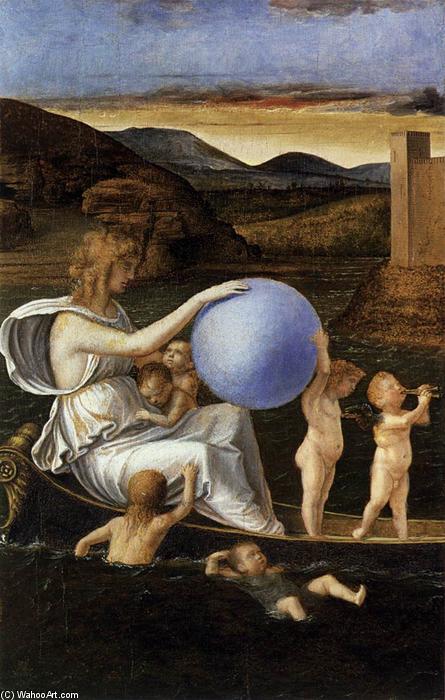
Giovanni Bellini's “Four Allegories: Fortune (or Melancholy),” painted around 1490, isn’t merely a depiction of figures; it’s an immersive experience in the heart of Renaissance Venice. This small panel, measuring just 34 x 22 cm, pulsates with a quiet intensity—a testament to Bellini's mastery of color and his profound understanding of human emotion. The scene unfolds on what appears to be a simple raft or boat, yet it’s far from ordinary. At its center sits a woman, draped in rich fabrics, holding aloft a luminous blue sphere – an object immediately imbued with symbolic weight. Surrounding her are four distinct individuals, each embodying a facet of the allegorical theme: Fortune herself, represented by the central figure; Melancholy, perhaps the most poignant presence; a youthful embodiment of Hope; and a somber representation of Time. The composition isn’t one of dramatic action but rather a carefully orchestrated tableau of contemplation, inviting viewers to ponder the complexities of human existence.
Bellini's Venetian style is immediately recognizable – a departure from the rigid formality of earlier Florentine Renaissance art. He embraced a looser brushstroke and a more sensual approach to color than his predecessors. Notice how he uses glazing techniques—thin layers of translucent paint applied over dried underlayers—to create an astonishing depth and luminosity. The blue sphere, for instance, isn’t simply painted; it seems to radiate light itself, reflecting the artist's innovative use of oil paints, a relatively new medium in Venice at the time. This technique allowed Bellini to achieve subtle gradations of color and a remarkable sense of atmosphere – a hallmark of his style.
The Weight of Symbolism: Decoding the Allegorical Figures
Each figure within “Four Allegories” carries a potent symbolic charge, rooted in classical philosophy and medieval thought. Fortune, often depicted as melancholic rather than triumphant, holds the blue sphere – traditionally associated with wisdom and knowledge, but here imbued with a sense of restraint and perhaps even sorrow. The woman herself is frequently interpreted as representing Lady Wisdom, a figure who understands that true happiness lies not in fleeting pleasures but in contemplation and inner peace. Melancholy, rendered with a palpable sadness, embodies the awareness of mortality and the transience of earthly joys. Hope, youthful and radiant, offers a glimmer of optimism amidst the prevailing gloom, while Time, represented by an older figure, silently observes the unfolding drama, reminding us of the relentless passage of years.
The setting—the boat or raft—further enhances the allegorical meaning. It suggests a journey through life, fraught with uncertainty and challenges. The figures are not actively engaged in any particular action; they’re caught in a moment of quiet reflection, inviting the viewer to join them in contemplating their own place within the grand scheme of existence. The inclusion of children adds another layer of complexity – perhaps representing innocence lost or the potential for renewal.
A Legacy Forged in Venice: Bellini's Artistic Influence
Giovanni Bellini’s work stands as a crucial bridge between the Byzantine artistic traditions he inherited and the burgeoning humanism of the Renaissance. He was deeply influenced by artists like Gentile da Fabriano and Andrea Mantegna, but he ultimately forged his own distinctive style—one characterized by its luminous colors, atmospheric perspective, and profound emotional depth. Bellini’s innovations in oil painting – particularly his masterful use of glazing techniques – had a lasting impact on Venetian art, paving the way for the careers of Titian and Tintoretto. His “Four Allegories” exemplifies this transition, showcasing a shift towards greater naturalism and psychological complexity while retaining a distinctly spiritual sensibility.
Reproductions of "Four Allegories" offer a remarkable opportunity to experience Bellini’s genius firsthand. ArtsDot's hand-painted reproductions capture the essence of the original painting—its subtle color variations, delicate brushstrokes, and profound emotional resonance—with unparalleled fidelity. Whether displayed in a private collection or incorporated into an interior design scheme, this artwork serves as a timeless reminder of the enduring power of art to inspire contemplation and evoke emotion.