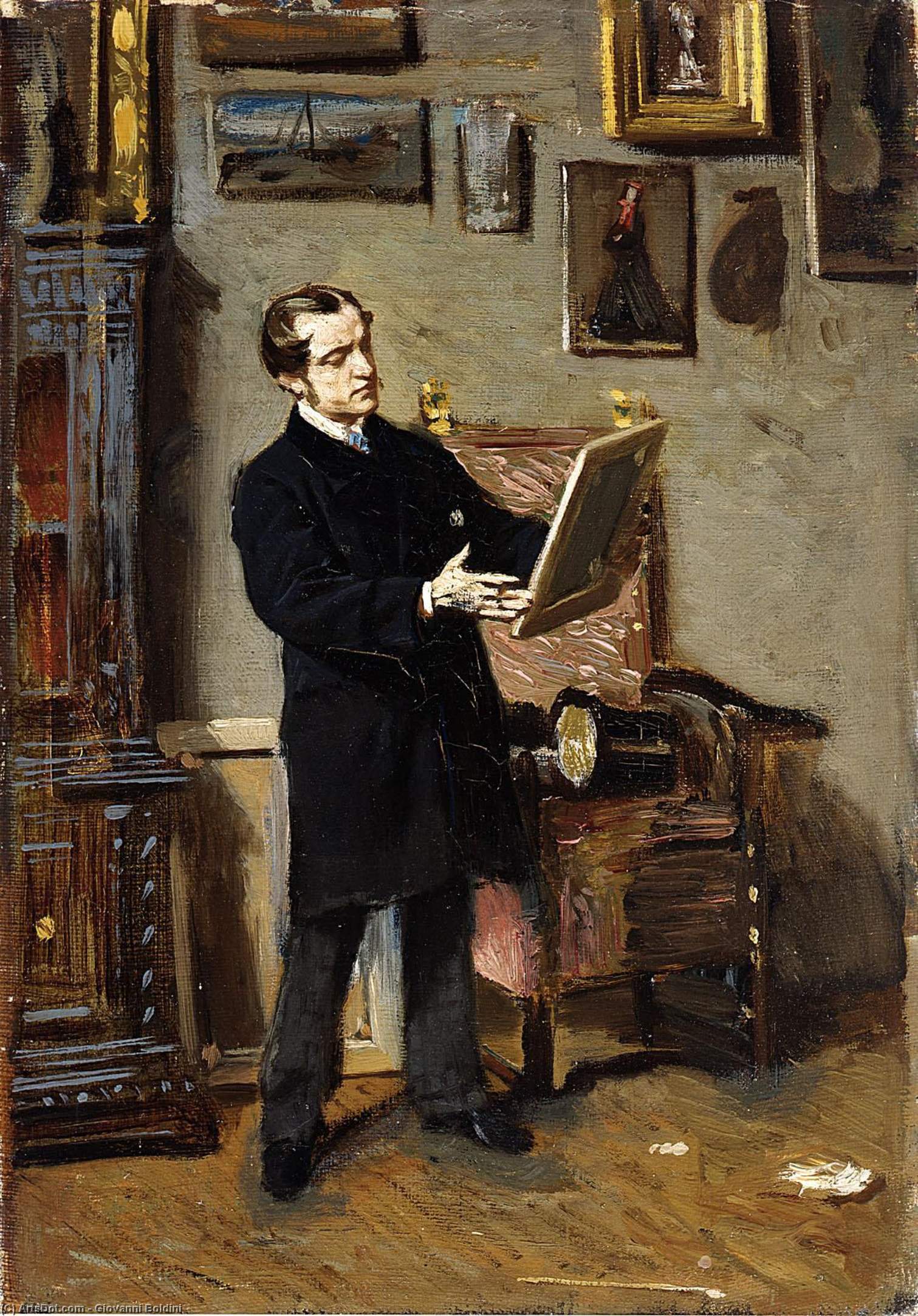
Giovanni Boldini's 'Self-Portrait while Looking at a Painting': A Window into an Artist’s Soul
Giovanni Boldini’s ‘Self-portrait while Looking at a Painting,’ executed in 1865, is more than just a depiction of the Italian master himself; it’s a profound meditation on art, observation, and the very nature of creative inspiration. This intimate canvas, measuring a modest 22 x 32 cm, offers a rare glimpse into Boldini's studio – a space brimming with intellectual stimulation and artistic ambition. The painting immediately draws the viewer in with its quiet intensity, capturing a moment of focused contemplation as Boldini studies another work, his own portrait held before him like a mirror reflecting both his skill and his aspirations.
- Subject Matter: A meticulously rendered self-portrait within an artist’s studio.
- Artist: Giovanni Boldini
- Date: 1865
- Size: 22 x 32 cm
The Studio as a Canvas: Composition and Setting
Boldini’s genius lies not just in his technical prowess but also in his ability to construct a scene that resonates with meaning. The composition is deceptively simple, yet powerfully effective. A central chair anchors the eye, while a dining table subtly suggests the sustenance needed for prolonged artistic endeavor. The walls are adorned with multiple paintings – a deliberate choice by Boldini that speaks volumes about his engagement with the wider art world. These aren’t merely decorative elements; they represent a conversation between artists, a recognition of influences, and perhaps even a subtle self-critique. The inclusion of a clock on the upper left wall adds an element of timelessness, reminding us of the fleeting nature of beauty and the artist's urgent need to capture it before it vanishes.
Technique and Realism: Boldini’s Signature Style
Executed in oil on canvas, ‘Self-portrait while Looking at a Painting’ exemplifies Boldini’s mastery of realism. His brushwork is remarkably smooth and controlled, creating an illusion of depth and texture that invites the viewer to step into the scene. The meticulous rendering of the room – from the worn wood of the table to the subtle reflections on the paintings – demonstrates his keen eye for detail. Boldini's use of color is particularly noteworthy; he employs a rich palette with carefully modulated tones, creating a sense of luminosity and warmth that elevates the painting beyond mere representation. The technique employed allows for a remarkable level of detail, drawing the viewer into the scene and fostering a connection with the artist himself.
Symbolism and Context: A Reflection on Art
Beyond its technical brilliance, ‘Self-portrait while Looking at a Painting’ is laden with symbolism. The act of Boldini studying another artwork suggests a constant process of learning and refinement – an acknowledgement that art is not static but evolves through observation and engagement. The inclusion of his own portrait within the scene can be interpreted as a self-assessment, a moment of critical reflection on his own work. It’s a poignant reminder that every artist grapples with questions of identity, style, and legacy. This painting stands as a testament to Boldini's artistic prowess and his ability to blend self-reflection with the broader context of art.
A Timeless Masterpiece
‘Self-portrait while Looking at a Painting’ by Giovanni Boldini is a captivating artwork that continues to resonate with viewers today. Its intimate scale, combined with Boldini's masterful technique and insightful composition, creates a truly unforgettable image. This piece offers a unique window into the mind of one of the Belle Époque’s most celebrated portraitists, inviting us to contemplate the enduring power of art and the profound connection between artist and creation.