A Roman Echo: Unveiling the Layers of “Ruins with Figures”
Giovanni Paolo Panini’s “Ruins with Figures,” painted in 1720, isn't merely a depiction of ancient ruins; it’s an immersive journey into the heart of memory and the constructed nature of history itself. Born in Piacenza, Panini rose to prominence not as a painter of grand narratives, but as a master of illusionistic interiors – a “vedutista” specializing in capturing the imagined grandeur of Rome. This particular work exemplifies his signature style: a meticulously rendered landscape populated with fragments of antiquity, imbued with an almost theatrical sense of drama and timelessness. The painting immediately draws the eye into a scene that feels both familiar and utterly fabricated, prompting a fundamental question about how we perceive and represent the past.
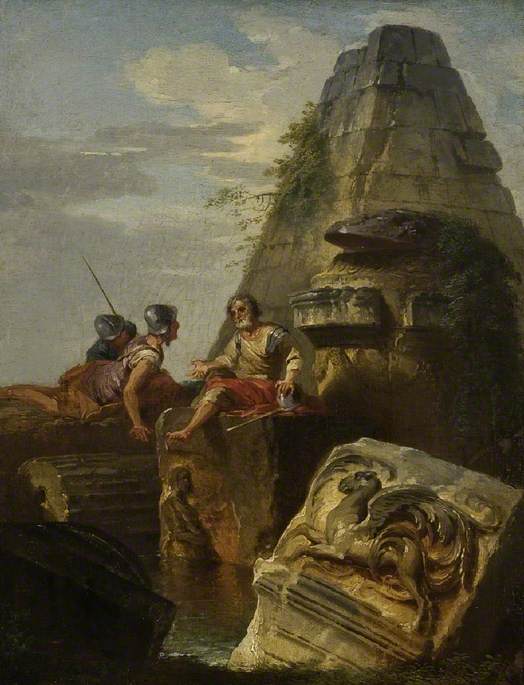
The composition is dominated by crumbling structures – arches, columns, and walls – hinting at the remnants of a once-magnificent Roman city. These aren’t simply archaeological fragments; they are carefully orchestrated elements within a meticulously designed space. Notice the deliberate arrangement: the broken columns suggest a lost temple, while the scattered stones evoke a fallen mausoleum. The figures in the foreground—two men and a woman engaged in conversation—are not incidental additions but integral to the scene’s narrative. They serve as anchors for the viewer, inviting us to contemplate the stories these ruins might hold, and suggesting that even our understanding of history is shaped by human interpretation.
The Art of Illusion: Panini's Technique
Panini’s genius lay in his mastery of perspective and illusionism. He employed a complex system of vanishing points and foreshortening to create the impression of vast, three-dimensional space—a technique honed during his early career as a stage designer for elaborate theatrical productions. The painting is executed with remarkable detail, utilizing delicate brushstrokes to capture the texture of weathered stone and the folds of fabric worn by the figures. The use of light and shadow further enhances the sense of depth and realism, drawing the viewer into the scene. Crucially, Panini wasn’t aiming for a literal representation; he was crafting an *idealized* Rome—a Rome as it *should* be remembered, informed by classical ideals and embellished with his own artistic vision.
- Color Palette: Dominated by earthy tones – ochres, browns, and grays – reflecting the weathered stone of the ruins.
- Brushwork: Precise and controlled, creating a sense of meticulous detail and architectural precision.
- Perspective: A sophisticated use of linear perspective creates an illusion of depth and space, drawing the viewer into the scene.
A Window to Rome’s Past – and Present
“Ruins with Figures” emerged during a period of intense fascination with classical antiquity in 18th-century Europe. The rediscovery of Roman ruins fueled a renewed interest in the empire's art, architecture, and culture—a trend known as Neoclassicism. Panini’s work perfectly captures this spirit, offering a romanticized vision of Rome that resonated deeply with contemporary audiences. However, it’s important to recognize that Panini wasn’t simply documenting history; he was actively shaping it. He created these imagined ruins not just for aesthetic pleasure but also as a means of preserving and celebrating the legacy of Rome—a legacy that was constantly being reinterpreted and reimagined.
Furthermore, the painting speaks to a broader human concern: our relationship with time and memory. The crumbling ruins serve as a potent symbol of mortality and impermanence, while the figures in the foreground represent humanity’s ongoing attempt to grapple with these concepts. “Ruins with Figures” is not just a beautiful landscape; it's a meditation on the enduring power of art to shape our understanding of the past—and perhaps even influence our perception of the present.
Collecting and Experiencing Panini’s Vision
Reproductions of “Ruins with Figures” offer a remarkable opportunity to bring this captivating scene into your home or office. High-quality prints on canvas capture the painting's rich colors and intricate details, while framed versions add an element of sophistication and elegance. Consider how the artwork’s evocative atmosphere can complement various interior design styles—from classic Romanesque to contemporary minimalist. Whether you are a seasoned art collector or simply seeking a piece that embodies timeless beauty and intellectual depth, “Ruins with Figures” is a truly exceptional addition to any collection.