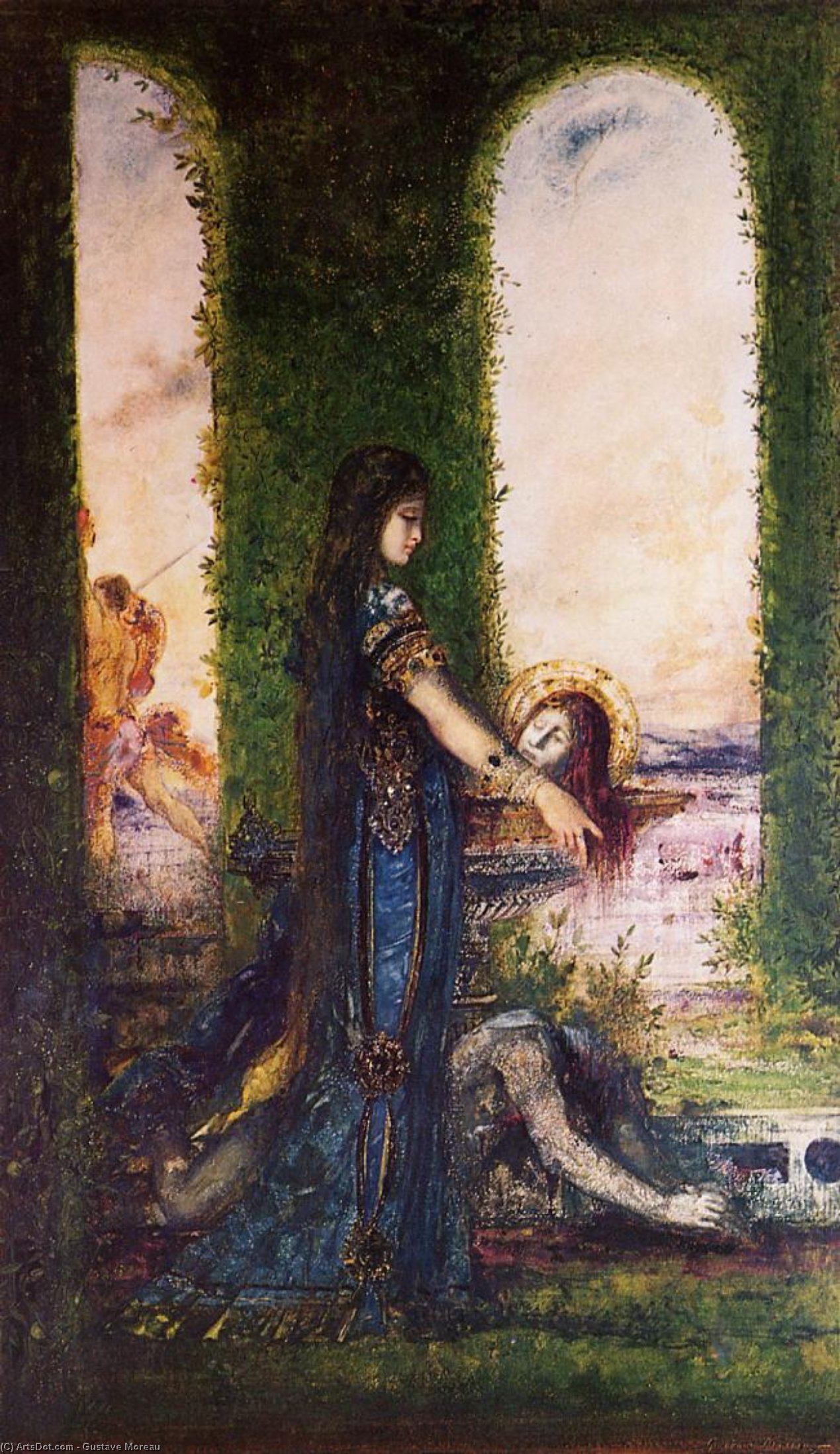
Moreau’s haunting watercolor ‘Salome in the Garden,’ steeped in Symbolist mysticism, depicts a woman poised over a prone figure amidst lush foliage—a serene tableau reflecting Moreau's exploration of myth and psychology. Immerse yourself in this exquisite reproduction.
Жртва симбола и визионар слике, Густав Море је био француски ренесансни уметник који је оставио траг у историји сликања. Из познатог музеја Мореа у Парису су му се прецизније прилагодиле техничке карактеристике и стил, док су његове најзначајније слике представљале митове и бибљске приче које су га одликовале. Иновативни и веома емоционални Море је био утицајан на последишње уметнике као што су Ма
The Ethereal Realm of Salome
In the delicate, luminous world of Gustave Moreau’s Salome in the Garden, the boundaries between reality and myth dissolve into a haze of enchanting beauty. Completed in 1878, this watercolor masterpiece invites the viewer into a meticulously crafted symbolic universe where every translucent wash whispers of ancient legends and psychological depth. The scene captures Salome, draped in opulent fabrics and adorned with jewels, her hand resting with a haunting tenderness upon the head of a figure prone upon the earth. It is a moment suspended in time, evoking the heavy atmosphere of religious iconography and the intoxicating tension of biblical tragedy. This is not merely a depiction of a legend; it is an immersive experience into the artist’s private, dreamlike vision, where the weight of history meets the lightness of a dream.
Technique and the Symbolist Soul
Moreau’s approach distinguishes him profoundly from the Impressionists who sought to capture only the fleeting effects of light. Instead, he employed a technique characterized by layering translucent washes of color—primarily deep blues and verdant greens—to create an atmosphere of hazy luminescence. This method allows the ivory paper to breathe through the pigment, lending the artwork a sense of spiritual radiance. Such artistry was central to the Symbolist movement, which arose in France during the Belle Époque as a powerful reaction against the materialism and scientific rationalism of the Victorian era. By prioritizing emotion and suggestion over literal accuracy, Moreau uses the garden setting as a potent metaphor; the lush flora represents both a paradise lost and a fertile ground for spiritual rebirth, creating a visual language that speaks directly to the subconscious mind.
A Timeless Presence for Modern Interiors
For the discerning collector or interior designer, Salome in the Garden offers far more than mere aesthetic appeal; it provides a profound emotional and intellectual anchor for any curated space. The painting’s ability to evoke contemplation and mystery makes it an exquisite centerpiece for a sophisticated room, whether it be a quiet library or a grand, light-filled salon. The subtle interplay of cool tones and the intricate, jewel-like details provide a sense of luxury and depth that complements both classical and contemporary decor. To display a high-quality reproduction of this work is to invite the enigmatic spirit of the late 19th century into the modern home, surrounding oneself with the hauntingly beautiful textures of a master who dared to paint the unseen realms of the human psyche.