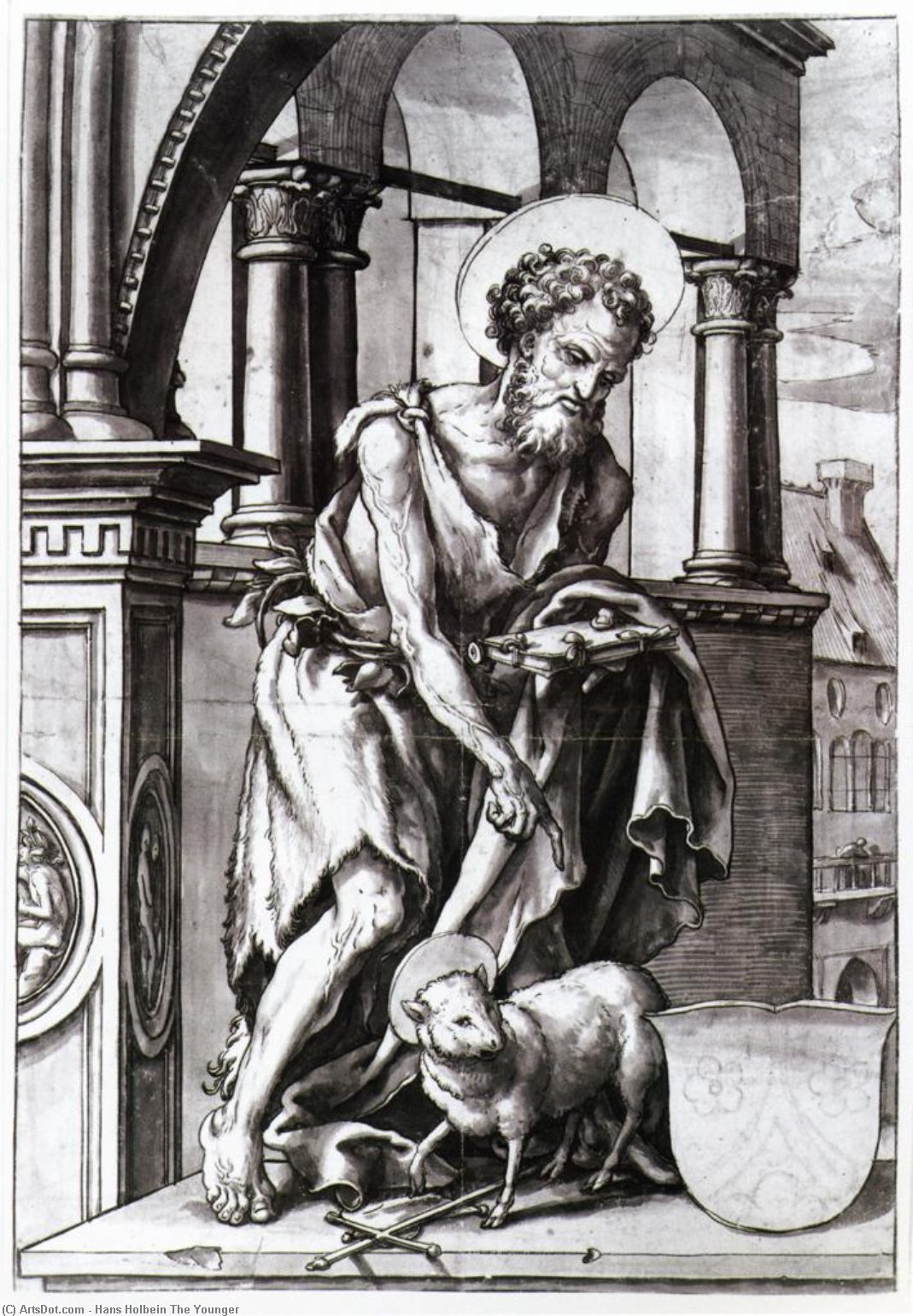
Delve into the masterful chalk drawing of St. John the Baptist by Hans Holbein the Younger—a cornerstone of Northern Renaissance art, celebrated for its meticulous realism and symbolic depth.
Hans Holbein Mlađi (1497-1543), nemačko-švajcarski slikar poznat po realističnim portretima engleske kraljevske porodice, uključujući i Henrika VIII. Njegova dela, poput 'Poslanika', odlikuju detalji i simbolizam, ostavljajući trajan utisak na umetnost.
The Soul of the Northern Renaissance
In the quiet, focused strokes of Hans Holbein the Younger’s St. John the Baptist, one finds the very heartbeat of the Northern Renaissance. Completed around 1519, this chalk drawing is far more than a mere religious depiction; it is a profound testament to an era defined by a relentless pursuit of truth through observation. Unlike the idealized, sweeping forms often associated with their Italian contemporaries, Holbein’s work invites the viewer into a realm of startling intimacy and tactile reality. Every line serves a purpose, bridging the gap between the divine subject and the physical world, making the saint feel not like a distant icon, but a living presence captured in a moment of quiet contemplation. To behold this piece is to witness the transition from the medieval to the modern, where humanist ideals meet an almost supernatural command of detail.
A Masterclass in Monochromatic Detail
The true brilliance of this piece lies in its technical execution, where the humble medium of chalk and charcoal is elevated to extraordinary heights. Holbein employs a rigorous, almost scientific precision, using fine lines and intricate hatching to sculpt form out of the paper's surface. There is a rhythmic beauty in the way he delineates the textures of the saint’s rugged hair and the heavy, flowing folds of his robes. Through masterful control of light and shadow, he creates a sense of three-dimensional volume that breathes life into the figure. The monochromatic palette—a sophisticated range of grays, blacks, and whites—strips away the distraction of color to focus the eye entirely on the interplay of light, allowing the subtle nuances of skin and stone to emerge with breathtaking clarity. For those seeking a piece that embodies technical mastery, this drawing offers an unparalleled study in tonal variation and precision.
Sacred Space and Symbolic Resonance
Within this composition, architecture and anatomy dance in a balanced, sacred arrangement. St. John stands centrally, anchored by a stone platform that suggests both stability and humility. The background, featuring arched columns and a receding building facade, utilizes linear perspective to create a sense of profound depth, drawing the viewer into a sanctified space. Every element is imbued with symbolic weight: the halo encircling his head radiates divine connection, while the presence of a small animal at his feet hints at themes of purity and innocence. For the discerning collector or interior designer, this artwork offers more than just visual beauty; it provides a focal point of spiritual gravity and historical depth. It is an evocative piece that brings a sense of timeless grace and intellectual richness to any curated collection or sophisticated interior.