A Vision in Crimson: The Enduring Allure of Holbein’s Precision
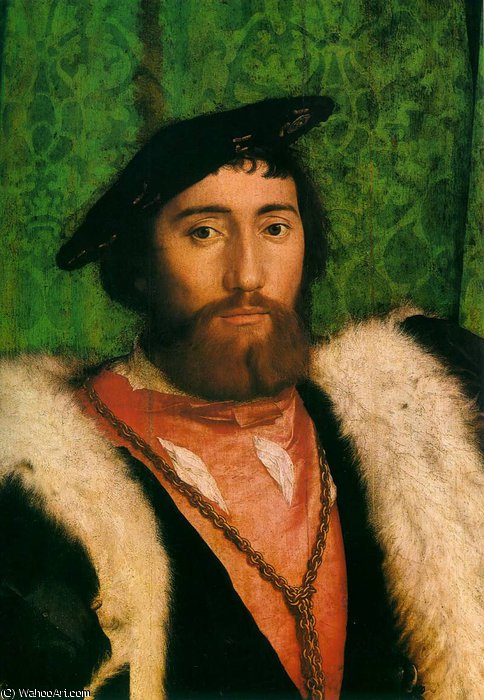
To encounter an untitled portrait by Hans Holbein the Younger is to step into a realm where the boundary between reality and representation dissolves under the weight of meticulous observation. In this enigmatic masterpiece, the artist captures more than just a likeness; he preserves a moment of profound psychological presence. The subject, a man of unmistakable distinction, is presented in a striking crimson tunic, its vibrant hue anchored by crisp white trim that commands the viewer's immediate attention. A subtle yet significant chain encircles his neck, serving as a quiet testament to his social standing and perhaps hinting at the worldly possessions or spiritual commitments that defined his era. Against a serene, verdant backdrop, the figure exudes a sense of composed confidence, his gaze steady and his posture anchored by the masterful composition that Holbein so expertly crafted.
The true magic of this work lies in its technical execution, a hallmark of the Northern Renaissance. Utilizing oil paint on panel, Holbein achieved a level of luminosity and tonal nuance that remains breathtaking even centuries later. Through the delicate application of layers, he mastered the art of chiaroscuro, allowing light to dance across the subject's features and create a dramatic interplay of shadow that lends the portrait its expressive, three-dimensional power. Every anatomical detail—from the subtle musculature of the face to the precise texture of the beard—is rendered with an almost supernatural accuracy. This dedication to realism does not merely document a person; it breathes life into them, inviting the observer to contemplate the humanity behind the paint.
<
Historical Resonance and Timeless Elegance
Born in the artistic hub of Augsburg, Holbein was a product of a lineage of masters, having honed his skills within the workshop of his father, Hans Holbein the Elder. This upbringing instilled in him a reverence for detail that would eventually make him the preeminent portraitist of the 16th-century English court. This particular piece reflects the humanist ideals of his time—a period where the celebration of individual character and the precise observation of the natural world became paramount. The painting serves as a bridge between the late Gothic tradition and the burgeoning intellectualism of the Renaissance, offering a window into a world of stability, grandeur, and refined taste.
For the discerning collector or interior designer, this artwork offers much more than mere decoration; it provides a focal point of historical depth and sophisticated beauty. The bold contrast between the warm reds and the cool greens creates a visual harmony that can anchor a room, whether placed in a contemporary gallery setting or a classic, traditional study. Owning a high-quality reproduction of such a masterpiece allows one to surround themselves with the quiet dignity of the Renaissance, bringing an atmosphere of intellectual curiosity and timeless elegance into any modern space. It is an invitation to pause, to look closer, and to find inspiration in the enduring legacy of one of history's greatest observers.