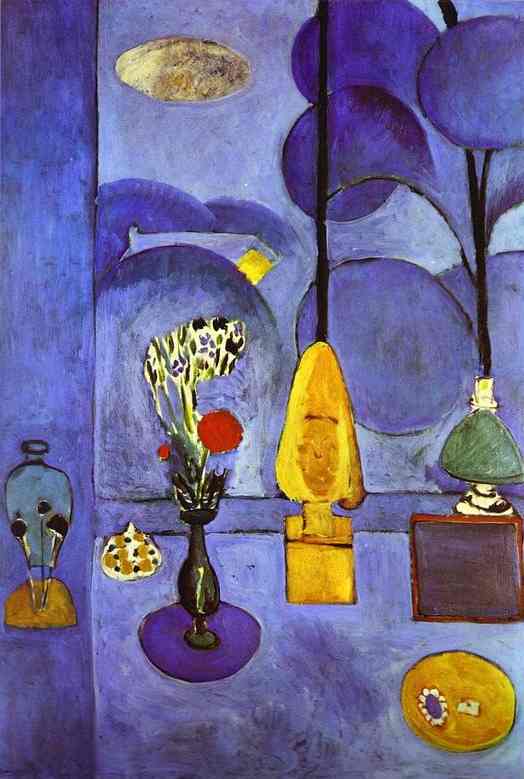
The Blue Window
Henri Matisse’s
The Blue Window stands as a cornerstone of Fauvist art—a bold declaration of color and emotion that continues to captivate audiences today. Created in 1911, this painting transcends mere representation, inviting viewers into a realm where visual sensation reigns supreme. Measuring 130 x 90 cm, it resides within the Museum of the Annunciation in France, offering a rich context for understanding Matisse’s artistic evolution and the broader trajectory of modern art movements.
Composition and Decorative Elements
The centerpiece of
The Blue Window is undeniably its luminous blue expanse—a hue chosen not for realism but for expressive intensity. Surrounding this dominant color are carefully positioned decorative items: a hanging lamp casting a warm glow, several vases brimming with flowers strategically placed on tables and walls, and two bowls nestled near the center of the composition. These elements aren’t merely ornamental; they contribute to the painting's spatial depth and create an inviting atmosphere—a deliberate attempt by Matisse to evoke feelings of comfort and tranquility.
Fauvist Style: A Symphony of Color
Matisse’s masterful use of color exemplifies the defining characteristic of Fauvism, a movement he spearheaded alongside Pablo Picasso. Rejecting Impressionistic subtleties, Fauves embraced pure pigment—unmixed hues applied directly onto the canvas—to convey emotion and sensation rather than objective observation. The vibrant blues, yellows, and reds dominate
The Blue Window, resulting in a visual experience that pulsates with energy and vitality. This stylistic choice was initially met with controversy—critics deemed it jarring and unnatural—yet Matisse’s unwavering conviction in color as a vehicle for artistic expression cemented his legacy as one of the most influential artists of the early 20th century.
Historical Context: Challenging Artistic Conventions
The Museum of the Annunciation played a pivotal role in showcasing Fauvist art and fostering dialogue about its significance. Matisse’s work challenged prevailing artistic conventions—particularly those championed by Impressionism—and paved the way for subsequent movements like Expressionism. By prioritizing emotional impact over meticulous detail, Matisse signaled a fundamental shift in artistic priorities, reflecting the anxieties and aspirations of a rapidly changing society.
Notable Works Alongside The Blue Window
Exploring Matisse’s broader oeuvre reveals an artist deeply committed to experimentation and innovation. Consider
The Pink Studio (181 x 221 cm), another Fauvist masterpiece characterized by its bold color palette and simplified forms—a testament to Matisse’s ability to distill complex emotions into striking visual compositions. Similarly,
La Chaise aux pêches Huile sur Toile Collection Particulière (130 x 89 cm) exemplifies Matisse’s exploration of decorative patterns and his masterful handling of color—a captivating reflection of the artist's artistic vision. And finally,
Zorah sur la terrasse Moscou, Musée Pouchkine (116 x 100 cm) demonstrates Matisse’s ability to capture the essence of a landscape scene with remarkable clarity and emotional resonance.
The Pink Studio and
La Chaise aux pêches Huile sur Toile Collection Particulière offer further insights into Matisse’s artistic explorations and solidify his position as a visionary artist whose influence continues to inspire generations of creatives. For a deeper understanding of Fauvist art and its historical context, consult
Henri Matisse on Wikipedia.