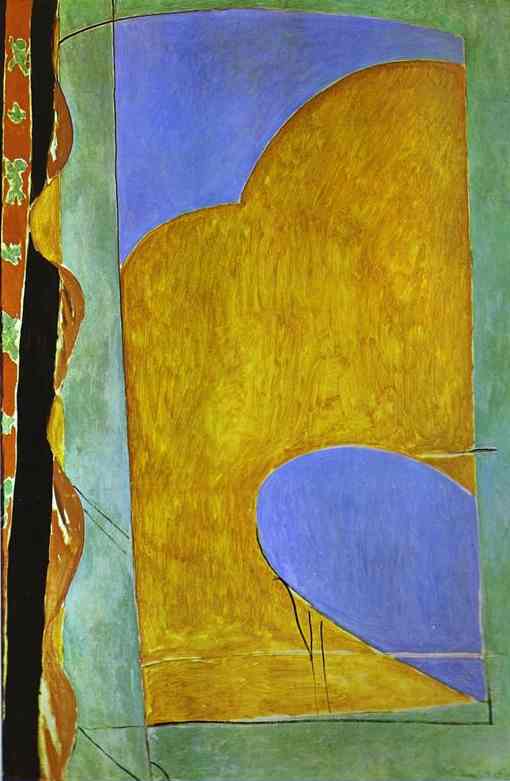
Henri Matisse’s ‘The Yellow Curtain,’ created in 1915, embodies the Fauvist movement with its striking use of yellow and blue hues. This monumental canvas showcases Matisse's innovative approach to color and form, reflecting his profound influence on 20th-century art. Located at MoMA, it remains a testament to artistic brilliance and continues to inspire viewers worldwide.
A Burst of Color Against Tranquility: Exploring Henri Matisse’s ‘The Yellow Curtain’
Henri Matisse’s “The Yellow Curtain,” painted in 1915, stands as a cornerstone of Fauvist art—a movement that irrevocably altered the course of modern painting. More than just an aesthetically pleasing image, it's a deliberate provocation, a manifesto of artistic rebellion against academic conventions and a profound meditation on emotion conveyed through pigment.
The canvas itself is deceptively simple: a curtain rendered in bold swathes of yellow, punctuated by strategic accents of blue. Yet within this apparent minimalism lies an astonishing dynamism. Matisse eschewed meticulous realism, prioritizing instead the expressive potential of color—a principle championed by Pablo Picasso and fundamentally reshaping artistic discourse.
The Fauvist Revolution: Breaking Free From Tradition
Born in Le Cateau-Cambrésis in 1869, Henri Émile Benoît Matisse’s early life wasn't marked by artistic ambition. Initially pursuing law, his trajectory shifted dramatically after a serious illness prompted him to rediscover painting—a passion nurtured during convalescence and blossoming into an enduring vocation.
The Fauvist movement arose in response to the prevailing stylistic restraints of Impressionism and Post-Impressionism. Artists like Matisse and Picasso rejected blending colors subtly, opting for jarring juxtapositions that aimed to capture raw emotion rather than objective observation. They believed color could communicate feelings directly—a revolutionary concept at the time.
Decoding Color: Symbolism and Emotional Resonance
Matisse’s masterful manipulation of yellow is particularly noteworthy. Traditionally associated with warmth, optimism, and enlightenment, here it dominates the composition, radiating outwards from a central circle. The blue hues provide counterpoint—representing serenity, depth, and perhaps even melancholy—creating a tension that compels the viewer's gaze.
The simplified forms of the curtain contribute to this emotional impact. Matisse reduced shapes to their essential elements, prioritizing color over detailed representation. This stylistic choice underscores his belief in conveying feeling through abstraction, mirroring the movement’s core ethos.
A Legacy Enduring Inspiration
"The Yellow Curtain" resides at MoMA (Museum of Modern Art), New York, where it continues to captivate audiences and inspire artists alike. Its enduring appeal stems from its ability to distill complex emotions into a visually arresting composition—a testament to Matisse’s genius and the transformative power of Fauvist art.
For those seeking to experience the vibrancy and emotional depth of this iconic masterpiece, ArtsDot.com offers exceptional reproductions crafted with meticulous attention to detail. Explore the artwork here: https://ArtsDot.com