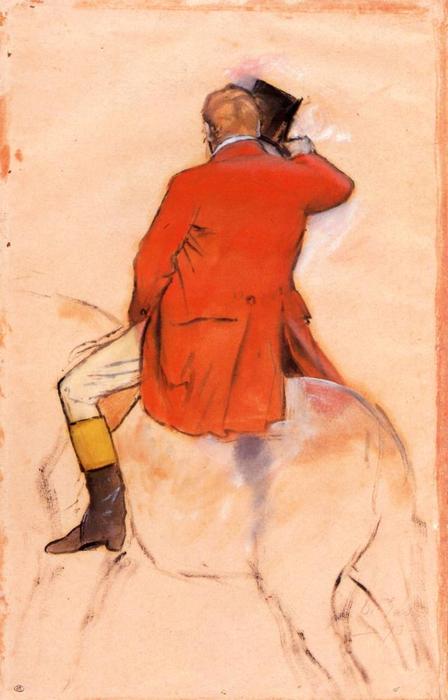
Experience Edgar Degas’s iconic ‘Rider in a Red Coat,’ a captivating Impressionist painting from 1868 showcasing a man on horseback with remarkable detail and movement, perfect for art lovers seeking a timeless masterpiece.
A Moment Frozen in Motion: Edgar Degas’s *Rider in a Red Coat*
Edgar Degas's Rider in a Red Coat, completed in 1868, is more than just a depiction of a man on horseback; it’s a meticulously observed study of movement, light, and the subtle drama inherent in everyday life. This captivating wash-on-paper painting, measuring 43 x 27 cm, exemplifies Degas's unique approach to art – one that blended realism with an Impressionistic sensibility, resulting in a work brimming with quiet intensity and a remarkable sense of immediacy. The scene unfolds with a deliberate simplicity: a gentleman, clad in a striking scarlet coat, commands his horse as he surveys the landscape below. The red coat itself is a powerful visual element, drawing the eye immediately and suggesting both status and perhaps a touch of defiance against the natural order.
Impressionistic Realism: A Synthesis of Styles
- Style & Technique: Degas’s mastery lies in his ability to capture fleeting moments with remarkable precision. The ‘wash-on-paper’ technique, favored by the artist, allows for a delicate layering of color and tone, creating an ethereal quality that is characteristic of Impressionism. The loose brushstrokes and subtle gradations of light contribute to the painting's atmospheric effect, suggesting movement rather than static representation.
- Influences: While often associated with the Impressionists like Monet and Renoir, Degas remained a staunch realist at heart. He was deeply influenced by classical sculpture, particularly the works of Canova, which informed his understanding of anatomy and composition. This influence is evident in the horse’s powerful musculature and the rider's confident posture.
- Historical Context: Created during a period of significant social and artistic change in France, Rider in a Red Coat reflects the growing interest in depicting modern life – particularly the lives of the bourgeoisie – with unprecedented honesty. The painting speaks to the burgeoning urban landscape and the changing role of the individual within it.
Symbolism and Narrative Depth
Beyond its technical brilliance, the painting possesses a subtle narrative depth. The rider’s downward gaze suggests contemplation or perhaps a moment of decision-making. The two figures in the background – one standing attentively, the other observing from a distance – add layers to the scene, hinting at an unspoken story and inviting the viewer to participate in its interpretation. The horse itself, a symbol of power and freedom, further enhances the painting’s symbolic resonance. It's not merely a portrait of a rider; it’s a meditation on human interaction with nature and the complexities of social dynamics.
A Legacy of Observation
Rider in a Red Coat stands as a testament to Edgar Degas’s extraordinary eye for detail and his unwavering commitment to portraying the world around him with honesty and sensitivity. This piece, alongside other works like *Interior (The Rape)* and portraits of Joseph-Henri Altès, reveals Degas's profound understanding of movement, light, and human psychology. Its enduring appeal lies in its ability to capture a fleeting moment – a moment frozen in time – that continues to resonate with viewers today. A hand-painted reproduction offers the opportunity to bring this remarkable work into your home or office, allowing you to appreciate Degas’s genius firsthand.