Едгар Дегас: Револуционарни француски сликар познат по својим запањујућим балетним дијалозима и париским сценама, као иновативним техникама — исти мајстор модерне уметности.
Откријте британску и интернационалну уметност на Тхе Тате Бритен! Истражите векове шемастера, од Тернера до модерних икона – посета је бесплатна у Лондону у рецијевској галерији.
Тхе Тате Бритен, Лондонска уметност, британска уметност, Тернер, Пре-Рафаелити, Милбанк, Архитектура, Модерна уметност, Скулптура, Картине, Штампе, Галерија, Музеј, Уметничка колекција, Стирлинг
Тхе Тате Бритен
Велика
A Moment Suspended in Time
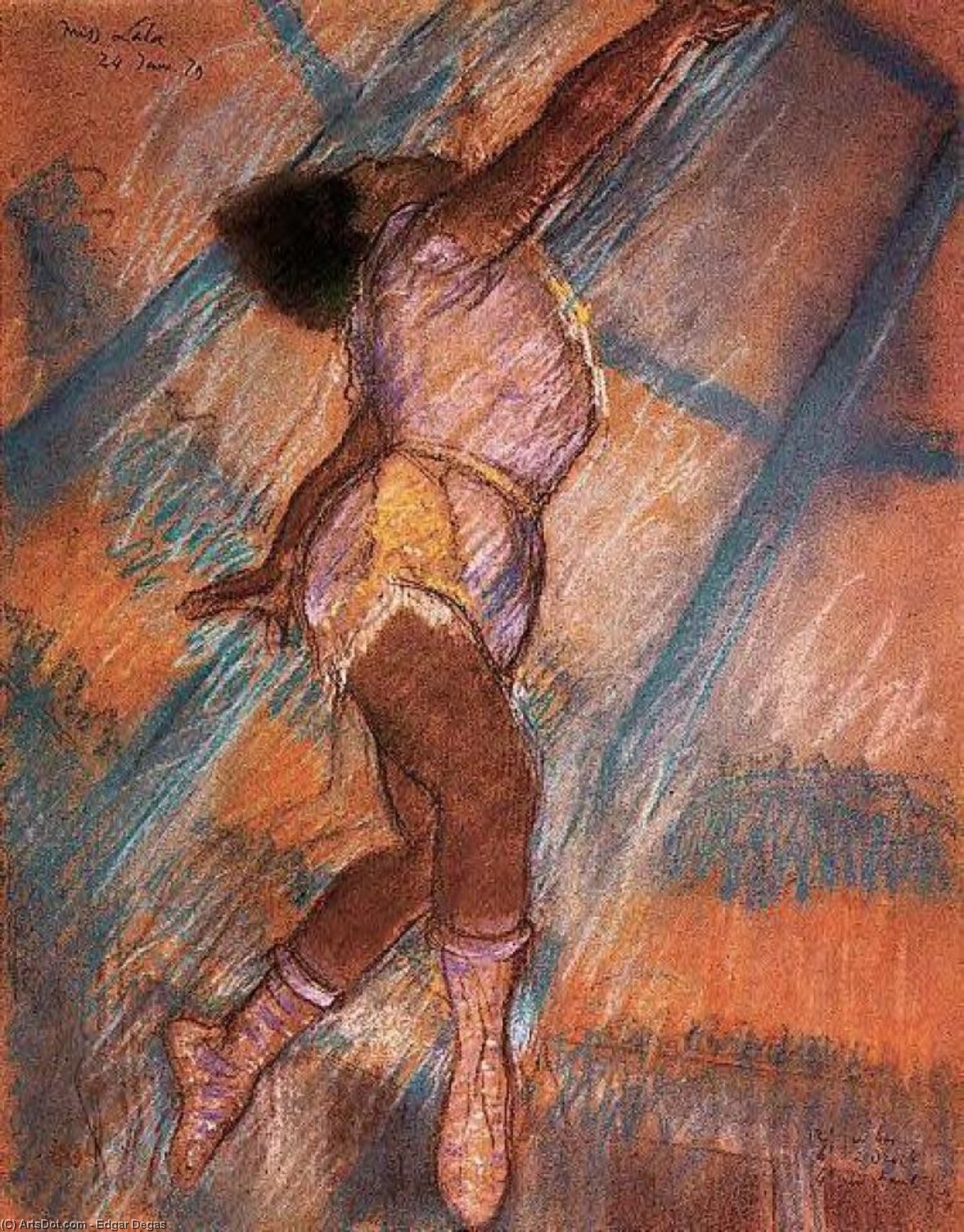
In the flickering light of the late nineteenth-century Parisian circus, Edgar Degas found more than mere entertainment; he discovered a profound laboratory for studying the mechanics of human grace. His pastel study, Study for 'La La at the Cirque Fernando', serves as an intimate window into this ephemeral world. The artwork captures the legendary aerialist Miss La La at the very apex of her daring feat, suspended by nothing more than a leather mouthpiece clenched between her teeth. There is a breathtaking tension held within the frame—a precarious balance between the terrifying gravity of the circus ring and the ethereal beauty of a body in flight. Degas does not merely observe the spectacle; he dissects the physics of movement, inviting the viewer to share in the collective breathlessness of the audience gathered below.
The composition is a masterclass in dynamic energy, pulling the eye upward toward the dizzying heights of the Cirque Fernando’s dome. While the background glows with warm, amber hues that evoke the dusty, sun-drenched atmosphere of the arena, the focus remains intensely personal. The subject, draped in white, becomes a luminous focal point against the darker, more crowded periphery of spectators. This arrangement creates a sense of depth and immersion, making the viewer feel less like a distant observer and more like a participant sitting among the ringside crowd, peering up into the rafters where magic and danger collide.
The Alchemy of Pastel and Light
To capture such a fleeting moment, Degas turned to the medium of pastel, a choice that was nothing short of revolutionary for the subject matter. Unlike the heavy, slow-drying layers of oil paint, pastel allowed the artist to work with an immediacy that mirrored the rapid pulse of a live performance. The soft, velvety texture of the pigment creates a dreamlike haze, softening the edges of the crowd and allowing the light to seem as though it is vibrating off the paper. This technique lends the piece its unique luminosity, where the white of Miss La La’s costume seems to catch the stray glimmers of gaslight, creating a sense of motion that feels continuous rather than frozen.
For the discerning collector or interior designer, this work offers a sophisticated interplay of texture and tone. The delicate application of color—ranging from deep, earthy shadows to brilliant, light-filled highlights—provides a versatile aesthetic that can anchor a room with both drama and elegance. It is an artwork that demands attention through its subtle complexity rather than through loud or garish colors. The piece embodies the Belle Époque spirit: a period of intense creativity, social transformation, and a fascination with the spectacular.
An Enduring Legacy of Movement
Beyond its technical brilliance, this study stands as a testament to Degas’s identity as a realist who sought the truth in motion. While his contemporaries often chased the fleeting effects of sunlight in landscapes, Degas found his light within the human form and the structured chaos of modern Parisian life. This work is not just a portrait of an acrobat; it is a study of courage, of the fragile boundary between mastery and catastrophe, and of the way art can immortalize a second that was never meant to last.
Owning a high-quality reproduction of this masterpiece allows one to bring a piece of art history’s most captivating era into a contemporary space. Whether placed in a gallery-style setting or as a conversation piece in a refined living area, the Study for 'La La at the Cirque Fernando' radiates an energy that is both nostalgic and eternally modern. It remains a profound inspiration for anyone moved by the intersection of human strength and artistic delicacy.