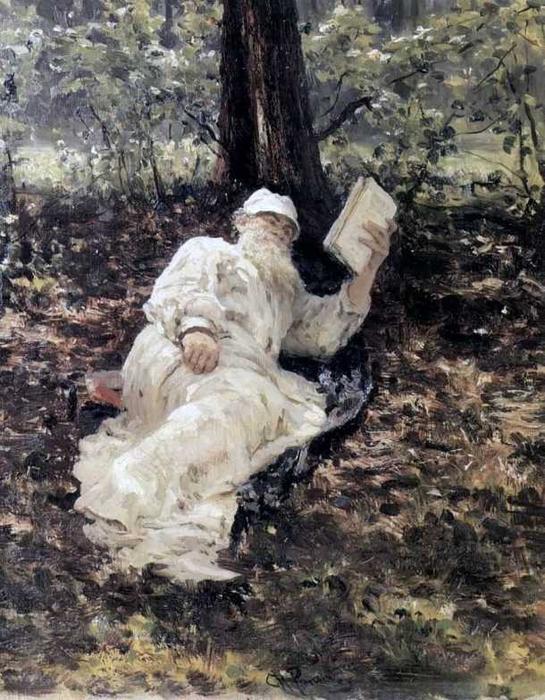
Leo Tolstoy in the forest

Experience tranquility with Repin's 'Leo Tolstoy in the Forest.' This realistic portrait captures the author’s contemplative spirit amidst nature's embrace, showcasing masterful brushwork and a serene atmosphere.


Иља Репин (1844 - 1930)

Ilja Repin (1844-1930), vodeći ruski realista! Otkrijte njegova dela kao 'Brodski vučači na Volgi', koja oslikavaju ruski život, istoriju i društveni komentar sa snažnom emocijom. Ikona ruskog realizma!

Leo Tolstoy in the Forest: A Portrait of Contemplation

  • Subject & Historical Context: Ilya Repin's "Leo Tolstoy in the Forest," painted in 1891, offers a poignant glimpse into the life of one of Russia’s most celebrated literary figures. Tolstoy, nearing the end of his life and grappling with profound philosophical questions, is depicted not in a formal setting but immersed in nature – a deliberate choice reflecting his evolving spiritual beliefs and rejection of societal conventions. The painting captures a moment of quiet introspection during a period marked by Tolstoy's increasing criticism of the Russian Orthodox Church and the Tsarist regime, ultimately leading to his self-imposed exile.
  • Style & Technique: Repin, a master of realism with burgeoning Impressionistic tendencies, employs a loose and visible brushstroke technique that moves away from the rigid academic style prevalent earlier in his career. This approach lends a sense of immediacy and naturalism to the scene. The application of paint is textured; evidence of impasto on Tolstoy’s clothing suggests a deliberate effort to capture the fabric's movement and weight. While the composition adheres to realistic proportions, the softened edges and atmospheric perspective hint at an Impressionistic influence, prioritizing the overall mood and light effects over meticulous detail.
  • Composition & Symbolism: The painting utilizes a pyramidal structure, with Tolstoy as the apex, drawing the viewer's eye directly to the subject. He is positioned slightly off-center, creating visual dynamism. A large tree trunk anchors the left side of the composition, symbolizing strength and permanence, while the surrounding foliage evokes the restorative power of nature. Tolstoy’s relaxed posture, absorbed in reading, conveys a sense of inner peace and intellectual pursuit. The book he holds represents his lifelong dedication to writing and philosophical exploration. The forest itself serves as a powerful symbol – a retreat from the complexities of life and a connection to something larger than oneself.
  • Color Palette & Lighting: The color palette is dominated by muted earth tones—greens, browns, and creams—creating a harmonious and tranquil atmosphere. Highlights of white and cream in Tolstoy’s clothing draw attention to his face and hands, emphasizing the details that reveal his character. The diffused, natural lighting suggests an overcast day or filtered sunlight, contributing to the overall sense of calm and contemplation. The subtle interplay of light and shadow adds depth and dimension to the scene, further enhancing its realism.
  • Emotional Impact & Legacy: "Leo Tolstoy in the Forest" is more than just a portrait; it's an exploration of the human condition—a moment captured in time that invites viewers to reflect on themes of solitude, intellectual curiosity, and the search for meaning. Repin’s ability to convey Tolstoy’s inner world through his posture and expression makes this painting a powerful testament to the artist’s skill and sensitivity. The work remains a significant example of late 19th-century Russian realism and continues to resonate with audiences today.

About Ilya Yefimovich Repin

  • Early Life & Education: Ilya Yefimovich Repin, born on July 24, 1844, in Chuguev (present-day Ukraine), was a pivotal figure in Russian realist painting. His early artistic training began with icon restoration and portrait commissions under Ivan Bunakov. He later attended the St. Petersburg Academy of Fine Arts where he met influential figures like Ivan Kramskoi.
  • Artistic Career: Repin’s career flourished as he moved away from strict academic realism, embracing a more expressive style. Notable works include "Barge Haulers on the Volga" (1873), which brought him widespread recognition, and “Reply of the Zaporozhian Cossacks” (1880-1891). He was renowned for his insightful portraits of prominent Russian intellectuals and artists, including Tolstoy, Mussorgsky, and Glinka.
  • Later Years & Legacy: Repin established a country estate, Penaty Memorial Estate, which became a hub for Russian artistic society. He remained active until his death on September 29, 1930, leaving behind a legacy as one of Russia’s most important and influential artists.