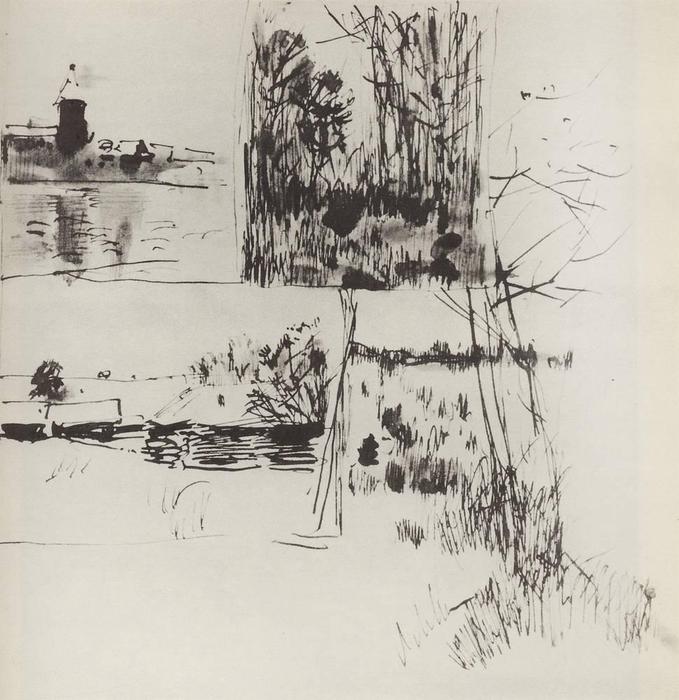
Строenje у води. На крајињу деревушке. Искрено преноси осећај руског пейзажа уз помоћ изразитих линија и атмосферске перспективе. Левитанов шедевар руске романтике!
Исаак Левитан био је руски лирички крајописци који је пробио жанр „душевне панорами“, преводећи осећања природе у слике и стварајући незаборавни свет Русије кроз своје великања као што су „Осенчење светиљке“ и „Вечити мир.“
Building by The Water. At The Edge Of Village – A Symphony Of Russian Landscape
Isaac Levitan’s “Building by The Water. At The Edge Of Village,” created circa 1895, transcends mere visual representation; it embodies the very essence of Russian landscape painting—specifically what critics termed "mood landscapes." More than just a depiction of scenery, this monochrome sketch is an embodiment of Levitan's profound connection to the Russian soul, distilled into a deceptively simple composition that continues to captivate audiences today. Examining this piece reveals layers of artistic intention and symbolic resonance that elevate it beyond the ordinary, establishing itself as one of Russia’s foremost Romantic painters.
A Fragmented Vision: Composition & Technique
Levitan eschewed meticulous realism in favor of expressive technique—a hallmark of Impressionism and Post-Impressionism—influences evident in artists like Van Gogh and Monet. The composition is deliberately fractured, presenting multiple viewpoints within a single image. Thick, gestural lines dominate the sketch, conveying rapid execution and prioritizing feeling over precise detail. These bold strokes capture movement and atmosphere with remarkable immediacy – imagine the wind rustling through reeds as you gaze upon this scene. Hatching and cross-hatching are skillfully employed to build form and texture, particularly in representing foliage and shadows—techniques that imbue the landscape with palpable depth and volume. The artist’s deliberate disregard for conventional perspective contributes to a sense of spatial ambiguity, inviting viewers to contemplate the landscape's mood rather than its literal representation; it’s as if you’re stepping into a dreamscape.
The Landscape as Reflection: Symbolism & Atmosphere
The subject matter centers on a tranquil marsh or wetland area—a recurring motif in Levitan’s oeuvre—suggestive of both solitude and contemplation. The muted palette – predominantly shades of grey – reinforces this melancholic atmosphere, mirroring the artist's own emotional state and reflecting the broader cultural anxieties of the period. Consider the subtle interplay of light and shadow; it speaks to a yearning for peace amidst the uncertainties of life. The distant buildings glimpsed amidst the reeds hint at human presence juxtaposed against the vastness of nature, prompting reflection on humanity’s relationship with its environment – a theme central to Romantic art's exploration of emotion and imagination.
Historical Context & Artistic Legacy
Levitan’s work emerged during a period of significant social and intellectual upheaval in Russia – the twilight years of Tsarist rule marked by growing disillusionment with industrialization and urbanization. Artists like Levitan sought refuge in the natural world, finding solace and inspiration in its unchanging beauty amidst societal change. His artistic legacy extends far beyond mere visual representation; he elevated landscape painting to a form of psychological exploration, establishing himself as one of Russia’s most celebrated Romantic painters. “Building by The Water” remains a testament to his ability to convey profound emotion through understated artistry—a timeless masterpiece that continues to resonate with viewers seeking beauty and contemplation.
### Materials & Reproduction Considerations
The artwork is executed primarily in paper and black ink/charcoal, reflecting the artist’s commitment to economical materials while maximizing expressive potential. High-quality reproductions aim to faithfully capture the tonal nuances and textural subtleties of the original sketch, allowing collectors and interior designers alike to appreciate Levitan's artistic vision. Framing options that complement the artwork’s subdued palette – perhaps a simple wooden frame in dark brown – would enhance its contemplative mood and underscore its enduring beauty.