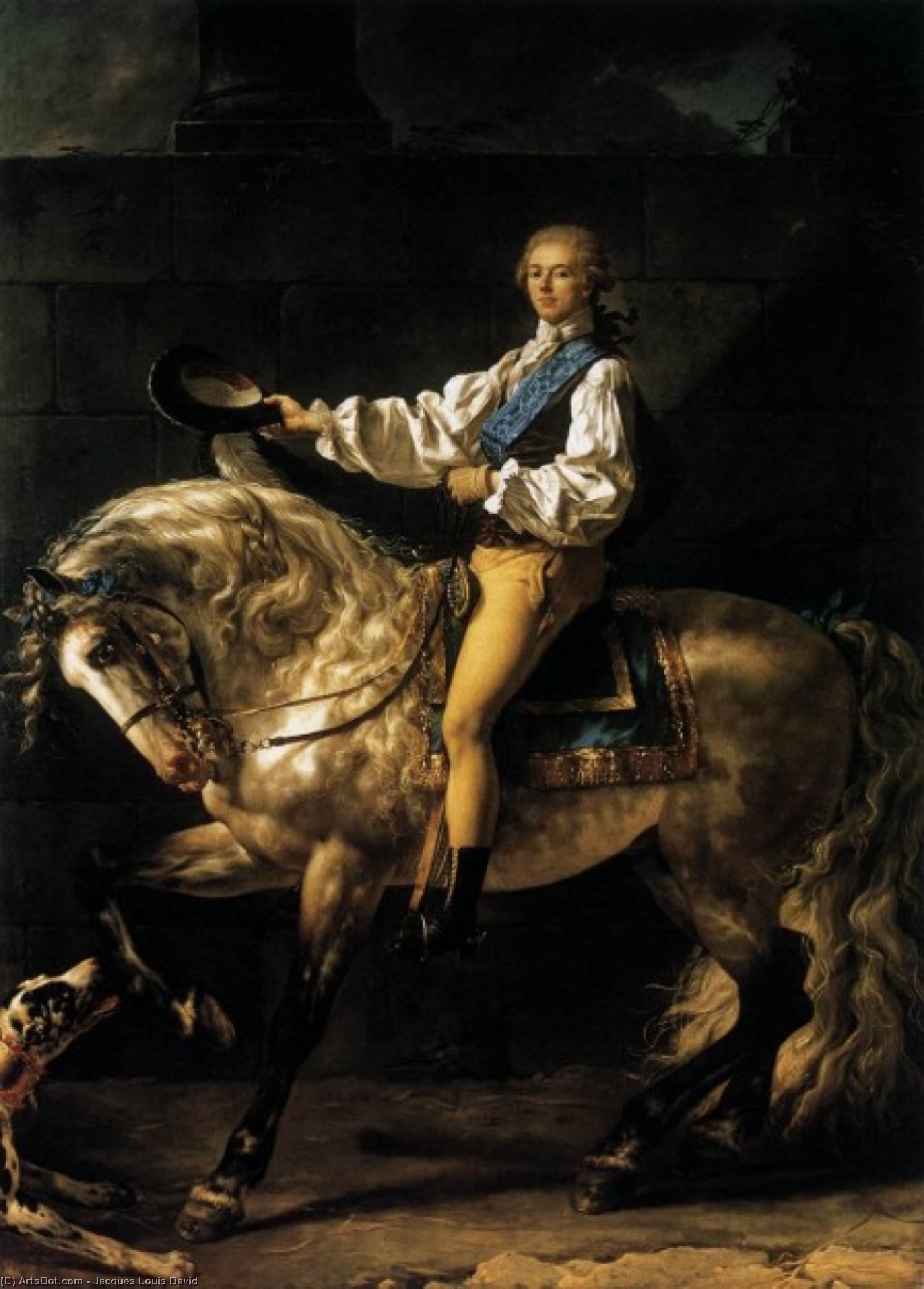
A Vision of Neoclassical Grandeur
In the vast annals of art history, few works capture the transition from aristocratic elegance to the stern moral clarity of the Enlightenment as poignantly as Jacques-Louis David’s Equestrian Portrait of Stanislas Kostka Potocki. Executed in 1781, this monumental canvas serves as a breathtaking bridge between eras. As the frivolous, swirling ornamentation of the Rococo period began to fade, David emerged as the architect of a new visual language—one rooted in the disciplined strength of ancient Greece and the stoic dignity of Rome. This portrait is not merely a depiction of a nobleman; it is a carefully constructed manifesto of virtue, stability, and idealized nobility that continues to captivate the modern eye.
The composition centers on the commanding presence of Potocki, mounted atop a powerful steed that radiates controlled energy. Dressed in striking white attire accented with deep blue trim, the subject exudes an air of effortless command. David’s mastery of chiaroscuro—the dramatic interplay between light and shadow—sculpts the rider and horse with a sculptural precision that feels almost three-dimensional. Every muscle of the horse is rendered with anatomical accuracy, while the play of light across Potocki’s clothing lends a luminous quality to the figure, pulling the viewer into the heart of this heroic scene.
Symbolism and the Language of Virtue
Beyond its surface beauty, the painting is rich with symbolic layers intended to communicate the character of the sitter and the values of his era. The equestrian motif itself has long been a symbol of authority, leadership, and the triumph of human reason over raw, animalistic instinct. By positioning Potocki in this classical pose, David elevates the subject from a mere man of wealth to a figure of timeless importance. The inclusion of the two dogs at the periphery adds a layer of domestic loyalty and fidelity, grounding the grandiosity of the central figure with a sense of grounded, earthly devotion.
Even the subtle details, such as the clock visible in the background, whisper of the fleeting nature of time and the importance of leaving a lasting legacy through virtuous action. For the discerning collector or interior designer, this painting offers more than just aesthetic appeal; it provides a focal point of intellectual depth. The crisp lines and assertive forms create a sense of permanence and order, making it an ideal centerpiece for spaces that demand an atmosphere of sophistication, strength, and historical resonance.
A Timeless Masterpiece for the Modern Collector
To possess a reproduction of this magnitude is to invite the spirit of the French Neoclassical movement into one's personal sanctuary. The scale of the original—a staggering 304 x 218 cm—is echoed in the emotional weight of its subject matter. Whether placed in a grand library, a formal dining hall, or a contemporary gallery space, the painting acts as an anchor of classical tradition. It speaks to a period of profound transformation, reminding us of the enduring power of clarity, reason, and the pursuit of excellence.
For those seeking to curate an environment of prestige, David’s work offers an unparalleled opportunity to engage with history. The painting does not merely decorate a wall; it commands the room, offering a window into a world where art was used to define the very essence of human dignity. It remains a profound testament to the ability of a single brushstroke to capture the soul of an age.