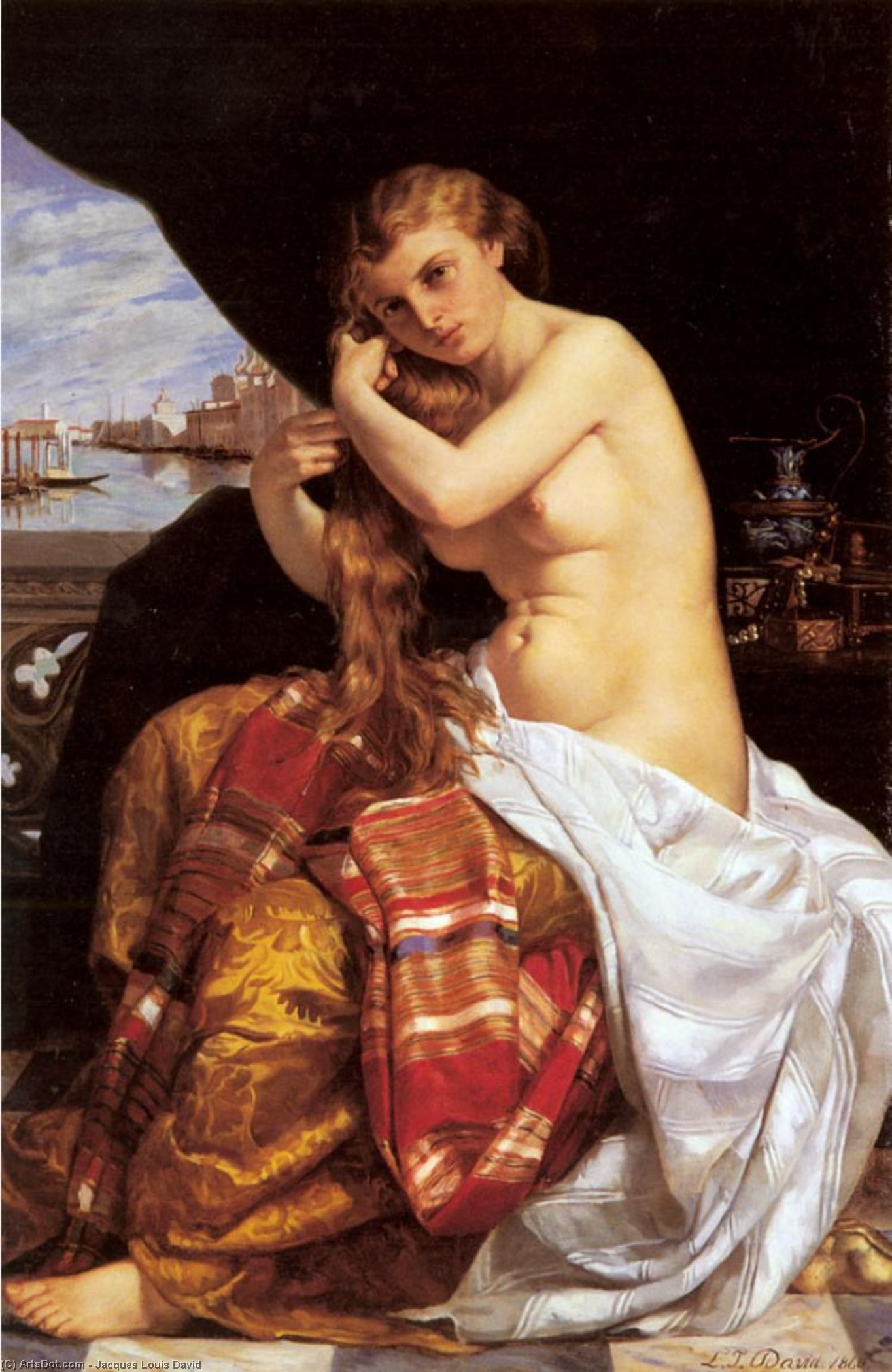
A Window into Venetian Opulence: Jacques-Louis David’s *Venitienne A Sa Toilette*
Jacques-Louis David's Venitienne A Sa Toilette (1783) is more than a simple portrait; it’s a meticulously constructed tableau of aristocratic leisure, steeped in the anxieties and aspirations of late 18th-century France. Painted during a period of profound social and political transformation – the Rococo era yielding to the stark ideals of Neoclassicism – David captures a moment of intimate vanity within a carefully orchestrated setting. The subject, likely a Venetian noblewoman, is presented in the act of grooming, her long hair cascading around her, an emblem of both beauty and the burdens of social status. This seemingly private scene speaks volumes about the values of the time: the importance of appearance, the meticulous attention to detail, and the controlled display of wealth.
Neoclassical Composition and Technical Mastery
- Compositional Rigor: David’s mastery is immediately evident in the painting's rigorously structured composition. The woman occupies a central position, drawing the viewer’s eye with her direct gaze, while the surrounding elements – the furniture, the vases, and the boats – are arranged to create a sense of depth and spatial harmony. This deliberate arrangement reflects the Neoclassical emphasis on order, reason, and clarity, rejecting the perceived excesses of Rococo art.
- Technique: David employed his signature technique of *sfumato*—a subtle blurring of edges—to soften forms and create a sense of atmospheric perspective. The use of light and shadow is particularly effective in highlighting the woman’s features and emphasizing the luxurious textures of her clothing and the surrounding objects. His brushwork, though precise, avoids excessive detail, contributing to the painting's overall elegance and restraint.
Symbolism and Context: A Reflection of Society
The inclusion of specific details within the scene is laden with symbolic meaning. The two boats visible through the window offer a glimpse into the Venetian landscape, hinting at wealth, travel, and perhaps even illicit affairs – themes frequently explored in aristocratic portraiture. The vases, meticulously placed around the room, represent abundance and prosperity, while the clock serves as a reminder of the relentless passage of time, a common motif in Neoclassical art. The painting was created during a period of increasing social unrest in France, with the seeds of revolution already being sown. David’s depiction of aristocratic leisure can be interpreted as both a celebration of the established order and a subtle critique of its extravagance.
Emotional Impact and Artistic Legacy
Despite its formal qualities, *Venitienne A Sa Toilette* possesses a remarkable emotional resonance. The woman’s expression – a mixture of serenity and self-awareness – invites the viewer to contemplate her inner life. David's ability to capture such nuanced emotion within a portrait is a testament to his artistic skill and his understanding of human psychology. This work exemplifies David’s pivotal role in shaping the course of 18th-century art, bridging the gap between Rococo frivolity and the austere ideals of Neoclassicism. A hand-painted reproduction offers an unparalleled opportunity to experience the beauty and intellectual depth of this iconic masterpiece.