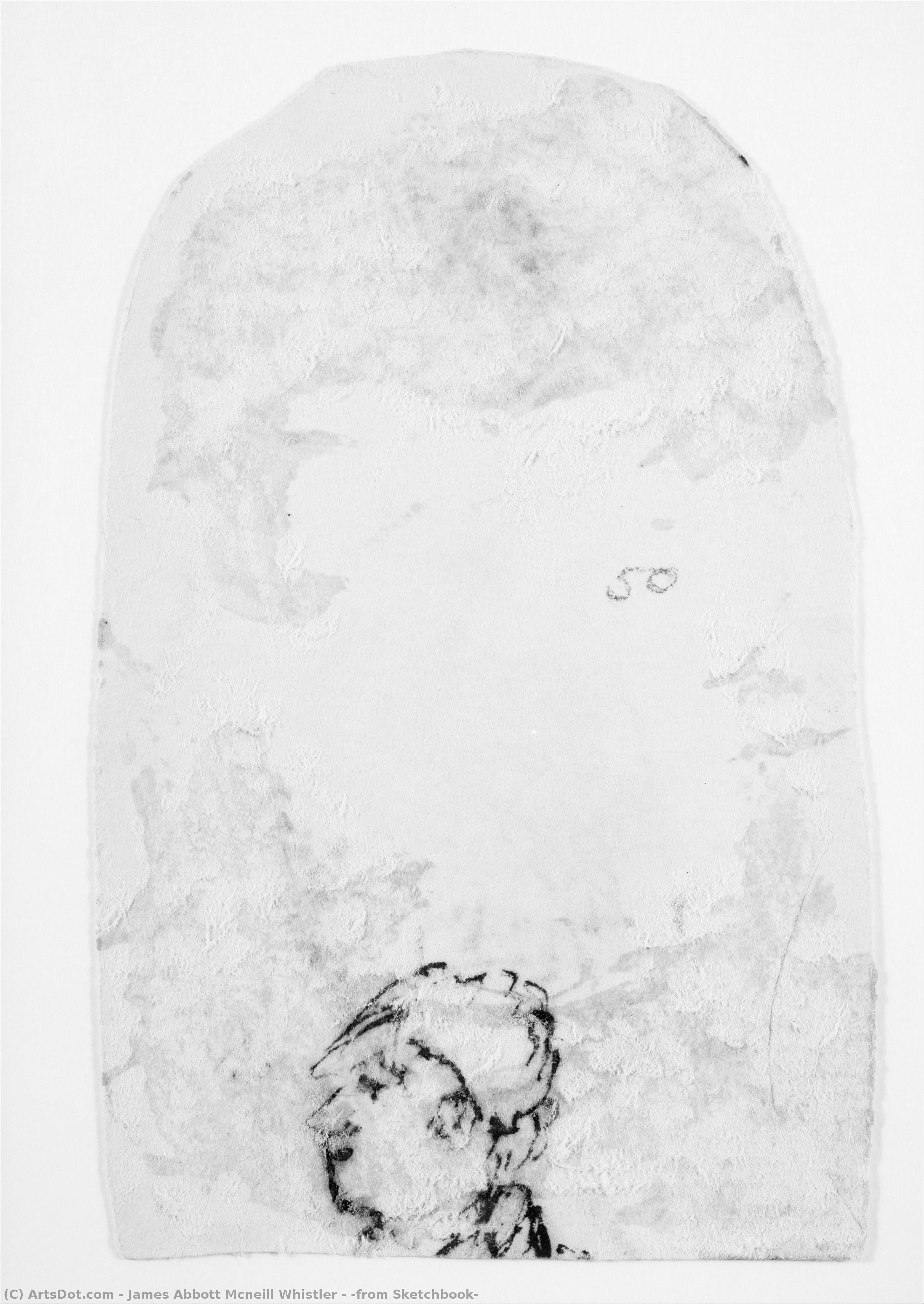
James Abbott McNeill Whistler - Artist's Studio (from Sketchbook)
“Artist’s Studio (from Sketchbook)” by James Abbott McNeill Whistler stands as a testament to the burgeoning Aesthetic movement of mid-Victorian England—a deliberate rejection of didactic art in favor of pure visual experience. Executed in 1854–55, this deceptively simple pencil sketch captures a moment of quiet contemplation within Whistler’s workspace, offering viewers an intimate glimpse into the creative process itself.
- Subject Matter: The artwork centers on a portrait head of a man—a figure rendered with remarkable precision despite its understated execution. Whistler eschews grand narratives or allegorical representations, prioritizing instead the direct observation of human form and expression.
- Style & Technique: Whistler’s approach aligns squarely with tonalism, a stylistic trend championed by artists like Frederic Church and George Inness. The drawing employs subtle gradations of tone—primarily achieved through hatching and cross-hatching—to convey depth and texture without resorting to harsh contrasts. This technique prioritizes atmospheric illusion over meticulous detail, reflecting Whistler’s belief that “art for art’s sake” transcends moral instruction.
- Composition: The composition is remarkably balanced, with the male head positioned centrally against a loosely rendered background resembling billowing clouds or vapor. Whistler deliberately minimizes perspective, suggesting depth through overlapping forms and tonal variations—a conscious decision to liberate the eye from conventional spatial constraints.
Historical Context
Whistler’s artistic philosophy emerged during a period of significant intellectual debate concerning the role of art in society. The Aesthetic movement challenged prevailing Victorian sensibilities, arguing that beauty should be pursued for its own sake—independent of moral or didactic considerations. Whistler's rejection of narrative and his focus on sensory experience mirrored this broader cultural shift, positioning him as a pioneer of modern artistic thought.
Symbolism & Emotional Impact
Despite its apparent simplicity, “Artist’s Studio” resonates with profound symbolic implications. The solitary figure embodies introspection and contemplation—a reflection of Whistler's own philosophical stance. The amorphous background evokes notions of ethereal beauty and the sublime, mirroring Whistler’s fascination with capturing fleeting moments of atmospheric sensation. Ultimately, the drawing invites viewers to engage in a meditative experience, prompting consideration of art’s capacity to inspire wonder and evoke emotion.
Material & Craftsmanship
- Medium: Graphite pencils on paper
- Condition: The drawing exhibits a slight aged appearance, hinting at its handling and storage over time—a characteristic that lends it an aura of authenticity and adds to its visual appeal.