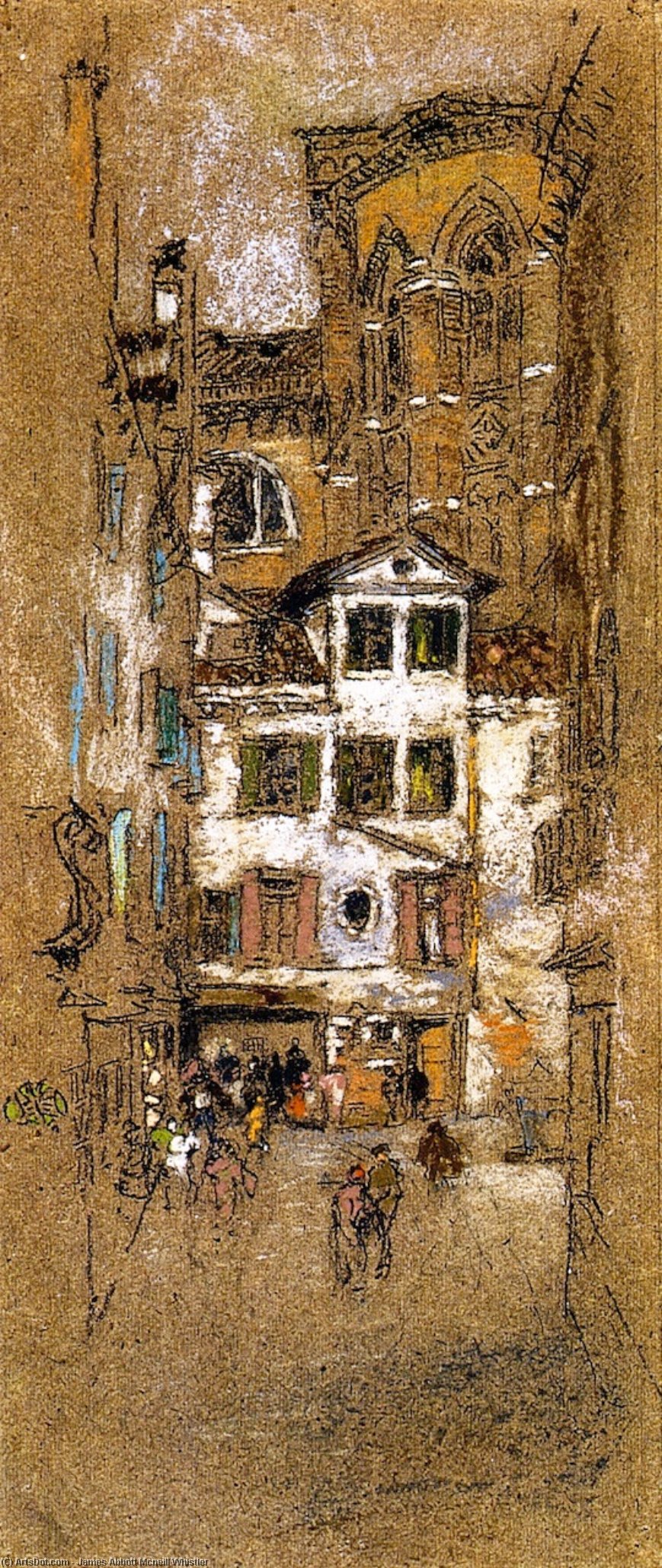
Whistler’s evocative chalk drawing captures the vibrant energy of Venetian city life in 1879, showcasing a bustling street scene filled with pedestrians and horse carriages—a testament to his aestheticist vision and enduring artistic legacy. Explore this captivating masterpiece at ArtsDot.
A Snapshot of Venetian Life: Whistler’s “Under the Frari”
James Abbott McNeill Whistler's "Under the Frari," completed in 1879, isn’t merely a depiction of a Venetian street; it’s a carefully considered meditation on perception and atmosphere—a cornerstone of Whistler’s aesthetic philosophy. Born in Lowell, Massachusetts, Whistler’s upbringing instilled in him an appreciation for observation and experimentation that would profoundly shape his artistic vision. His father's railroad career necessitated frequent moves, exposing young James to varied landscapes and fostering a restless spirit perfectly suited to the pursuit of creative endeavors. Despite initial disappointment at West Point—where he felt stifled by military discipline—Whistler persevered, securing employment with the U.S. Coast and Geodetic Survey, which provided valuable experience in capturing natural light and form.
- Subject Matter: The drawing captures a vibrant street scene beneath the Frari basilica, a prominent landmark in Venice. Whistler meticulously rendered the buildings lining the street, focusing on their architectural details rather than striving for photographic accuracy.
- Style: Whistler’s style embodies Aestheticism—a movement that championed artistic autonomy and prioritized formal beauty over narrative content. He rejected Victorian moral didacticism, arguing passionately for “art for art’s sake,” believing that painting should exist solely to stimulate the senses and evoke emotion.
Technique: Chromatic Harmonies and Subtle Detail
Whistler employed a chalk drawing technique—a medium favored by Impressionists but embraced by Whistler with his own distinctive approach. Unlike oil paints, chalk allows for gradual layering of tones, creating luminous effects that capture the nuances of light and shadow. The artist skillfully blended shades of grey and white to achieve remarkable tonal range, emphasizing the atmospheric quality of the scene. Close examination reveals intricate details—the textures of stone walls, the folds of clothing, and the reflections in windows—demonstrating Whistler’s dedication to capturing subtle visual cues that contribute to the overall impression.
Historical Context: Venice at the Dawn of Modernity
“Under the Frari” was created during a pivotal moment in Venetian history – the burgeoning influence of Impressionism and the questioning of traditional artistic conventions. Whistler's decision to depict Venice not as a picturesque tourist destination but as an environment ripe for sensory experience reflects this broader cultural shift. The basilica itself—the Frari—stood as a symbol of Venetian grandeur and religious piety, yet Whistler deliberately minimized its monumental presence, prioritizing instead the interplay of light and color on the urban landscape. This deliberate choice underscores Whistler’s rejection of sentimental storytelling and his commitment to exploring the fundamental principles of visual perception.
Symbolism Beyond Representation: Atmosphere as Emotion
While seemingly straightforward in its depiction of a street scene, “Under the Frari” operates on a deeper symbolic level. Whistler wasn't interested in conveying a specific narrative; he sought to evoke an emotional response through careful manipulation of color and form. The muted palette—dominated by grey tones—creates a sense of stillness and contemplation, inviting viewers to immerse themselves in the atmosphere of Venice. This approach aligns with Whistler’s belief that art should transcend mere representation, communicating feelings and sensations directly to the audience.
Emotional Impact: A Moment Frozen in Time
Ultimately, “Under the Frari” succeeds as a masterful distillation of Whistler's aesthetic ideals. It captures not just what is seen but how it feels—a quiet observation of urban life imbued with an understated elegance. The drawing invites contemplation and appreciation for the beauty inherent in everyday experience, reminding us that art can communicate profound truths without resorting to explicit storytelling. Its enduring appeal lies in its ability to transport viewers back to a Venetian streetscape bathed in diffused light, capturing a fleeting moment frozen in time—a testament to Whistler’s genius as an artist and his unwavering devotion to the pursuit of “art for art’s sake.”