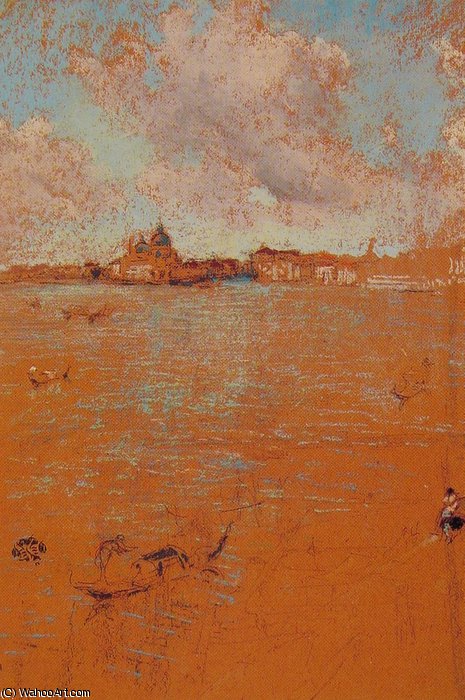
venetian scene

James Abbott McNeill Whistler’s Venetian Scene captures a serene cityscape bathed in atmospheric clouds—a quintessential example of Aestheticism's focus on beauty for its own sake. Painted during the Victorian era, this evocative artwork invites viewers to immerse themselves in Whistler’s masterful impressionistic style and contemplate owning a piece of art history.


Džejms Abbot Meknil Visler (1834 - 1903)

Lowell United States of America James Abbott McNeill Whistler james abbot mcneill whistler, james mcneill whistler, whistler Džems Abot Meknil Visler, američki slikar Tonalizma i Estetizma. Poznat po portretu 'Majka', nokturnima i filozofiji 'umetnost radi umetnosti'. Ključna figura viktorijanske ere! Tonalizam, Estetizam Estetski pokret Velázquez July 14, 1834 1903 James Abbott McNeill

A Venetian Reverie Captured in Light and Shadow

  • James Abbott McNeill Whistler’s “Venetian Scene” stands as a testament to the Aesthetic movement's core principle – prioritizing beauty for its own sake above didactic storytelling. Painted sometime around 1872-1873, this evocative canvas transports viewers back to the vibrant canals and atmospheric twilight of Venice during Whistler’s European travels.
  • The painting depicts a tranquil cityscape dominated by a calm body of water reflecting the muted hues of the sky. Whistler meticulously employed tonal gradation—a technique championed by Impressionists but perfected by Whistler himself—to create an illusionistic depth that captures the subtle nuances of Venetian light. Notice how he skillfully blends shades of grey and ochre to convey the coolness of dusk, punctuated by occasional bursts of color from distant buildings.
  • Beyond its masterful execution, “Venetian Scene” resonates with deeper symbolic meanings rooted in Whistler’s philosophical concerns. The stillness of the water mirrors a contemplative mood, inviting reflection on beauty and sensory experience—values central to Aestheticism. The solitary figure gazing upon the scene embodies the artist's desire to observe and appreciate the world without imposing preconceived notions or moral judgments.
  • Whistler’s artistic vision was profoundly influenced by Japanese prints (ukiyo-e), which he encountered during his travels. The flattened perspective and simplified forms characteristic of ukiyo-e subtly permeate Whistler’s composition, demonstrating a conscious effort to transcend academic conventions and embrace a more intuitive approach to representation.
  • Today, “Venetian Scene” continues to captivate audiences with its understated elegance and luminous quality. Reproductions crafted by ArtsDot offer an exceptional opportunity to experience this masterpiece firsthand, allowing collectors and interior designers alike to infuse their spaces with Whistler’s vision of serene beauty—a timeless reminder that art can exist purely for the pleasure it brings.