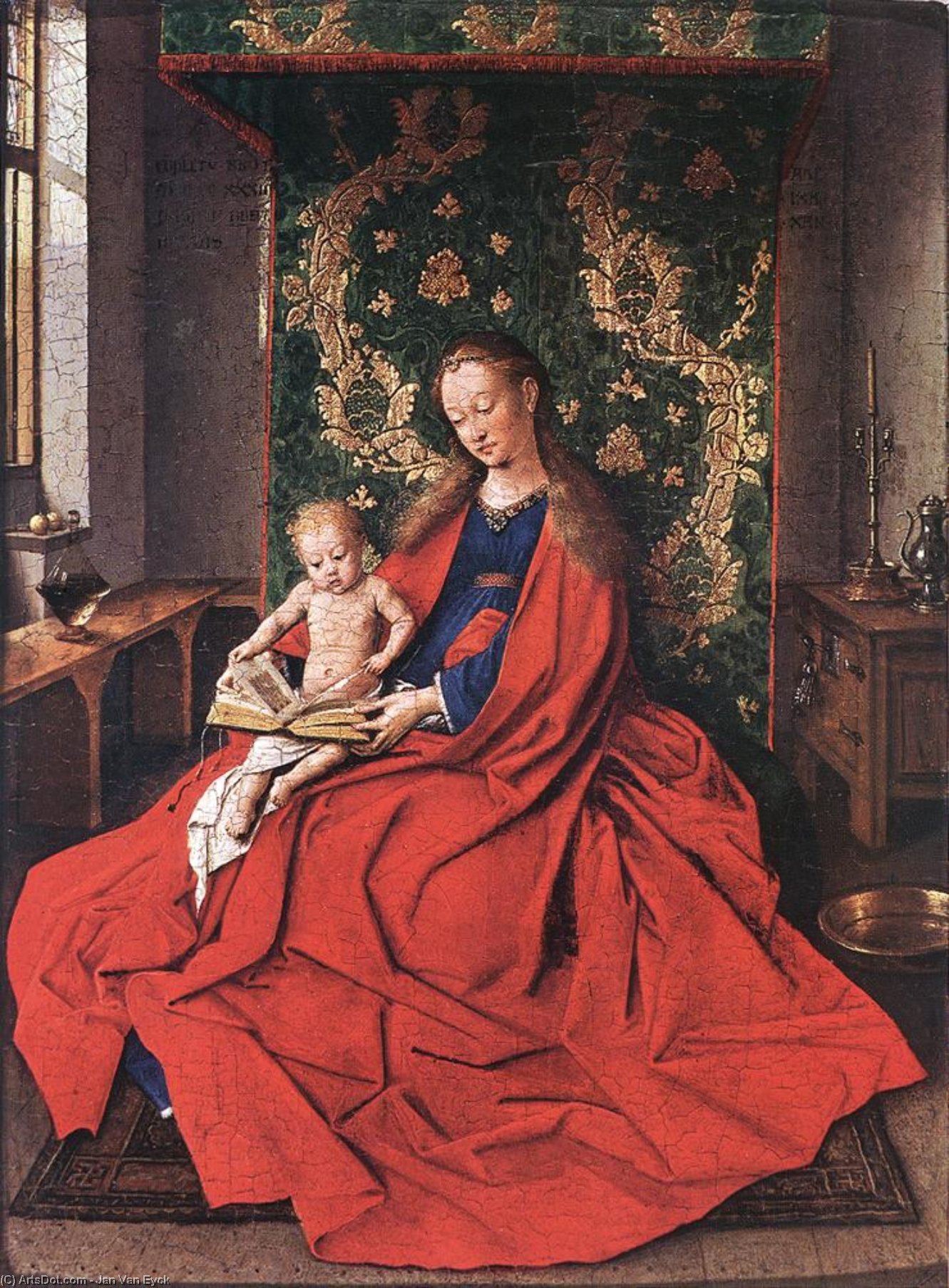
Madonna with the Child Reading
Jan Van Eyck's
Madonna with the Child Reading, a masterpiece from 1433, is a testament to the artist's skill in capturing intimate moments. This oil painting, measuring 26 x 19 cm, is housed at the
National Gallery of Victoria in Melbourne, Australia.
The Composition and Symbolism
The painting depicts a serene scene where the Madonna sits on a chair with her child in her lap. She appears engrossed in reading a book while gently holding the baby. The setting is in front of a window, visible through an open doorway, which adds depth to the composition. Several objects are strategically placed within the scene: a bowl on the right side, two cups near the top left corner, and a vase towards the bottom left. These elements contribute to the cozy and intimate atmosphere. They aren’t merely decorative; they symbolize domestic tranquility and piety—a reflection of medieval ideals concerning family life and spiritual devotion. The careful arrangement speaks volumes about Van Eyck's understanding of visual storytelling.
Artistic Techniques
Jan Van Eyck’s use of oil painting techniques is evident in the detailed rendering of textures and the play of light. The Madonna's clothing and the child’s skin are depicted with remarkable realism, showcasing the artist’s mastery over his medium. This meticulous attention to detail—the subtle folds of fabric, the luminous glow emanating from the window—is characteristic of Early Netherlandish painting and exemplifies Van Eyck’s groundbreaking approach to capturing naturalism. He achieved this incredible level of accuracy through layering thin glazes of pigment, a technique that allowed him to build up color gradually while preserving underlying tonal values.
Historical Context
This painting is part of Jan Van Eyck's oeuvre, which includes other notable works such as
Portrait of a Man (Man in a Turban) and
A Man in a Turban (possibly a self-portrait). These paintings demonstrate his ability to capture the essence of his subjects with precision and emotion. They stand alongside other masterpieces from the Burgundian Renaissance—a period marked by artistic innovation and political ambition—reflecting the cultural values of its time.
Relevance Today
The enduring appeal of 'Madonna with the Child Reading' lies in its timeless portrayal of maternal love and devotion. It continues to inspire art enthusiasts and scholars alike, offering a glimpse into the artistic and cultural values of the 15th century. Its serene beauty transcends temporal boundaries, reminding us of fundamental human emotions—compassion, tenderness, and faith—themes that resonate powerfully across centuries. For those interested in exploring more of Jan Van Eyck’s works or learning about other masterpieces,
Jan Van Eyck: Madonna with the Child Reading and
Discovering the Masterpieces of Christ Church Picture Gallery, Oxford, United Kingdom are valuable resources. In conclusion, 'Madonna with the Child Reading' by Jan Van Eyck is a masterpiece that encapsulates the essence of maternal love and devotion. Its intricate details and serene atmosphere make it a significant work in the history of art.