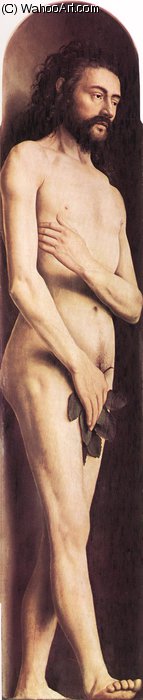
The Ghent Altarpiece: A Renaissance Unfolding
The Ghent Altarpiece, formally known as the Adoration of the Mystic Lamb, stands not merely as a painting but as a portal – a window into the burgeoning artistic and intellectual landscape of 15th-century Flanders. Commissioned by wealthy merchant Joos Vijd around 1422, this monumental polyptych, crafted primarily by the brothers Hubert and Jan van Eyck, is widely considered one of the earliest masterpieces of Early Netherlandish painting and a pivotal work in the transition from medieval symbolism to Renaissance realism. Its sheer scale – measuring nearly six feet tall and over twelve feet wide – immediately commands attention, drawing the viewer into a meticulously detailed world brimming with religious narrative and symbolic resonance.
Initially conceived as an altarpiece intended for the chapel of St Bavo’s Cathedral in Ghent, its history is as captivating as its artistry. Following its installation, the altarpiece was hidden from public view during the Reformation, surviving periods of neglect and even being briefly stolen. Its rediscovery in the 19th century sparked a renewed fascination with this extraordinary work, leading to extensive restoration efforts that have revealed the incredible depth and complexity within each panel. The altarpiece’s journey through history mirrors its artistic evolution – a testament to its enduring power and significance.
A Symphony of Detail: Van Eyck's Revolutionary Technique
What immediately strikes the viewer is Jan van Eyck’s groundbreaking mastery of oil paint, a medium he essentially pioneered in Northern Europe. Prior to this, artists primarily relied on tempera, which offered less vibrancy and flexibility. Van Eyck’s use of oil allowed for unprecedented levels of detail, luminosity, and subtle gradations of color – qualities that are breathtakingly evident in the altarpiece's intricate textures, shimmering fabrics, and remarkably lifelike depictions of human figures. The meticulous layering of thin glazes created a surface so smooth and reflective it seems to glow from within.
Beyond technique, Van Eyck’s attention to observation is unparalleled. He meticulously rendered every leaf, every fold in cloth, every strand of hair with astonishing accuracy. This commitment to realism was not merely decorative; it served to elevate the religious narrative, inviting viewers to contemplate the profound mysteries of faith and redemption. The altarpiece's surfaces are covered with a network of tiny dots, created by applying paint with a fine brush – a technique known as *stippling* that contributes significantly to its luminous quality.
Decoding the Symbolism: A Tapestry of Meaning
The Ghent Altarpiece is not simply a depiction of biblical events; it’s a complex allegory laden with symbolic meaning. The central panel, featuring the adoration of the Lamb – representing Christ – immediately establishes this theme. The figures surrounding the lamb are not merely portraits but embodiments of virtues and theological concepts. Mary, depicted as the “Mystic Lamb,” is flanked by John the Baptist, symbolizing repentance, and Joseph, representing humility. The angels playing musical instruments represent harmony and divine grace.
Further layers of symbolism can be found in the details: the fountain and lilies signify purity; the golden rays emanating from the central panel represent divine light; and the various saints and prophets depicted within the wings offer a visual encyclopedia of Christian history. The altarpiece’s structure itself is symbolic, with its two vertical registers representing heaven and earth, and its foldable panels suggesting the unfolding of God's plan for humanity.
A Legacy of Innovation: The Altarpiece's Enduring Impact
The Ghent Altarpiece represents a watershed moment in art history. It demonstrated the potential of oil paint to achieve unprecedented levels of realism, detail, and luminosity – qualities that would profoundly influence generations of artists. Its innovative use of perspective, its meticulous observation of nature, and its complex symbolic program established new standards for artistic excellence.
Today, the altarpiece remains a source of wonder and inspiration. It stands as a testament to the genius of Jan van Eyck and his brother Hubert, and it continues to captivate viewers with its beauty, complexity, and enduring power. Reproductions offer a remarkable opportunity to experience this masterpiece firsthand, bringing its intricate details and profound symbolism into any space – a reminder of the transformative potential of art.