A Monumental Encounter: The Tension of Fate and Intellect
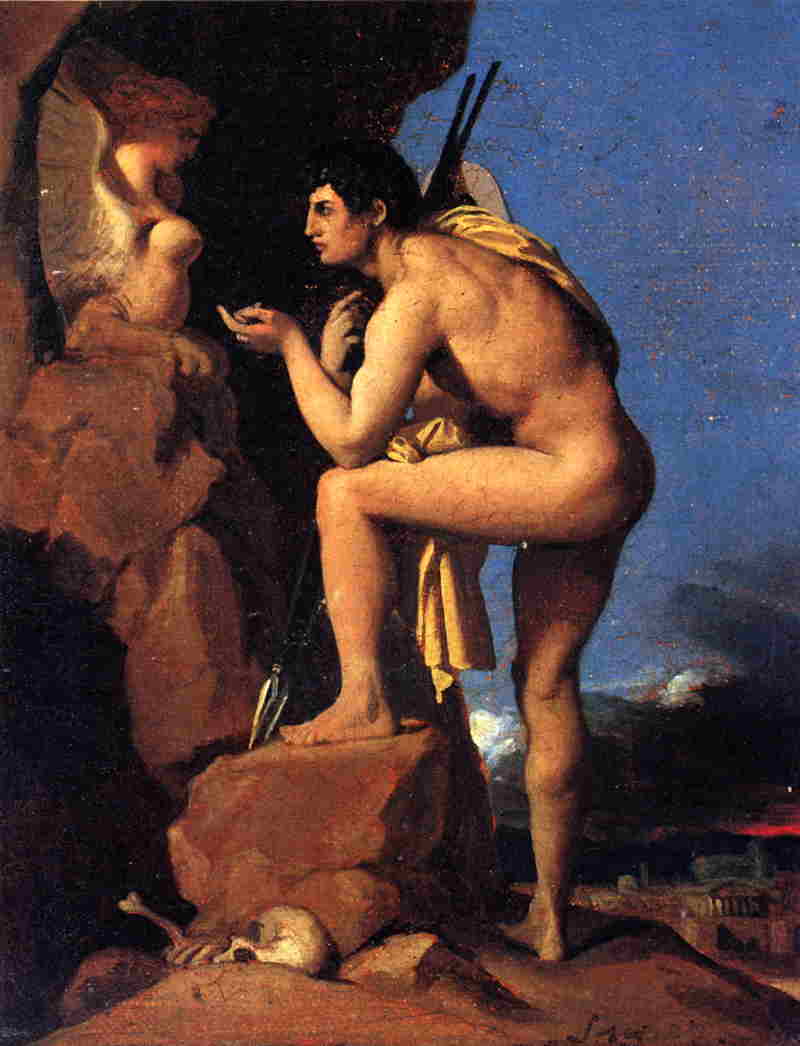
In the hallowed halls of art history, few canvases capture the breathless tension between human reason and primordial mystery as poignantly as Jean-Auguste-Dominique Ingres’s Oedipus and the Sphinx. This masterpiece, a cornerstone of the Neoclassical era, presents us with a moment frozen in time: the legendary King Oedipus at the precipice of his greatest trial. As he kneels before the enigmatic, predatory creature, the air in the painting feels heavy with an almost palpable stillness. It is not a scene of chaotic battle or clashing steel, but rather a profound, intellectual confrontation. The viewer is drawn into a silent, high-stakes dialogue where the fate of a kingdom hangs upon the strength of a single mind against the riddles of the divine.
The composition is masterfully orchestrated to evoke a sense of dramatic weight. Oedipus, positioned with a posture that conveys both humility and unwavering determination, faces the Sphinx—a creature that embodies both ancient wisdom and lurking menace. The Sphinx’s gaze is particularly arresting; it serves as a symbol of divine judgment, watching the hero with an intensity that suggests the inescapable burden of knowledge. Through this interaction, Ingres explores the eternal struggle between intellect versus instinct, illustrating the courage required to confront existential dilemmas through perseverance and logic.
The Mastery of Line and Luminous Technique
To behold this work is to witness the pinnacle of Neoclassical precision. Ingres, a staunch defender of disegno—the belief in the artist's ability to execute forms with absolute fidelity to nature—rejected the turbulent, visible brushstrokes of the Romantic movement in favor of a polished, sculptural perfection. His technique involved a painstaking process of layering thin, translucent glazes over a meticulous underpainting. This method achieved an unparalleled luminosity, allowing the textures of cold stone and warm flesh to coexist with breathtaking accuracy.
The surfaces of the painting are remarkably smooth, creating a dreamlike clarity that elevates the mythological subject into something eternal. Every curve of the Sphinx’s powerful form and every muscle in Oedipus’s frame is rendered with a sculptural quality that feels almost tactile. For the collector or interior designer, this level of detail offers a profound visual richness; the painting does not merely sit upon a wall but commands the space around it, providing a focal point of sophisticated elegance and technical brilliance.
A Timeless Legacy for the Discerning Collector
Beyond its technical prowess, Oedipus and the Sphinx carries a historical weight that resonates through the centuries. Created during Ingres’s formative years, the work reflects the broader artistic currents of his time, blending the rigorous discipline of classical ideals with the burgeoning emotional depth of the era. It is a painting that invites contemplation, making it an ideal acquisition for those who seek art that stimulates both the mind and the spirit.
Whether displayed in a grand library, a formal salon, or a contemporary living space, a high-quality reproduction of this work brings with it an aura of intellectual prestige. It serves as a conversation piece that transcends mere decoration, offering a window into the soul of Greek tragedy and the enduring triumph of the human spirit. For those looking to infuse their environment with a sense of history, drama, and unparalleled beauty, Ingres’s vision remains an incomparable source of inspiration.