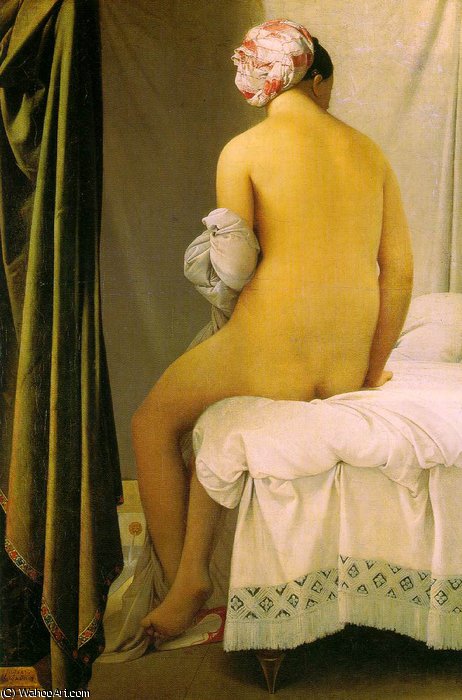
The
Valpinçon Bather, Louvre is a captivating oil painting created by the renowned French artist
Jean Auguste Dominique Ingres in 1808. This work exemplifies the Neoclassical style, characterized by its emphasis on classical forms and techniques. The painting is now housed at the
Musée du Louvre in Paris, France.
Artistic Style and Influences
Jean Auguste Dominique Ingres was a prominent figure in the Neoclassical movement, and his work was influenced by ancient Greek and Roman art. The
Valpinçon Bather, Louvre showcases the artist's mastery of line, form, and composition. The painting's use of light and shadow creates a sense of depth and volume, drawing the viewer's eye to the subject. Ingres' work was also influenced by other artists, such as Raphaël, and his admiration for the artist is evident in the
Valpinçon Bather, Louvre.
Painting Details and Significance
The painting measures 146 x 98 cm and depicts a female nude sitting on a bed, turned away from the viewer. The subject's back and shoulders are illuminated by a soft, diffuse light, creating a sense of intimacy and vulnerability. The
Valpinçon Bather, Louvre is considered one of Ingres' most important works, and its significance lies in its representation of the human form and its exploration of light and shadow. You can find more information about this painting on
ArtsDot.com or on
Wikipedia.
- The painting is characterized by its use of classical forms and techniques.
- The subject's back and shoulders are illuminated by a soft, diffuse light.
- The painting measures 146 x 98 cm and is considered one of Ingres' most important works.
Handmade oil paintings reproductions of the
Valpinçon Bather, Louvre are available on
ArtsDot.com, allowing art lovers to own a piece of history. The website offers a range of artistic styles and techniques, including Neoclassicism, making it a valuable resource for those interested in art and art history.
The
Valpinçon Bather, Louvre is a masterpiece of Neoclassicism, and its significance lies in its representation of the human form and its exploration of light and shadow. As a prominent work in the
Musée du Louvre, it continues to inspire and influence artists to this day.