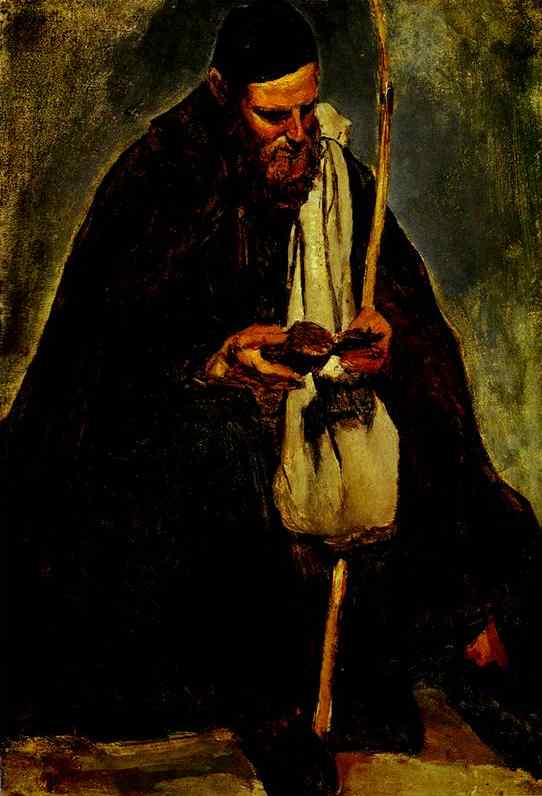
A Symphony of Solitude: The Soul of Corot’s Roman Vision
In the quietude of Jean-Baptiste-Camille Corot’s Seated Italian Monk, Reading, Rome, we encounter more than a mere portrait of a solitary figure; we step into a profound meditation on time and tranquility. Executed between 1865 and 1870, this masterpiece serves as a breathtaking distillation of the Romantic spirit, capturing that elusive, sublime yearning for beauty amidst the remnants of antiquity. As the eye wanders across the canvas, it finds a scene that transcends its physical Roman setting, inviting the viewer into a realm of deep, intellectual introspection. The monk, draped in heavy brown robes, becomes an anchor for our wandering thoughts, his focused attention on the text mirroring the very stillness Corot sought to immortalize.
The painting functions as a window into a world where the noise of modernity is silenced by the weight of history and the soft whisper of nature. For the discerning collector or interior designer, this work offers an unparalleled sense of serenity, making it a transformative piece for any space dedicated to contemplation or refined elegance. It does not merely decorate a wall; it alters the atmosphere of a room, infusing it with a sense of timelessness and grace.
The Mastery of Light and Atmospheric Depth
Corot’s technical brilliance lies in his ability to reject the rigid, meticulous detail of academic tradition in favor of a more emotive, atmospheric truth. He was a pioneer who understood that true perception is often blurred by light and shadow. In this work, his signature soft, blended brushstrokes create an astonishing level of depth, simulating the textures of weathered stone and lush foliage with remarkable subtlety. There is no harshness here; instead, we see the diffused sunlight filtering through the landscape, casting a gentle glow that softens the edges of reality.
This technique—often described as having a silvery, ethereal quality—allows the artist to build layers of pigment that breathe with life. By prioritizing the feeling of the atmosphere over anatomical precision, Corot achieves a sense of movement within the stillness. The way the light interacts with the crumbling Roman ruins creates a palpable sense of history, reminding us that even as stone decays, the essence of beauty remains eternal. This mastery of light makes the reproduction of such a piece a captivating centerpiece, offering a sophisticated play of tones that complements both classical and contemporary interiors.
A Legacy of Romanticism and Emotional Resonance
To understand this painting is to understand the evolution of landscape art. Corot stood at a pivotal crossroads in art history, bridging the gap between the structured discipline of Neoclassicism and the burgeoning freedom of Impressionism. Influenced by the dramatic energy of Eugène Delacroix, Corot sought to capture the sublime—that overwhelming sense of awe inspired by the vastness of nature and the grandeur of the past. The monk in this composition is not just a subject; he is a symbol of the human connection to the eternal, lost in thought amidst the echoes of a glorious era.
For those seeking to surround themselves with art that evokes emotion, Seated Italian Monk, Reading, Rome provides a profound emotional anchor. It speaks to the beauty of the quiet moment, the dignity of study, and the peaceful coexistence of man and his environment. Owning a high-quality reproduction of this work allows one to bring this piece of the Louvre’s soul into their own home, fostering an environment of peace, wisdom, and enduring aesthetic wonder.