Jean-Baptiste Greuze’s “The Dead Bird”: A Study in Sentiment and Loss
Jean-Baptiste Greuze's "The Dead Bird," painted around 1800, isn’t merely a depiction of a fallen avian; it’s a meticulously crafted tableau of sorrow, innocence, and the poignant beauty of fleeting moments. This small yet profoundly moving work, now housed within the Wallace Collection in London, offers a window into the burgeoning sentimentalism that captivated 18th-century France – a movement prioritizing emotional resonance over purely rational or historical subjects. Greuze, already established as a master of capturing human feeling, here distilled those skills into a concentrated dose of melancholic grace.
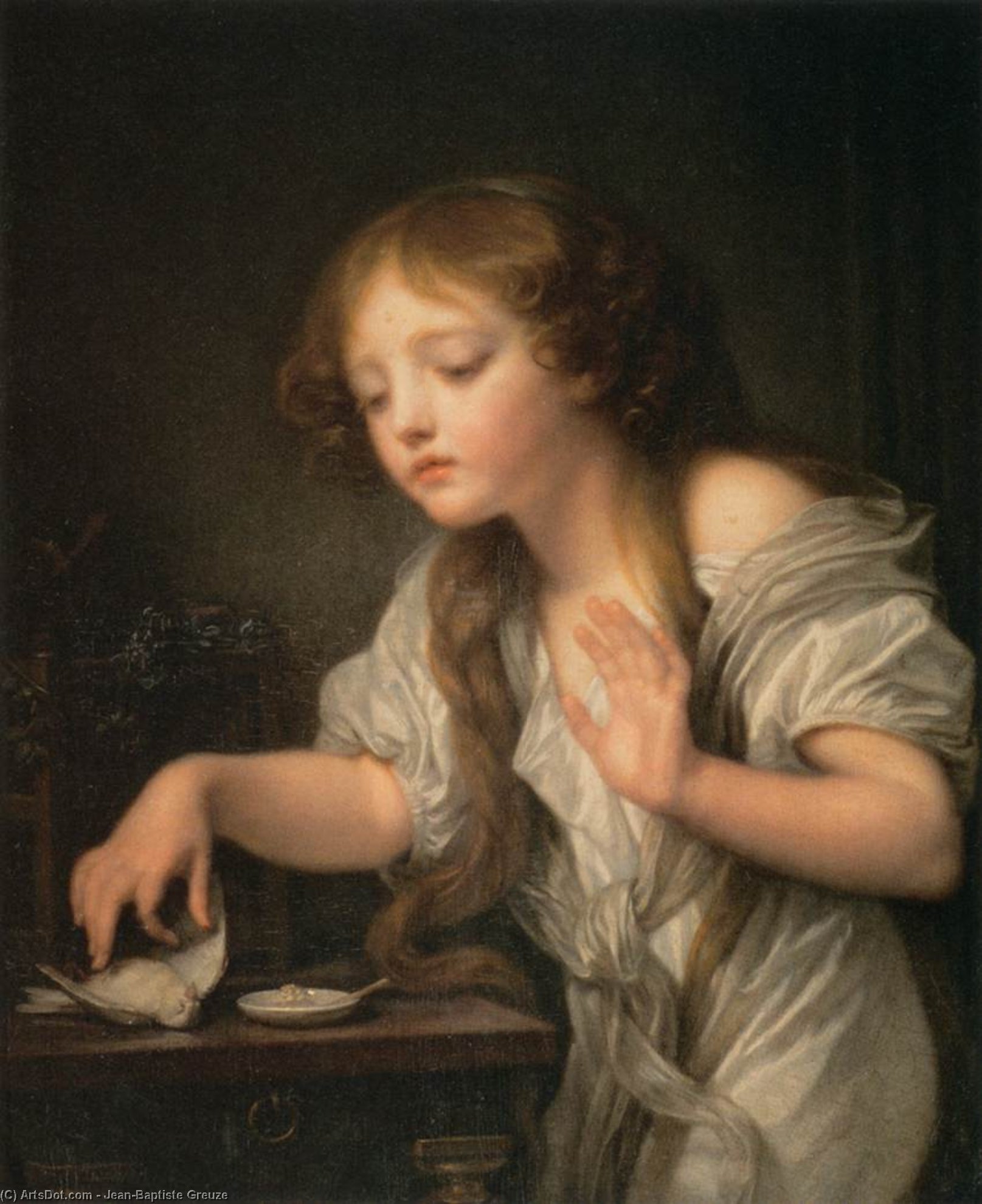
The painting immediately draws the viewer in with its stark simplicity and carefully orchestrated composition. A young girl, dressed in a pristine white gown that contrasts sharply with the muted tones of the background, sits at a simple wooden table. Her posture is one of utter dejection – her head bowed, her hands clasped protectively around a small, lifeless bird lying before her. The bird itself, rendered with exquisite detail, appears fragile and vulnerable, its feathers ruffled as if recently fallen from the sky. The lighting, soft and diffused, further enhances the atmosphere of quiet grief, casting gentle shadows that accentuate the girl’s sorrowful expression.
A Window into Sentimentalism
Greuze's work is inextricably linked to the rise of sentimentalism in art – a reaction against the grand narratives and idealized figures favored by the established academies. Sentimentalism sought to evoke strong emotions, particularly pity and compassion, through scenes of everyday life, often focusing on vulnerable individuals—children, the elderly, or those facing hardship. “The Dead Bird” perfectly embodies this aesthetic. It’s not a dramatic historical event or a mythological tale; it's a simple, intimate moment of loss that resonates deeply with the viewer.
Interestingly, Greuze’s approach was often met with skepticism by the Parisian art establishment. His tendency to paint from life, using models rather than relying solely on sketches and memory, was considered unorthodox. Furthermore, his focus on seemingly trivial subjects – a broken pitcher, a grieving child – challenged the prevailing notions of what constituted “worthy” artistic subject matter. Despite this resistance, Greuze’s ability to capture genuine emotion secured him a devoted following, particularly among women who found solace and identification in his depictions of human vulnerability.
Symbolism and Emotional Resonance
The symbolism within "The Dead Bird" is layered and subtly powerful. The bird itself represents innocence, fragility, and the ephemeral nature of life. Its death serves as a metaphor for lost potential, unfulfilled dreams, or perhaps even the premature loss of childhood. The girl’s white dress symbolizes purity and vulnerability, while her sorrowful expression speaks volumes about the pain of grief. The simple setting—a humble table with a cup and bowl – reinforces the painting's focus on everyday life and human emotion.
It is worth noting that Greuze frequently employed similar motifs in his work, often using domestic scenes to explore themes of morality, compassion, and the plight of the marginalized. The “Broken Pitcher,” another iconic example of his oeuvre, similarly utilizes a seemingly insignificant object—a shattered vessel—to symbolize broken hearts and lost innocence.
A Legacy of Emotional Depth
“The Dead Bird” remains a poignant and enduring work of art, demonstrating Greuze’s extraordinary talent for capturing the complexities of human emotion. Its quiet intensity and evocative imagery continue to resonate with viewers today, offering a glimpse into the sentimental sensibilities that shaped 18th-century France. Reproductions of this masterpiece provide an accessible way to experience the profound beauty and emotional depth of Greuze's vision – a testament to his enduring legacy as one of art history’s most sensitive and insightful painters.