A Glimpse Through the Looking Glass: The Intimacy of Vuillard and Waroquy
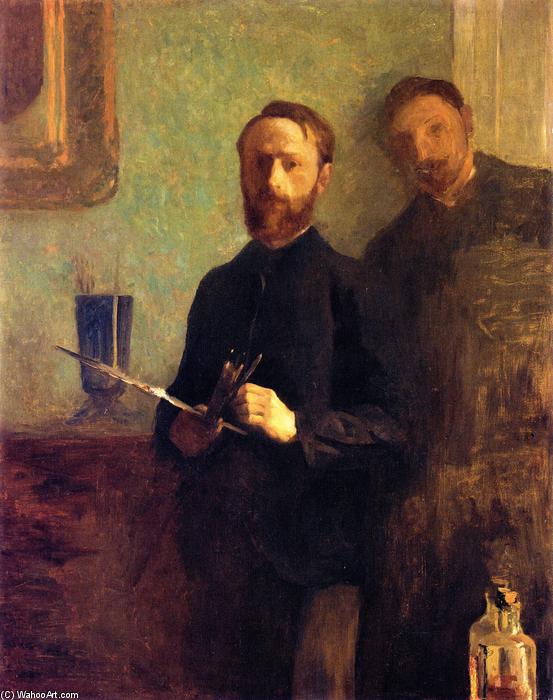
In the quiet, textured atmosphere of 1889, Jean Edouard Vuillard captured a moment that feels simultaneously grounded in reality and suspended in a dream. Vuillard and Waroquy is not merely a portrait of two men; it is an invitation into a private, psychological space where the boundaries between the subjects and their environment begin to blur. As a quintessential example of Post-Impressionism, the painting avoids the mere documentation of faces, opting instead to weave the figures into the very fabric of the room. The composition presents two men standing side by side, their presence marked by a certain pensive stillness. One man, perhaps the artist himself, holds a pair of scissors, a small detail that grounds the scene in a tactile, everyday reality, yet the overall effect remains hauntingly ethereal.
What truly captivates the discerning eye is the subtle, almost magical trick of perspective hidden within the brushwork. The painting possesses a dreamlike quality derived from its mirror-image composition, a phenomenon revealed by the delicate reflection in a small bottle positioned at the lower right. This technique creates a sense of looking through a veil, inviting the viewer to question the stability of what they see. For an art lover or a collector, this layer of mystery provides a profound depth that rewards repeated observation, making the piece a centerpiece of intellectual and visual intrigue.
The Nabis Influence: Color, Pattern, and Form
To understand the soul of this work, one must look to the avant-garde movement known as Les Nabis. As a prominent member of this group, Vuillard sought to break away from the rigid traditions of academic art, drawing heavy inspiration from the flattened planes and bold patterns of Japanese prints. In Vuillard and Waroquy, we see this mastery of spatial effects through the use of layered color and intricate textures. The room is not just a backdrop; it is an active participant in the narrative. Patterns emerge from the shadows, and the arrangement of objects—a vase, a couch, a chair, and various bottles—creates a rhythmic complexity that guides the viewer's gaze across the canvas.
The technique involves assembling areas of pure color to build form, a method that would later pave the way for much of modern abstraction. This approach allows the artist to capture the warmth of social interaction while maintaining a certain structural discipline. For interior designers, this painting offers an unparalleled masterclass in how pattern and tone can harmonize to create a sense of "lived-in" elegance. The interplay between the dark, sober garments of the men and the more luminous elements of the room creates a sophisticated tension that is both calming and stimulating.
A Timeless Addition to the Modern Collection
Beyond its historical significance as a relic of late 19th-century French innovation, this painting resonates with a contemporary emotionality. It speaks to the beauty found in quietude and the profound stories hidden within domestic interiors. The way Vuillard captures light—not as a harsh external force, but as a soft, permeating essence—makes the work feel incredibly warm and inviting. It is a piece that does not demand attention through volume, but rather earns it through subtlety and grace.
For those seeking to bring a sense of history and sophisticated artistry into their homes, a high-quality handmade oil painting reproduction of Vuillard and Waroquy serves as more than just decoration. It is an investment in atmosphere. By utilizing the same techniques and materials as the original, such a reproduction preserves the tactile essence of Vuillard’s brushstrokes and the rich, layered depth of his color palette. Whether placed in a sunlit study or a moody, curated gallery space, this work continues to breathe life into its surroundings, offering a window into a vanished era of artistic revolution.