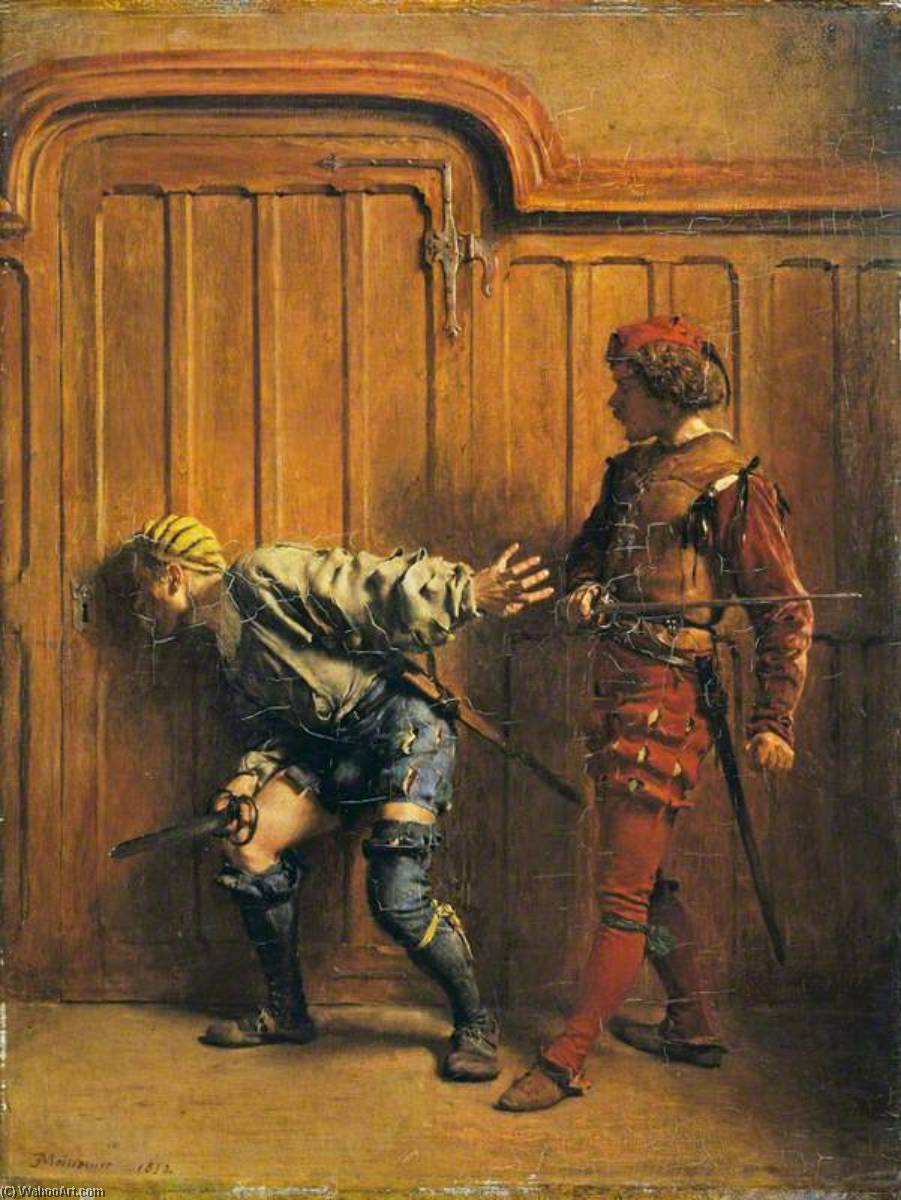
The Hired Assassins: A Microscopic Masterpiece of Victorian Intrigue
Jean-Louis-Ernest Meissonier’s “The Hired Assassins,” painted in 1852, is not merely a historical scene; it's a meticulously crafted window into the shadowed world of 17th-century France – a realm of clandestine plots, simmering resentments, and brutal efficiency. This arresting work, now housed within The Wallace Collection in London, immediately captivates with its dramatic composition and astonishing level of detail, qualities that cemented Meissonier’s reputation as one of the foremost artists of his era.
At first glance, the painting depicts a tense standoff within a dimly lit chamber. Two men dominate the foreground: a stoic knight, clad in gleaming armor, holding his sword aloft with unwavering resolve, and a shadowy figure – an assassin – pointing accusingly towards something unseen beyond the frame. The scene is rendered with a remarkable sense of immediacy, as if we’ve stumbled upon this pivotal moment frozen in time. However, closer inspection reveals the true genius of Meissonier's technique. He employed what he termed “microscopic painting,” painstakingly recreating every element – from the intricate folds of the knight’s armor to the texture of the wooden door behind him – with an almost obsessive attention to detail. This wasn’t simply about accuracy; it was a deliberate strategy to immerse the viewer in the scene, drawing them into its atmosphere and amplifying the sense of drama.
The historical context surrounding “The Hired Assassins” is crucial to understanding its significance. Painted during the Second Empire under Napoleon III, France was a nation grappling with political instability and social unrest. The rise of republican sentiment challenged the established monarchy, while secret societies and revolutionary movements lurked beneath the surface. Meissonier’s fascination with historical narratives, particularly those involving intrigue and betrayal, reflected this pervasive sense of uncertainty and danger. He frequently depicted scenes from the 17th century – a period often romanticized as one of chivalry and adventure – but always imbued them with a darker, more cynical edge.
The Art of Miniature Realism
Meissonier’s approach to painting was revolutionary for his time. He rejected the grand, sweeping narratives favored by many of his contemporaries, opting instead for intimate scenes focused on small groups of figures. This shift allowed him to concentrate his considerable skill on capturing the nuances of human expression and the subtle details of everyday life. His technique involved layering countless thin glazes of oil paint – a process that could take months or even years to complete – to achieve an unparalleled level of luminosity and depth. The result is a surface that seems to shimmer with reflected light, as if the scene were illuminated by candlelight.
The influence of Dutch Masters like Gabriel Metsu and Gerard Douw is readily apparent in Meissonier’s work. These artists, renowned for their ability to capture fleeting moments of domestic tranquility and intimate portraits, provided a model for Meissonier's meticulous attention to detail and his use of light and shadow. However, Meissonier pushed these techniques to an extreme, creating works that are both technically brilliant and emotionally resonant.
Symbolism and Narrative Tension
Beyond the immediate depiction of the scene, “The Hired Assassins” is laden with symbolic meaning. The knight’s unwavering stance represents authority and justice, while the assassin's gesture suggests a betrayal or impending doom. The unseen object towards which he points remains deliberately ambiguous, inviting speculation about the nature of the conspiracy. The darkened room itself contributes to the overall atmosphere of suspense, creating a sense that something terrible is about to happen.
The painting’s composition – with its strong diagonals and carefully arranged figures – further enhances the narrative tension. The eye is drawn from one element to another, constantly searching for clues and anticipating the next development in the story. Meissonier masterfully uses light and shadow to create a sense of depth and drama, drawing the viewer into the heart of the scene.
A Timeless Legacy
“The Hired Assassins” is more than just a historical painting; it’s a testament to Meissonier's extraordinary skill as an artist. His meticulous attention to detail, his mastery of light and shadow, and his ability to capture the nuances of human emotion have ensured that this work remains one of the most celebrated paintings of the 19th century. It continues to fascinate viewers with its dramatic composition, its intriguing narrative, and its remarkable technical achievement – a true masterpiece of microscopic realism.