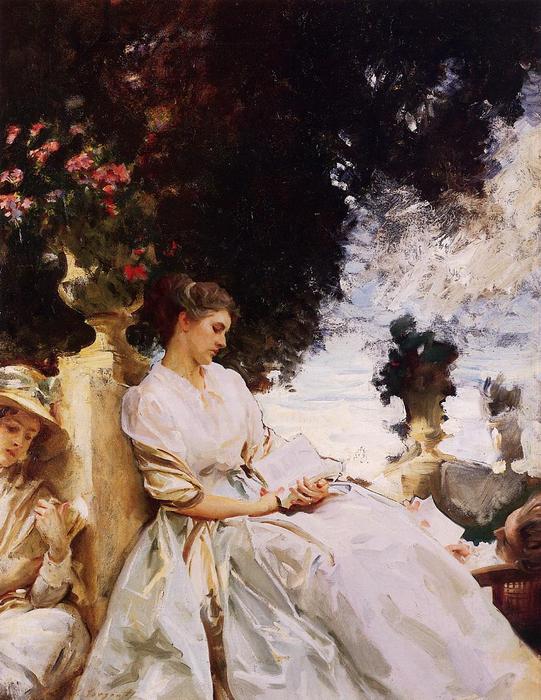
John Singer Sargent’s ‘In the Garden,’ Corfu captures the tranquil beauty of Mediterranean leisure with Impressionist brushstrokes and serene figures engrossed in reading amidst lush greenery and elegant vases.
John Singer Sargent био је амерички сликар који је провео већину свог живота у европској сцени ствари и познат по својим изузећно успешним портретима као и по импресионистичком стилу и великим делима која су остала трајна у историји уметности.
Meta Description: Откријте уметност Јохн Сингер Саргента! Погледајте иконе портрета као што је „Мадам Екс“, импресионистичке панорама и велика дела која су
A Moment Frozen in Mediterranean Light: John Singer Sargent’s ‘In the Garden’, Corfu
The painting “In the Garden,” created by John Singer Sargent in 1909, isn't merely a depiction of two women enjoying an afternoon amidst fragrant blossoms; it’s a distillation of Impressionism itself—a testament to Sargent’s ability to capture fleeting beauty and convey profound emotion through subtle brushstrokes. Situated within the Terra Foundation’s collection, this canvas (measuring 91 x 71 cm) transports viewers back to Corfu during the reign of Edward VII, offering an intimate glimpse into a privileged social milieu—a world where leisure and contemplation held sway alongside artistic ambition.
The Impressionist Technique: Capturing Atmosphere
Sargent’s approach to painting exemplifies the core tenets of Impressionism. Rather than striving for photographic realism, he prioritized conveying the sensation of light and color as perceived by the eye. Observe how Sargent utilizes loose, broken brushstrokes—almost invisible to the naked gaze—to build up layers of pigment that shimmer with reflected sunlight. The palette is dominated by muted greens and yellows, skillfully blended to create an illusion of depth and luminosity. Unlike academic painters who meticulously rendered every detail, Sargent deliberately blurred boundaries, prioritizing atmosphere over precise representation. This technique isn’t simply stylistic; it's fundamentally expressive—a way of communicating the intangible feeling of warmth and serenity that permeates the scene.
Symbolism Within Tranquility: Flowers as Vessels of Emotion
Beyond its masterful execution, “In the Garden” is rich in symbolic resonance. The abundance of flowering plants – jasmine, roses, and honeysuckle – serves as a visual metaphor for femininity and beauty—elements central to Sargent’s artistic vision. These blossoms aren't merely decorative; they embody an idealized notion of springtime renewal and joy. Furthermore, the positioning of the women—one seated on a bench, absorbed in reading, while the other leans beside her—suggests companionship and intellectual engagement. Their posture exudes calmness and grace, reflecting the overarching mood of contemplation that characterizes the artwork. The flowers themselves seem to radiate warmth and invite the viewer into this tranquil space.
Historical Context: Corfu Under Edwardian Influence
The painting’s setting—Corfu—was a favored destination for British aristocracy during the Edwardian era. The island offered respite from London society, providing opportunities for outdoor pursuits and social gatherings. Sargent himself spent considerable time in Corfu during his travels, immersing himself in the Mediterranean landscape and absorbing its artistic inspiration. This historical context informs our understanding of “In the Garden”—it reminds us that art is inextricably linked to its time—reflecting not only aesthetic trends but also broader cultural values. The painting captures a moment of aristocratic leisure—a celebration of beauty and refinement within a specific social framework.
Emotional Resonance: A Portrait of Quiet Elegance
Ultimately, “In the Garden” succeeds in evoking a powerful emotional response. It’s more than just a beautiful image; it's an invitation to savor stillness and appreciate the simple pleasures of life. The painting radiates warmth and tranquility—a palpable sense of contentment that lingers long after viewing. Sargent’s masterful use of color and brushstroke achieves this effect with remarkable subtlety, conveying emotion without resorting to overt sentimentality. It speaks to a universal desire for beauty and harmony—a yearning for moments of respite from the pressures of modern existence. “In the Garden” remains an enduring emblem of Impressionist artistry—a timeless masterpiece that continues to inspire admiration and contemplation.