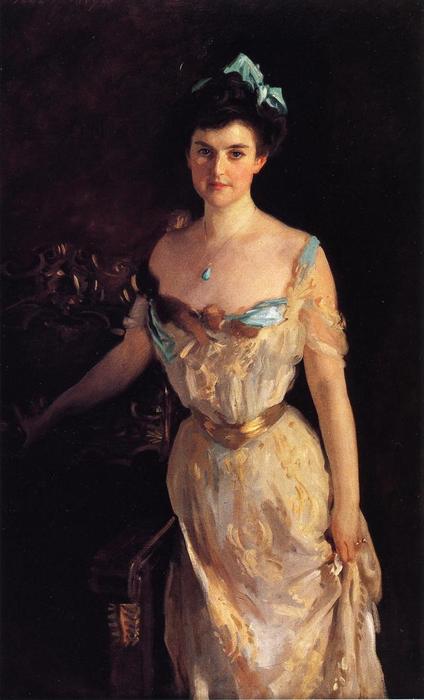
A Glimpse of Elegance: Mrs. Charles Pelham Curtis by John Singer Sargent
The world of art holds countless treasures, but few capture the fleeting beauty of a single moment with such exquisite precision as John Singer Sargent’s “Mrs. Charles Pelham Curtis.” Completed in 1903, this oil on canvas painting isn't merely a portrait; it’s a carefully constructed tableau of wealth, grace, and subtle social commentary, offering a captivating window into the Gilded Age. Measuring a substantial 152 x 76 cm, the work resides within the Portland Museum of Art in Maine, a testament to its enduring artistic merit.
Sargent’s mastery lies not just in his technical skill – the flawlessly rendered fabrics, the delicate shading of skin, and the precise depiction of light – but also in his ability to imbue his subjects with personality. “Mrs. Charles Pelham Curtis” is a study in poised elegance. The sitter, identified as Mrs. Charles Pelham Curtis, is presented in a luxurious white gown adorned with a striking blue bow, immediately drawing the eye. Her posture exudes confidence and refinement, while her hand gently holding a fan suggests both composure and an awareness of social expectations. The background, deliberately blurred, features two figures – likely family members or servants – adding depth to the scene without distracting from the central subject.
Realism Elevated: Sargent’s Technique and Style
Sargent was a pivotal figure in the Realist movement, yet he transcended simple imitation. He possessed an extraordinary ability to capture not just what he saw, but also *how* it felt – the texture of velvet, the warmth of candlelight, the subtle nuances of human expression. His brushwork is remarkably loose and expressive, particularly evident in the rendering of fabrics and drapery. Rather than meticulously detailing every thread, Sargent employed short, broken strokes to convey a sense of movement and volume. This technique, combined with his masterful use of light and shadow, creates an illusion of depth and realism that is both captivating and emotionally resonant.
The painting’s color palette is restrained yet sophisticated, dominated by soft whites, blues, and creams. These muted tones contribute to the overall atmosphere of understated luxury and refinement. Sargent's use of light is particularly noteworthy; it illuminates the sitter’s face and gown, highlighting her beauty while simultaneously creating a sense of mystery and intrigue. The subtle gradations of color suggest a sophisticated understanding of how light interacts with different surfaces.
A Portrait of an Era: Historical Context and Symbolism
"Mrs. Charles Pelham Curtis" is deeply rooted in the social and cultural landscape of the early 20th century – the Gilded Age, a period of unprecedented wealth and extravagance in America. The painting reflects the values and aspirations of this era, emphasizing beauty, refinement, and social status. The sitter’s attire—the luxurious gown, the delicate jewelry—are all symbols of her privileged position within society.
Interestingly, the inclusion of the two figures in the background hints at the complexities of domestic life during that time. They represent the support system necessary to maintain such a refined lifestyle, subtly acknowledging the roles and responsibilities of women within the upper class. Furthermore, Sargent’s choice to depict Mrs. Curtis in a pose of quiet contemplation suggests a deeper psychological depth beyond mere surface beauty – a characteristic often found in his most celebrated portraits.
Bringing Beauty Home: Reproductions and Legacy
ArtsDot.com offers meticulously crafted handmade oil painting reproductions of “Mrs. Charles Pelham Curtis,” allowing art enthusiasts to own a tangible piece of this iconic masterpiece. These reproductions faithfully capture the original’s color, texture, and emotional impact, bringing Sargent's vision into your home with exceptional detail. Whether you are an admirer of Sargent’s work or simply seeking a stunning addition to your collection, a reproduction of “Mrs. Charles Pelham Curtis” is a timeless investment in art history.
The legacy of John Singer Sargent continues to inspire artists and collectors alike. His ability to capture the essence of his subjects – their beauty, their character, and their place within the world – remains unparalleled. “Mrs. Charles Pelham Curtis” stands as a shining example of his genius, a testament to the power of art to transport us to another time and place.