A Vision of Edwardian Grace
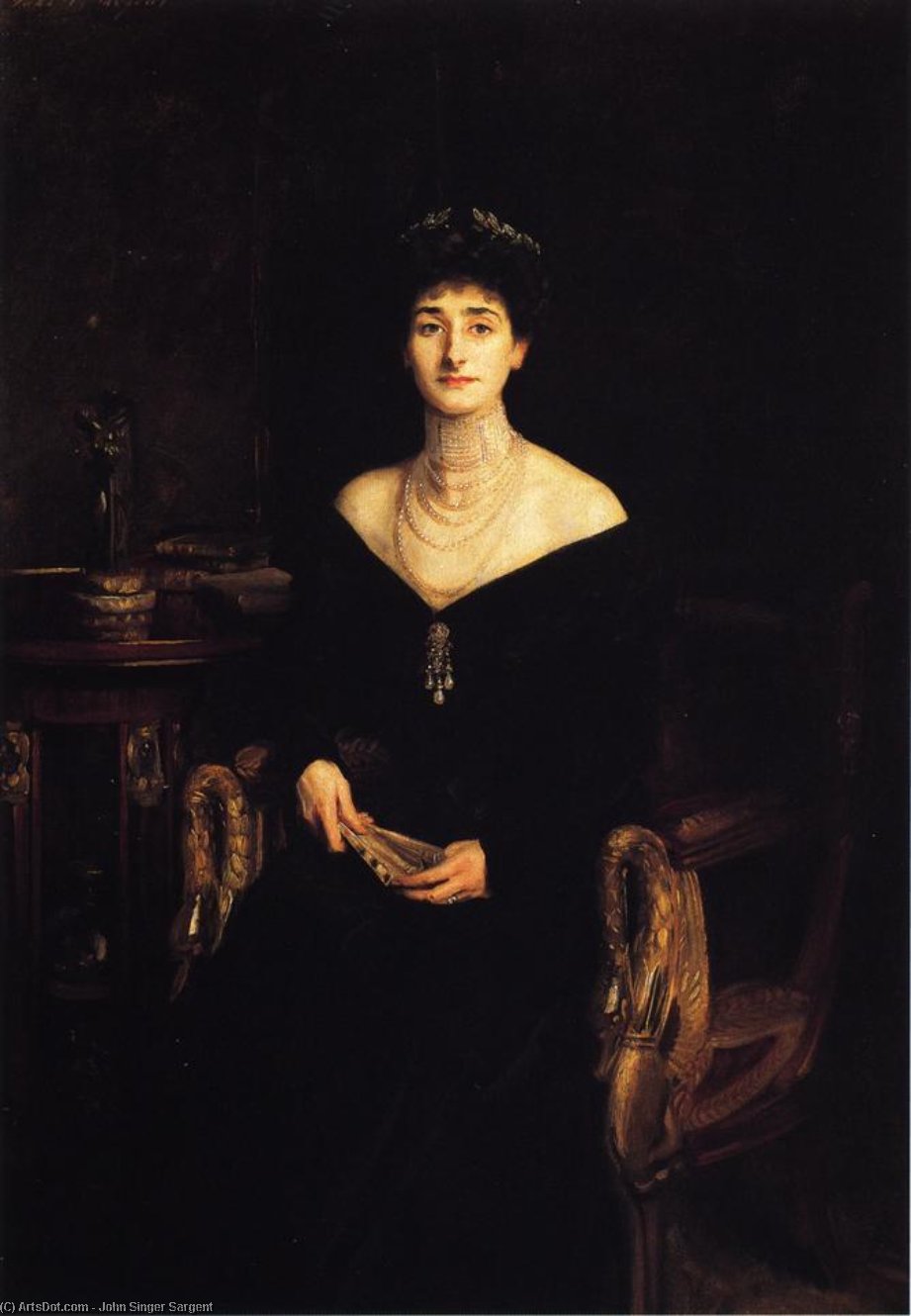
In the quiet, shadowed corners of art history, few portraits capture the ephemeral essence of an era as profoundly as John Singer Sargent’s “Mrs. Ernest G. Raphael (Florence Cecilia Sassoon).” Completed in 1905, this oil on canvas masterpiece is far more than a mere likeness; it is a window into the gilded splendor of the early twentieth century. As we gaze upon Florence Cecilia Sassoon, we are not simply observing a subject, but rather encountering an ideal of aristocratic poise. Seated with a serene, almost detached elegance, her gaze drifts slightly away from the viewer, inviting us into a world of quiet mystery and contemplative solitude. Sargent, a master of capturing the psychological depth behind the social mask, uses this subtle redirection of sight to imbue the portrait with an aura of sophisticated introspection.
The composition is a masterclass in balanced restraint. While the subject remains the undeniable heart of the work, Sargent surrounds her with elements that whisper of refined taste and domestic tranquility. To her side, a table adorned with delicate decorative objects provides a touch of understated luxury, while the heavy, velvet-draped upholstery of her chair anchors her within a space of immense comfort and status. The background, a deep and somber tapestry of browns and blacks, serves a vital purpose: it recedes into the shadows, pushing the luminous presence of Mrs. Raphael toward the foreground, ensuring that every nuance of her expression and every shimmer of her adornment commands our undivided attention.
The Alchemy of Light and Texture
To behold a Sargent portrait is to witness a breathtaking dialogue between light and material. The artist’s technical virtuosity is most evident in his ability to translate the tactile reality of the Gilded Age onto a flat canvas. Through meticulous brushwork, he achieves a stunning contrast between the porcelain smoothness of Sassoon’s skin and the opulent sheen of her jewelry. One can almost feel the weight of the luxurious fabrics; Sargent employs a brilliant blend of tonal gradations and soft highlights to render the intricate folds of her dress, capturing the way light dances across silk and velvet with an almost liquid quality.
This mastery of texture is supported by a sophisticated use of atmospheric perspective. By allowing the edges of the figure to soften and the background to deepen into obscurity, Sargent creates a sense of three-dimensional space that pulls the viewer inward. The lighting itself—soft, diffused, and seemingly emanating from an unseen source—casts gentle shadows that define the contours of her face and hands, lending the work a lifelike vitality. For the discerning collector or interior designer, this interplay of light and shadow offers a profound sense of depth, making the painting a dynamic centerpiece capable of transforming the mood of any room with its quiet, luminous energy.
An Enduring Legacy for the Modern Collector
Beyond its technical brilliance, “Mrs. Ernest G. Raphael” serves as a poignant historical document. It embodies the aesthetic preferences of an era defined by elegance, social convention, and a burgeoning sense of modern identity. Sargent’s ability to blend the precision of Realism with the evocative spirit of Impressionism allows the painting to transcend its 1905 origins, remaining strikingly relevant to contemporary sensibilities. The portrait does not shout; it whispers of a time when beauty was found in the subtle details—the glint of a gemstone, the drape of a sleeve, or the steady confidence of a well-composed pose.
For those seeking to infuse their living spaces with a sense of timeless sophistication, a high-quality reproduction of this work offers an unparalleled opportunity. It brings into a modern interior not just a beautiful image, but a piece of cultural heritage that evokes feelings of stability, luxury, and peace. Whether placed in a formal gallery setting or as a focal point in a curated study, Sargent’s portrait continues to inspire awe, serving as a testament to the enduring power of fine art to capture the very soul of human elegance.