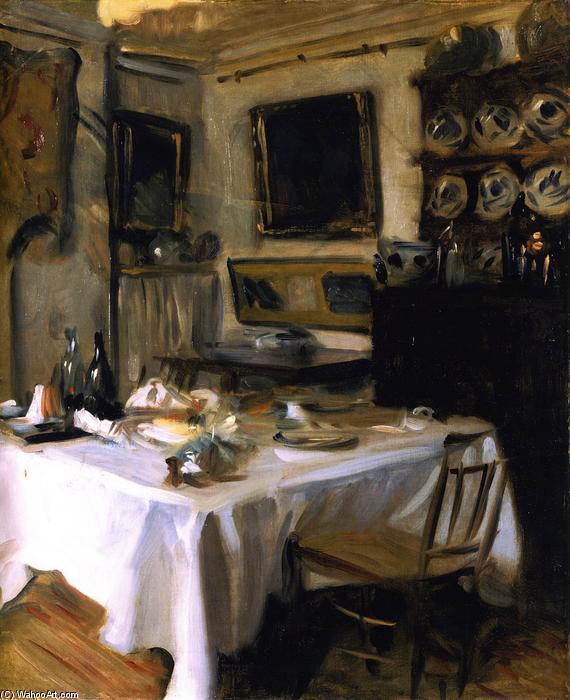
A Window Into Victorian Refinement: Exploring John Singer Sargent’s “My Dining Room”
“My Dining Room,” painted by John Singer Sargent in 1883, stands as an exquisite encapsulation of the Aesthetic Movement's preoccupation with beauty and sensory experience. More than just a depiction of domestic space, it’s a carefully constructed tableau designed to evoke a particular mood—one of understated elegance and cultivated leisure—characteristic of Victorian society at its zenith. Sargent, already establishing himself as a celebrated portraitist, sought to transcend mere representation, aiming instead for an immersive visual journey for the viewer.
- Style & Technique: Sargent’s masterful handling of oil paint exemplifies the Realism style championed by artists like Gustave Courbet and Jean-François Millet. However, unlike its predecessors, Realism here isn't concerned with gritty realism; rather, it prioritizes idealized beauty achieved through meticulous observation and skillful blending. The artist employs a pyramidal composition—drawing the eye upwards towards the central clock—creating a sense of stability and grandeur within the confined space.
- Historical Context: Painted during a period of immense social change – the burgeoning Industrial Revolution juxtaposed with anxieties surrounding moral decay – “My Dining Room” reflects a desire to recapture a vanished aristocratic ideal. Sargent’s patrons were often wealthy industrialists eager to surround themselves with symbols of refinement and sophistication, signaling their status within the evolving hierarchy of Victorian Britain.
Symbolism Beyond Decoration
The seemingly simple objects adorning the dining room—the gleaming silverware, the delicate floral arrangements, the polished mahogany furniture—are laden with symbolic significance. The clock, positioned prominently above the table, represents time and order – concepts crucial to Victorian moral philosophy. Similarly, the vases filled with flowers convey notions of femininity and beauty, mirroring the idealized feminine figure prevalent in art and literature of the era. Sargent’s deliberate choices contribute to a narrative that transcends mere visual pleasure; they communicate deeper cultural values.
- Light & Atmosphere: Sargent skillfully utilizes chiaroscuro—the dramatic interplay between light and shadow—to sculpt the forms within the room and create an ethereal atmosphere. Light streams in from a window, illuminating the tabletop and casting shadows that deepen the sense of intimacy and sophistication.
Capturing Emotion Through Detail
What distinguishes “My Dining Room” from countless other interior paintings is Sargent’s uncanny ability to convey emotion through subtle visual cues. The gaze of the woman seated at the table—directed slightly off-center—suggests thoughtfulness and contemplation, hinting at a deeper psychological complexity beneath the surface of outward appearances. These nuanced gestures invite viewers to engage in an unspoken dialogue with the artwork, prompting reflection on themes of beauty, leisure, and social status. Sargent’s meticulous attention to detail ensures that every element contributes to the overall emotional impact—a testament to his artistic genius and enduring legacy.
A Legacy Enduring Through Reproduction
Today, reproductions of “My Dining Room” grace homes and galleries worldwide, allowing audiences everywhere to experience the captivating beauty and intellectual depth of Sargent’s masterpiece. Selecting a high-quality print—one that faithfully captures the nuances of color and texture—offers an opportunity to appreciate this iconic artwork in its own right, preserving its timeless appeal for generations to come. It remains a poignant reminder of Victorian ideals and a celebration of artistic skill—a visual poem etched forever onto canvas.