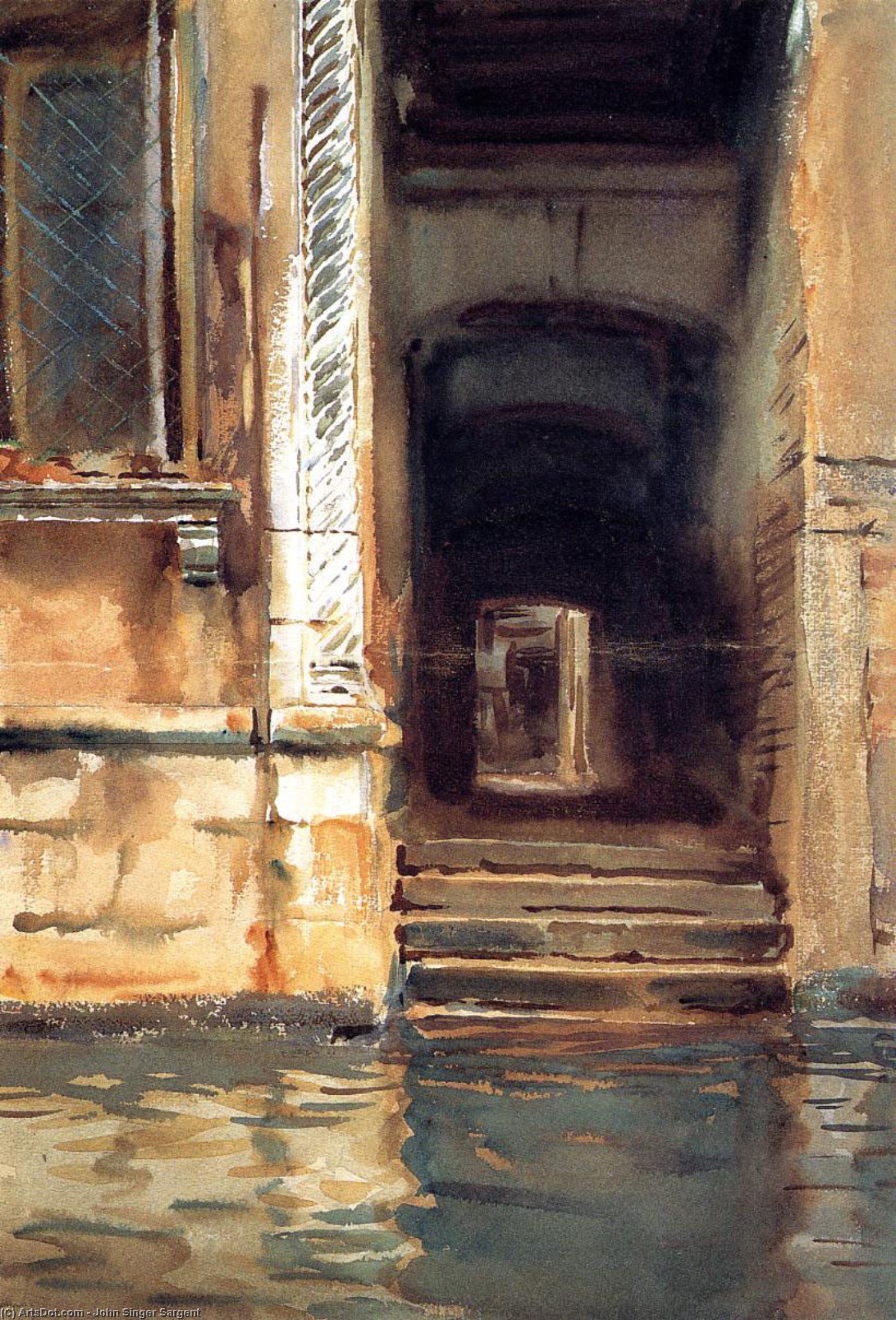
A Window Into Venetian Elegance: Exploring John Singer Sargent’s “Venetian Doorway”
The Venetian Doorway, painted by John Singer Sargent in 1902, isn't merely a depiction of an alleyway; it’s a masterful distillation of Impressionism and a poignant reflection on the fading grandeur of European aristocracy. Located within the Currier Museum of Art in Manchester, New Hampshire—a repository for exceptional European and American paintings—this watercolor captures a fleeting moment of urban life against the backdrop of Venice's historic charm. Sargent, already establishing himself as a titan of portraiture during his formative years, sought to transcend mere representation, aiming instead to convey atmosphere and emotion with remarkable precision.
- Style & Technique: Sargent’s signature Impressionistic approach prioritized capturing the ephemeral qualities of light and color—a technique he honed throughout his prolific career. Notice how he employs loose brushstrokes and subtle tonal variations to create a sense of depth and luminosity, eschewing sharp outlines in favor of hazy impressions. The watercolor medium itself lends an ethereal quality to the scene, enhancing its melancholic beauty.
- Composition & Setting: The painting’s composition is deceptively simple yet profoundly effective. A narrow passageway bisects the canvas, drawing the eye upwards towards a staircase and culminating in a window overlooking the Venetian street below. This upward gaze symbolizes aspiration and perhaps a yearning for connection to a bygone era—a sentiment echoed by the solitary figure glimpsed at the top left corner.
Historical Context: The Twilight of Imperial Splendor
Painted during Sargent’s Parisian years, “Venetian Doorway” speaks to the broader cultural anxieties surrounding the decline of the Austro-Hungarian Empire. Venice, once a dominant maritime power and seat of imperial authority, was undergoing significant transformations as its aristocratic elite faced increasing pressures from economic realities. Sargent's artistic choices—his focus on an ordinary urban space rather than opulent palaces—reflect this shift in sensibility, suggesting a preoccupation with capturing the spirit of a moment before it vanished entirely.
- Symbolism & Mood: The muted palette—dominated by shades of ochre, gray, and lavender—contributes to the painting’s pervasive mood of quiet contemplation. The window itself serves as a visual metaphor for observation and introspection, inviting viewers to contemplate the passage of time and the fragility of beauty.
- Influence & Legacy: Sargent's masterful rendering of light and color profoundly influenced subsequent generations of Impressionist painters. “Venetian Doorway” stands as testament to his ability to distill complex emotions into a deceptively understated visual statement—a legacy that continues to inspire artists and collectors alike.
Emotional Resonance: Capturing the Essence of Memory
Ultimately, “Venetian Doorway” transcends its formal elements to evoke a powerful emotional response. It’s not simply a beautiful painting; it's an invitation to linger in contemplation—to savor the subtle nuances of color and texture and to allow oneself to be transported back to a moment imbued with nostalgia and melancholy. Like many Impressionist masterpieces, Sargent’s work reminds us that true artistic achievement lies not merely in technical virtuosity but in conveying profound human experience.
A high-quality reproduction of “Venetian Doorway” offers an unparalleled opportunity to bring this evocative image into your home—a tangible connection to the artistic spirit of a bygone era and a celebration of Sargent’s enduring legacy.