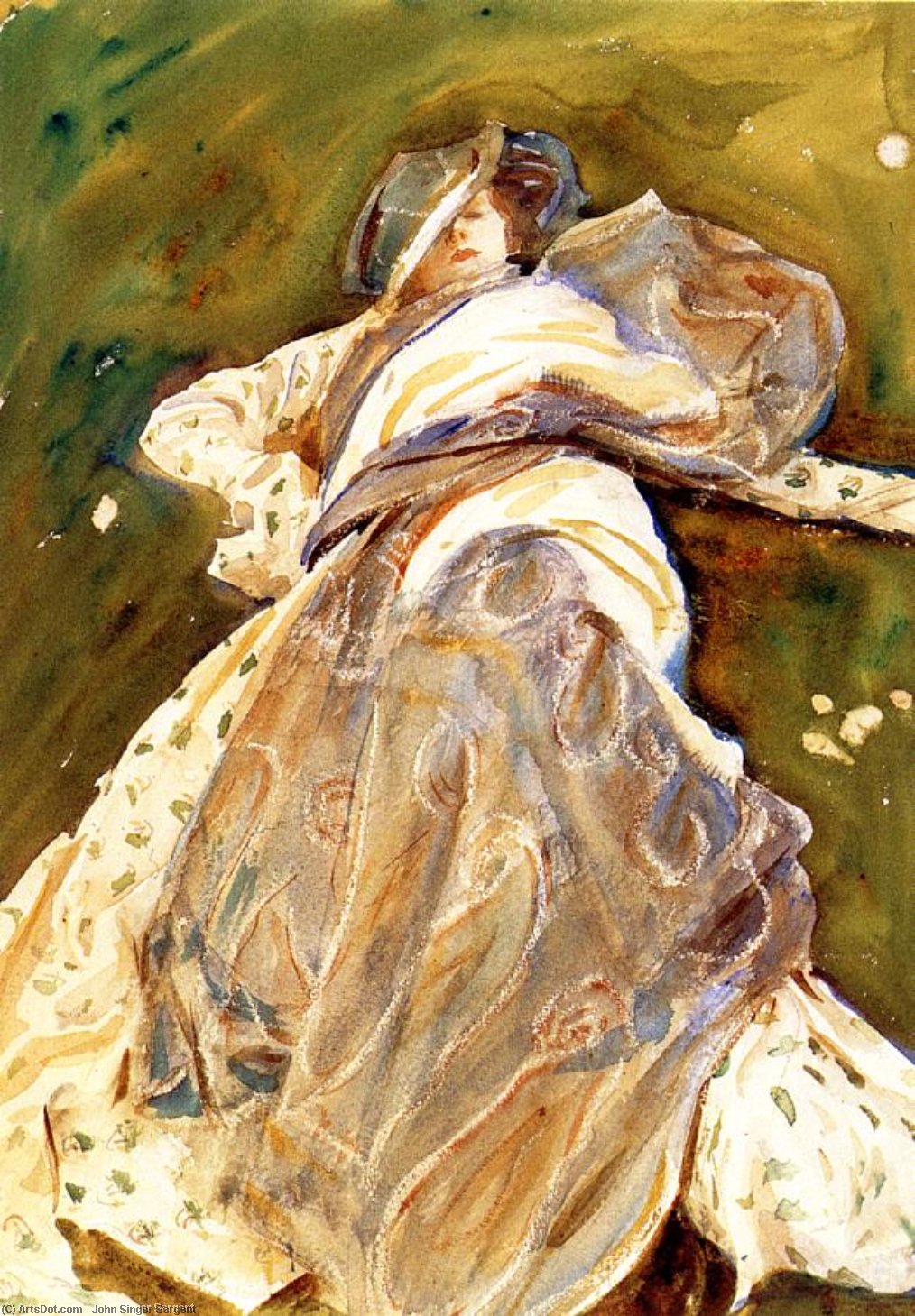
A Moment of Quietude: John Singer Sargent’s “Woman Reclining”
John Singer Sargent's "Woman Reclining," painted in 1908, is more than just a depiction of a woman at rest; it’s an exquisitely rendered meditation on vulnerability, contemplation, and the fleeting beauty of a summer afternoon. This watercolor masterpiece, measuring 52 x 37 cm, immediately draws the viewer into its softly lit world, echoing the artist's signature style – one characterized by a profound sensitivity to light and atmosphere, reminiscent of his celebrated portraiture from the Gilded Age.
- The Impressionistic Vision: Sargent’s approach here leans heavily into American Impressionism, mirroring the influence of artists like John Singer Sargent himself. Rather than striving for photographic realism, he prioritized capturing a subjective experience – the feeling of warmth, the play of light on fabric, and the quiet intimacy of the scene.
- A Bed of Color: The composition centers around a reclining woman, her form rendered with loose, flowing brushstrokes that create a sense of movement and fluidity. The use of layered watercolor washes builds up rich textures and translucent effects, particularly evident in the folds of her drapery and the subtle gradations of color within the blurred background.
Technique and Materials – A Dance of Watercolor
Sargent’s mastery lies in his skillful manipulation of watercolor pigments. The technique employed here is quintessential to the medium: building up layers of translucent washes, allowing each layer to bleed into the next, creating depth and luminosity. This process results in a remarkably delicate effect, where colors seem to shimmer and blend seamlessly. The paper itself plays a crucial role, its texture contributing to the overall sense of softness and dreaminess. The shallow perspective further enhances this illusion, flattening the space and intensifying the figure’s presence – a hallmark of Sargent's approach.
- Layering for Depth: The artist meticulously built up color and value through repeated layering, achieving remarkable depth despite the limitations of watercolor.
- Transparency and Blending: The use of transparent washes allowed for subtle blending and a luminous quality that is characteristic of Sargent’s work.
Symbolism and Emotional Resonance
"Woman Reclining" transcends a simple portrait; it evokes powerful symbolic associations. The pose itself – the surrender to rest, the acceptance of stillness – speaks to themes of vulnerability and peace. The blurred background, suggestive of a garden or landscape, adds to this sense of detachment and introspection. It’s as if the woman is lost in her own thoughts, suspended between reality and dream. The warm lighting further contributes to the emotional impact, casting gentle shadows that heighten the sense of intimacy and melancholy. This piece resonates with viewers on a deeply personal level, inviting contemplation about the nature of beauty, rest, and the human condition.
Historical Context and Artistic Legacy
Painted in 1908, this work reflects Sargent’s evolving artistic sensibilities as he navigated the changing landscape of the art world. His early career was dominated by portraiture for the wealthy elite, but he consistently sought to infuse his work with a deeper emotional resonance. “Woman Reclining” exemplifies this shift, demonstrating a move towards greater abstraction and a more subjective interpretation of reality – qualities that would become increasingly important in the development of modern art. This piece stands as a testament to Sargent’s enduring legacy as one of the most influential portrait painters of his time, a master of light, color, and human emotion.