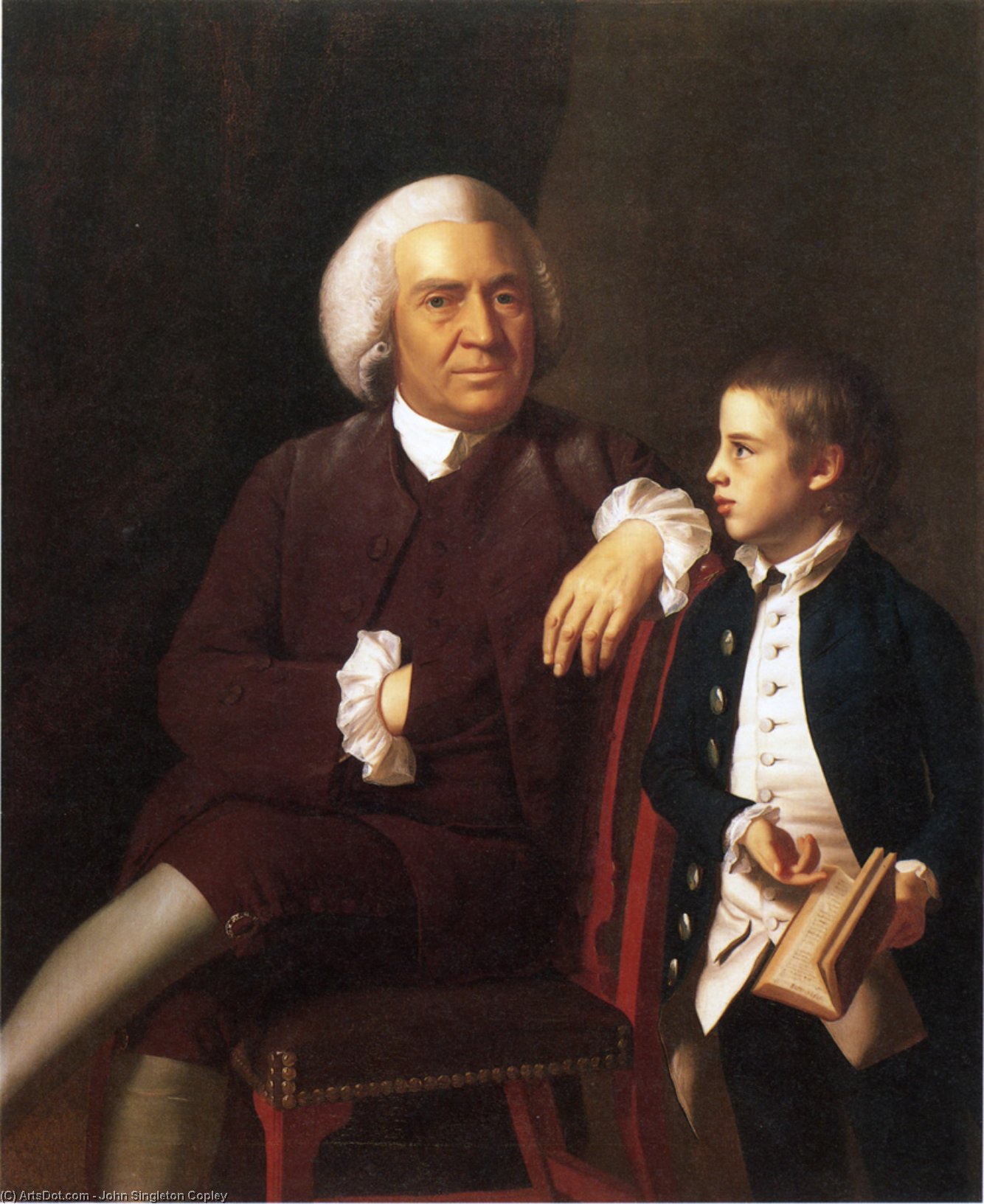
Admire John Singleton Copley's masterpiece, 'William Vassall and His Son Leonard,' a stunning Neo-Classical portrait housed at SFMOMA depicting wealthy figures amidst opulent surroundings. Explore its details & discover more about Copley’s legacy.
Јохн Синглтон Коплеј био је велик амерички сликар који је познат по својим детаљним портретима и иновативним историјским сценама. Истражите његове шедевралје данас!
Muzej lepih umetnosti u San Franciscu: Posetite veličanstvene galerije umetnosti i evropskih klasika u srcu Kalifornije! Istražite bogate kolekcije i inspirišite kreativnost.
San Francisco Muzeji umetnosti, Kolekcija umetnosti, De Young Muzej, Legija priznanja, Američka umetnost, Evropske slike i skulpture, Rodinova skulptura, Monetove pejzaže, Park Hriherosov Trg
A Portrait of Dignity Amidst Change: Exploring John Singleton Copley’s William Vassall and His Son Leonard
The painting “William Vassall and His Son Leonard,” completed in 1772 by the Anglo-American artist John Singleton Copley, stands as a remarkable achievement of Neo-Classical portraiture—a visual chronicle of both aristocratic refinement and the burgeoning anxieties surrounding the American colonies’ relationship with Britain. More than just a depiction of two men seated before a brick wall, it's an exquisitely crafted tableau that speaks volumes about social status, familial bonds, and the artistic sensibilities of its era.
The Artist’s Vision: Neo-Classicism in Boston
John Singleton Copley wasn’t formally trained; he honed his skills through observation and tireless experimentation—a testament to the spirit of self-reliance prevalent in colonial Boston. Unlike the Rococo style dominating European courts, Copley embraced Neo-Classicism, drawing inspiration from ancient Greek and Roman ideals. This stylistic choice reflected a broader cultural movement aimed at elevating art beyond mere ornamentation, emphasizing clarity, balance, and idealized representations of human form—values deeply rooted in Enlightenment thought. Copley’s meticulous attention to detail – the subtle folds of Vassall's waistcoat, Leonard’s inquisitive gaze – exemplifies this commitment to realism tempered by artistic aspiration.
A Study in Texture and Light: Technique and Craftsmanship
Copley’s masterful technique is immediately apparent upon viewing “William Vassall and His Son Leonard.” He employed oil paint on canvas with remarkable precision, layering thin glazes of color to achieve luminous effects that capture the ambient light filtering through the brick wall. The artist skillfully rendered textures—the rough surface of the brickwork contrasts sharply with the smooth sheen of Vassall’s clothing—creating a palpable sense of depth and materiality. This painstaking process underscores Copley's dedication to capturing not just appearance but also atmosphere, mirroring the broader artistic preoccupation with conveying psychological nuance.
Symbolism Within Elegance: Contextualizing the Portrait
The setting itself – an opulent room adorned with furniture and framed by a brick wall—holds symbolic significance. Brick walls were common in Boston’s wealthier homes, representing stability and permanence amidst the turbulent political landscape of the time. Vassall, a prominent merchant and landowner, embodies this solidity, while Leonard, his son, represents the future—a young man poised to inherit his father's legacy. The restrained palette – dominated by muted browns and creams – reinforces the mood of dignified composure, reflecting the aristocratic ideals championed during Copley’s lifetime.
Emotional Resonance: Capturing Character Through Observation
Perhaps most powerfully, “William Vassall and His Son Leonard” succeeds in conveying a profound sense of human emotion. Copley's gaze is focused intently on his subjects, capturing their expressions with remarkable accuracy. Vassall’s furrowed brow suggests thoughtfulness, while Leonard’s inquisitive stare hints at youthful curiosity—details that invite viewers to contemplate the complexities of familial relationships and the passage of time. The painting transcends mere likeness; it embodies a deeper understanding of human psychology—a skill that cemented Copley's reputation as one of America’s foremost portraitists.
A Legacy Enduring Through Reproduction
Today, “William Vassall and His Son Leonard” resides in the Fine Arts Museums of San Francisco, where its beauty continues to inspire admiration. High-quality reproductions allow art enthusiasts worldwide to experience Copley's artistic vision firsthand—a testament to his enduring influence on American art history. Its meticulous detail and luminous quality serve as a reminder that true artistry lies not only in technical skill but also in the ability to convey emotion and capture the spirit of an era.