A Moment Frozen in Reflection: Analyzing Julian Alden Weir’s “Face Reflected in a Mirror”
Julian Alden Weir's "Face Reflected in a Mirror," completed in 1896, stands as a quintessential example of Impressionist portraiture—a genre characterized by its focus on capturing fleeting moments and atmospheric conditions rather than precise likenesses. Painted during the height of Weir’s Parisian artistic explorations, this artwork transcends mere visual representation; it delves into themes of introspection and identity through masterful technique and subtle symbolism.
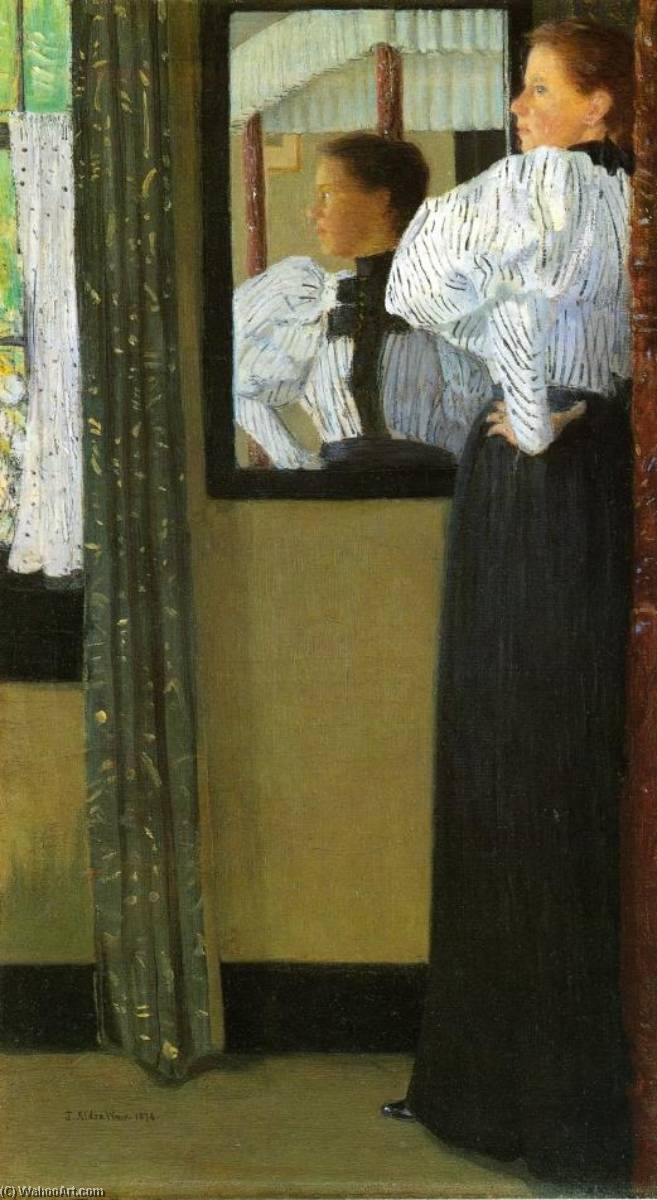
The painting depicts a young woman seated before a large mirror in what appears to be a modestly furnished bedroom. The composition is deliberately vertical, emphasizing the centrality of her figure and mirroring herself—a motif that immediately invites contemplation about self-perception and inner life. Weir skillfully employs soft, diffused lighting – reminiscent of the Impressionists’ fascination with capturing natural light – casting gentle shadows across the room and illuminating the woman's face with a warm glow. This illumination isn’t merely decorative; it serves to heighten the emotional resonance of the scene, conveying a sense of quiet solitude and thoughtful consideration.
Weir’s technique is meticulous brushwork, achieved through layering thin glazes of oil paint onto canvas. The resulting surface possesses remarkable smoothness, subtly hinting at the texture of fabric—likely drapery adorning the walls—and wood surfaces beneath. Careful attention to detail extends beyond mere representation; Weir captures nuances in skin tone and facial expression with remarkable sensitivity, conveying a palpable sense of emotion without resorting to overt theatricality. This understated realism aligns perfectly with the Impressionist ethos of prioritizing feeling over factual accuracy.
Historically, “Face Reflected in a Mirror” reflects the broader artistic currents of its time—the burgeoning interest in psychological portraiture and the desire to depict inner states alongside external appearances. Weir’s work draws inspiration from artists like Édouard Manet and Claude Monet, who championed innovative approaches to painting and challenged academic conventions. The mirror itself functions as a powerful symbol – representing not only physical reflection but also the duality of selfhood and the complexities of human consciousness. It prompts viewers to consider how we perceive ourselves and how our inner thoughts shape our outward behavior.
Ultimately, “Face Reflected in a Mirror” succeeds in evoking a profound emotional response. The painting’s serene atmosphere and delicate rendering invite contemplation about identity, vulnerability, and the beauty found within quiet moments of introspection. Its enduring appeal lies in its ability to capture the essence of human experience—a timeless exploration of self-awareness that continues to resonate with audiences today.
- Artist: Julian Alden Weir
- Year Created: 1896
- Style: Impressionism
- Medium: Oil Paint on Canvas
- Dimensions: Unknown
Where to Find More Information:
https://www.wikiart.org/en/julian-alden-weir/face-reflected-in-a-mirror-1896