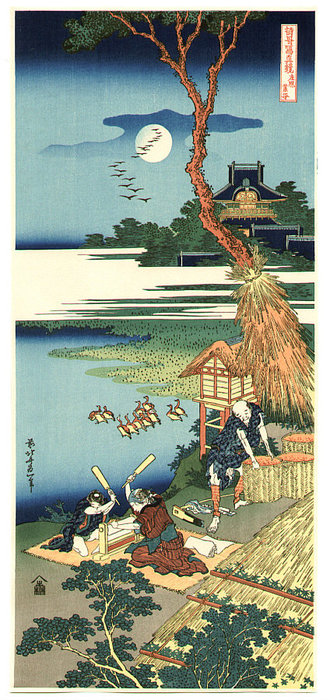
Уметност „Песму Ариваре Но Нарихире“ Кацушика Хокусаја из серија „Сто песама објашњених медицинском сестрама“, прецизна Едо доба, приказује мирну лепоту и симболичке елементе у традиционалној японској гравуре.
A Window into Edo Japan: Exploring Katsushika Hokusai’s “Poem by Ariwara no Narihira”
The artwork "Poem by Ariwara no Narihira," part of Hokusai's celebrated *One Hundred Poems Explained by the Nurse* series (Hyakunin isshu uba ga etoki), transcends mere visual representation; it embodies a profound distillation of ninth-century poetic sensibilities and masterful Edo period printmaking technique. Created during Japan’s Tokugawa era, this woodblock print offers a captivating glimpse into the cultural landscape of its time—a realm governed by Confucian ideals yet brimming with artistic innovation. Produced around 1830-32, it stands as one of Hokusai's most poignant explorations of themes surrounding beauty and melancholy.
- Subject Matter: The print depicts Ariwara no Narihira, a renowned poet from the Heian period (794–1185), seated on the ground beneath a towering pine tree. Alongside him is a fisherman holding a fishing rod—a deliberate pairing intended to convey a sense of quiet contemplation amidst the natural world.
- Style: Hokusai’s style is instantly recognizable as Romantic Impressionism, blending meticulous observation with expressive brushstrokes that capture fleeting moments of emotion. Unlike many other prints of his time, this piece eschews grand narratives or heroic figures, prioritizing instead a serene depiction of human presence within the vastness of nature.
Technique and Craftsmanship: The Art of Ukiyo-e
The print’s breathtaking beauty stems from Hokusai's unparalleled command of *ukiyo-e*, or “pictures of the floating world.” This technique relies on meticulously carved wooden blocks—typically six—each painstakingly inked with pigment and pressed onto paper to produce multiple impressions. The subtle gradations of color achieved through layering inks contribute significantly to the print’s atmospheric depth, mirroring the misty landscapes that characterize Hokusai's oeuvre. Notably, the artist employed Prussian blue pigment – a revolutionary imported dye at the time – which dramatically expanded the palette available to printmakers and allowed for unprecedented tonal range. This masterful use of color elevates the image beyond simple representation, conveying an emotional resonance that continues to captivate viewers today.
Symbolism: Pine Trees and Quiet Reflection
The pine tree itself holds immense symbolic significance in Japanese culture. Representing longevity, resilience, and steadfastness—qualities admired in emperors and revered as emblems of spiritual fortitude—it serves as a powerful counterpoint to the fisherman’s vulnerability. The poem referenced – “Waters of Tatsuta, never even in the golden age of old did the gods in their might behold you fairer, laced with crimson of leaves” – speaks directly to Narihira's contemplation of beauty and mortality. It encapsulates the Heian poet’s yearning for transcendence amidst earthly concerns. The juxtaposition of these elements underscores Hokusai’s intention to evoke a profound sense of contemplative serenity—a cornerstone of Edo aesthetic ideals.
Emotional Impact: A Moment Frozen in Time
“Poem by Ariwara no Narihira” resonates deeply with viewers due to its ability to capture and convey a palpable sense of stillness and melancholy. The muted palette—dominated by blues and greens—creates an atmosphere of contemplative serenity, inviting contemplation on themes of impermanence and the sublime. Hokusai’s masterful rendering doesn't merely depict a scene; it encapsulates a feeling—a profound appreciation for beauty tempered by awareness of its fleeting nature. It remains a testament to the enduring power of art to communicate complex ideas and emotions across centuries, offering an unparalleled glimpse into the artistic spirit of nineteenth-century Japan.